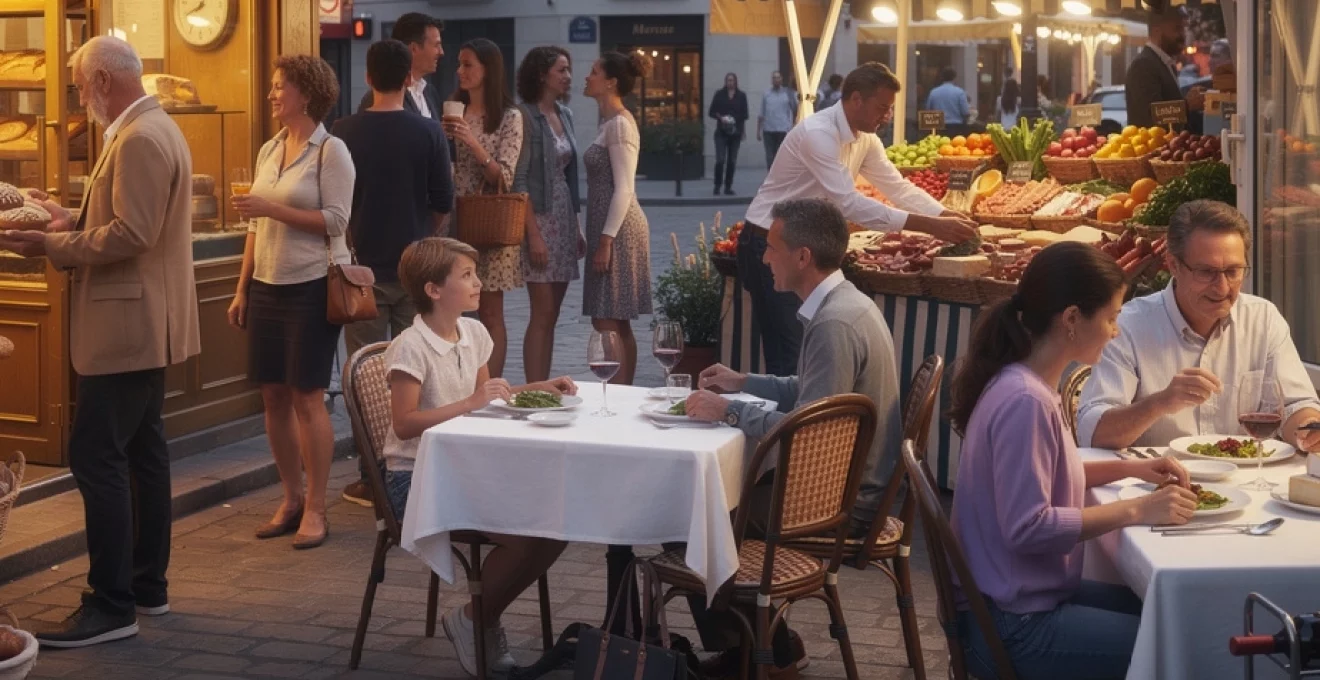
French gastronomy extends far beyond haute cuisine and Michelin-starred restaurants. It permeates every aspect of daily existence, from the morning dash to the boulangerie to the carefully orchestrated Sunday lunch that stretches well into the afternoon. Unlike many cultures where food serves primarily as fuel, in France, manger—the act of eating—represents a fundamental social ritual that structures time, defines community bonds, and expresses regional identity. The average French person spends approximately 135 minutes per day eating and drinking, compared to just 74 minutes for Americans, according to OECD statistics. This temporal investment reflects a cultural philosophy where meals aren’t merely consumed but experienced, where the provenance of ingredients matters as much as their preparation, and where dining traditions passed through generations continue to resist the homogenising forces of globalisation.
The integration of gastronomic principles into everyday French life isn’t accidental—it’s supported by legislation, protected by appellations, reinforced through education, and sustained by commercial patterns that prioritise quality over convenience. From the legal definition of what constitutes an authentic baguette to the protected lunch breaks enshrined in labour law, France has systematically embedded food culture into its social infrastructure. This comprehensive approach creates an environment where you naturally adopt certain eating patterns, shopping habits, and culinary values simply by participating in French society.
The ritual of daily bread: boulangeries and the french morning routine
The neighbourhood boulangerie serves as the cornerstone of French daily life, a space where gastronomic tradition intersects with social ritual. Walking past a French bakery at 7:30 AM, you’ll witness a queue of customers clutching still-warm baguettes, their ends often nibbled before reaching home—a universally forgiven transgression. This morning pilgrimage isn’t merely about acquiring bread; it represents a daily affirmation of quality standards, a moment of community interaction, and a connection to centuries-old craft traditions. Approximately 67% of French people visit a boulangerie at least once weekly, with 30,000 artisanal bakeries still operating across the country despite competition from industrial producers.
The ritual typically unfolds with remarkable consistency. Customers greet the baker by name, exchange pleasantries about the weather or local happenings, and make their selections from an array of morning offerings. The transaction itself follows unwritten protocols: you don’t touch the bread yourself, you state your preference clearly (“une baguette bien cuite” for a well-done crust), and you carry your purchase unwrapped or in a simple paper sleeve. This seemingly simple exchange reinforces social bonds and maintains standards—if your local baker produces substandard bread, you’ll simply take your custom elsewhere, ensuring that quality remains paramount.
Artisanal baking techniques: from levain naturel to pain de tradition française
Traditional French bread-making represents a sophisticated craft requiring years of apprenticeship to master. The levain naturel (natural sourdough starter) method involves cultivating wild yeasts and bacteria over days or weeks, creating complex flavour profiles impossible to achieve with commercial yeast. Each bakery maintains its own starter, sometimes passed down through generations, which imparts distinctive characteristics to the final product. The fermentation process typically extends 12-24 hours, allowing enzymes to break down complex carbohydrates and develop the bread’s signature tangy notes and chewy crumb structure.
The pain de tradition française represents a protected category established in 1993, requiring specific production methods: no freezing at any stage, no additives beyond the four basic ingredients (flour, water, salt, yeast or levain), and production on the premises where it’s sold. This bread must contain between 12-15% protein and achieve a specific crust-to-crumb ratio. Bakers who produce genuine tradition bread distinguish themselves from industrial operations, commanding premium prices whilst preserving ancestral techniques. The result? A product with superior nutritional value, enhanced digestibility due to prolonged fermentation, and flavours that reflect the terroir of locally milled wheat.
The baguette’s protected status under the 1993 french bread decree
The Décret Pain of 1993 established stringent criteria for what can legally
defines a “baguette de tradition française”: it must be made on site, cannot be frozen or part-baked, and may contain only wheat flour, water, salt and yeast or levain. No additives, preservatives or improving agents are allowed. In practice, this decree draws a legal line between industrially produced bread and artisanal loaves, giving consumers a reliable benchmark in a market where the baguette is both symbol and staple. When you ask for “une tradition” rather than a generic baguette, you are invoking this legal framework and signalling a preference for craftsmanship over convenience.
This protected status shapes everyday life in subtle ways. It sustains small independent bakeries against supermarket competition, it anchors the price and perceived value of bread, and it reassures you that the daily baguette on the table meets certain quality criteria. In 2022, UNESCO went a step further by inscribing the “artisanal know-how and culture of baguette bread” on the Intangible Cultural Heritage list, reinforcing how central the baguette is to French identity. The combined force of national law and international recognition helps ensure that the humble stick of bread remains a living expression of French gastronomy, not just a mass-produced commodity.
Queue culture and social interaction at neighbourhood bakeries
The scene outside a neighbourhood boulangerie at 8 a.m. offers a snapshot of French social life. People queue patiently, rarely attempting to cut the line, and the wait becomes a moment of low-key interaction rather than irritation. Snatches of conversation about school holidays, local politics or last night’s TV float through the air, and even if you do not exchange more than a “bonjour” and “bonne journée”, you participate in a shared ritual. Unlike anonymous supermarket aisles, the tight space and predictable tempo of the bakery invite eye contact and small talk.
This “queue culture” also reinforces social norms around politeness and timekeeping. You greet the room as you enter and again as you leave, regardless of whether you know anyone personally. Children learn early how to order a baguette or pain au chocolat on their own, giving them a small but meaningful sense of autonomy. For newcomers, integrating into this micro-society—learning how to stand, what to say, when to move forward—can be as important as learning the language. Over time, your baker becomes part of your social network, aware of your preferences and rhythms in a way that reinforces the personal nature of French food culture.
Regional morning bread variations: croissant au beurre versus pain au chocolat terminology
Although the baguette dominates French bread culture, the morning pastry counter reveals strong regional identities. Even the simple question of whether you buy a pain au chocolat or a chocolatine can expose your geographic origins, with the south-west fiercely defending the latter term. In Paris and much of the north, the canonical order is “un croissant au beurre et un pain au chocolat”, whereas in Toulouse or Bordeaux you would be more likely to hear “une chocolatine”. The product is identical—a rectangle of laminated dough wrapped around chocolate sticks—but the vocabulary is charged with local pride.
The distinction between croissant ordinaire and croissant au beurre also shapes everyday choices. The butter-based version, made with pure dairy butter rather than a mix of butter and vegetable fat, is legally required to have its crescent tips perfectly straight, while the cheaper ordinary croissant is curved. Regulars know to specify “au beurre” if they want the richer, flakier option, accepting a higher price for better ingredients. Regional specialties further enrich the morning repertoire: in Alsace, you might find kouglof; in Provence, the orange-scented gibassier; in Brittany, the caramelised kouign-amann. These variations mean that even a quick breakfast run becomes a way of tasting local history.
The structured meal framework: how entrée, plat, and dessert define french dining patterns
Beyond breakfast, French gastronomy structures the day around a predictable sequence of courses: entrée (starter), plat (main course) and dessert, often with bread and sometimes a separate cheese course. This triptych appears not only in restaurants but also in school canteens, workplace cafeterias and many family dinners. Even when the meal is simplified on busy weeknights, the underlying framework remains: a light starter such as grated carrots or a green salad, followed by a protein-based main and vegetables, and a simple dessert like yogurt or a piece of fruit. This structured meal framework reinforces portion control and variety, helping to explain how rich French food can coexist with relatively low obesity rates compared to other Western nations.
Instead of grazing and snacking throughout the day, people in France tend to eat at fixed times, with lunch and dinner as anchor points. The expectation of a complete meal at set hours makes it easier to refuse snacks between times, both socially and psychologically. For you as a visitor or expatriate, adapting to this pattern can initially feel rigid, especially if you are used to flexible eating schedules. Yet many find that once they embrace the rhythm of entrée–plat–dessert, they feel more satisfied and less prone to mindless eating.
The sacred lunch break: legislative protection of the two-hour midday pause
Nowhere is the structured meal more visible than at lunchtime. French labour law historically prohibited employees from eating at their desks, and although that rule has been relaxed, the cultural weight of the midday break remains strong. In many companies, you will find a dedicated cafeteria or at least a communal kitchenette where colleagues gather to eat together rather than in isolation. According to Eurostat, French workers consistently report some of the longest average lunch breaks in Europe, often close to an hour, with many small towns still honouring a de facto two-hour pause when shops close between 12:00 and 14:00.
This “sacred” lunch break shapes daily life on multiple levels. It slows the pace of commerce, but it also protects a space for social contact and gastronomic enjoyment. Schoolchildren benefit as well: primary and secondary schools typically allocate 60 to 90 minutes for lunch, and canteen menus must comply with national nutritional standards that mirror the entrée–plat–dessert structure. For families, this means children grow up seeing a proper lunch as a non-negotiable part of the day rather than a hurried sandwich at their desk. If you move to France, learning to anticipate closures and plan shopping or appointments around lunch hours quickly becomes second nature.
Apéritif and digestif culture in daily social exchanges
At the bookends of the main meal, the traditions of apéritif and digestif reinforce the social dimension of French gastronomy. The apéritif, typically taken before dinner, might consist of a glass of pastis, kir, Champagne or a simple verre de vin, accompanied by olives, nuts or small crackers. It signals a transition from workday to leisure, giving friends and family a chance to catch up before the formality of the table. In many households, especially on weekends, the apéritif is almost more important than the meal itself as a space for conversation.
After the meal, particularly in more traditional or rural settings, a digestif such as cognac, armagnac or herbal liqueurs like Chartreuse may be served. While daily consumption has declined for health reasons, the concept remains embedded in the language: being invited “pour l’apéro” is a recognised social category, lighter than a full dinner but more substantial than a quick drink. For you as a guest, understanding these codes helps you navigate invitations—if someone suggests “un apéro dinatoire”, expect a buffet-style evening where substantial food and drinks blur the line between cocktail hour and dinner.
The role of cheese course sequencing in domestic and restaurant settings
One distinctive feature of French meal structure is the placement of the cheese course. Unlike Anglo-Saxon traditions where cheese may appear as an appetiser or as part of a dessert board, in France cheese is typically served after the main course and before dessert. This sequencing reflects both taste and digestion theories: the richness of cheese is thought to close the savoury phase while leaving room for something sweet. In restaurants offering a set menu, you often choose between a cheese plate or dessert, though in more indulgent contexts you may opt for both.
At home, even a simple weeknight meal might end with a small piece of cheese and a slice of baguette, especially in regions with strong dairy traditions like Normandy, Auvergne or the Jura. Children quickly learn the basics of cheese etiquette: not cutting off the “nose” of a wedge-shaped Brie, for instance, and taking a portion that preserves the shape of the cheese. This daily exposure cultivates what you could call “cheese literacy”—an easy familiarity with textures, aromas and regional names that would take years to acquire elsewhere. For many French families, the cheese board is not an occasional treat but a quiet, everyday expression of their gastronomic heritage.
Market economy and terroir: weekly marchés and their impact on household shopping habits
If the boulangerie structures mornings and the meal framework shapes the day, weekly open-air markets (marchés) organise shopping routines around the concept of terroir. Most towns, even small ones, host at least one market per week where producers sell seasonal fruits, vegetables, cheeses, charcuterie and sometimes prepared dishes. Rather than doing a single big supermarket trip, many households shop in smaller, more frequent batches, planning meals according to what looks best on the stalls. This habit not only supports local economies but also anchors everyday gastronomy in the cycles of nature.
At the market, you encounter a direct, tactile version of French food culture: you can smell the melons, inspect the dirt still clinging to carrots, and chat with vendors about how to cook blettes or artichokes. Prices are often displayed by origin as well as by weight, reinforcing awareness of regional provenance. For someone newly arrived in France, learning to navigate the market—when to go, how to queue, what questions to ask—can feel like an initiation into a parallel food universe where relationships and trust matter as much as labels.
Appellation d’origine contrôlée (AOC) products in everyday consumption
The concept of Appellation d’Origine Contrôlée (AOC) is central to how French people think about food quality and authenticity. Originally developed for wine, the system now covers cheeses, butters, meats and even lentils, tying products to specific geographic areas and production methods. You might imagine that such certified items are rare luxuries, reserved for special occasions. In reality, AOC products form part of everyday consumption: a weekday gratin might feature AOC Comté; a simple salad could be dressed with AOC Puy lentils; breakfast butter may come from AOC Charentes-Poitou.
This normalisation of labelled quality has two important effects on daily life. First, it educates consumers by constantly exposing them to the language of origin and method—you start to notice whether your goat cheese is from the Loire Valley or Provence and develop preferences accordingly. Second, it embeds the idea that paying a little more for guaranteed provenance is worthwhile, even for ordinary meals. For you as a shopper, learning basic AOC names offers a quick way to navigate French markets and supermarkets, helping you choose products that express local terroir rather than generic industrial flavour.
Seasonal eating patterns dictated by regional agricultural cycles
French markets make seasonality impossible to ignore. In spring, stalls overflow with asparagus, radishes and strawberries; summer brings tomatoes, peaches and courgettes; autumn showcases mushrooms, squash and game; winter highlights cabbages, leeks and citrus from the Mediterranean. While supermarkets increasingly offer out-of-season imports, cultural norms still valorise eating “de saison”, both for taste and environmental reasons. Restaurants proudly advertise seasonal menus, and cookbooks emphasise recipes aligned with the calendar.
For many households, planning meals around seasonal produce is less a conscious eco-choice and more a practical response to what is available and affordable. You are unlikely to find decent fresh cherries in November, so you simply do not expect cherry desserts then. This rhythm encourages culinary anticipation: the first spring strawberries become an event, the appearance of galettes de sarrasin with fresh mushrooms marks autumn, and seasonal shellfish platters signal the year-end holidays. Adjusting your own habits to this cycle can be one of the most rewarding aspects of living in France, as you learn to associate specific flavours with moments in the year.
Direct producer relationships: the maraîcher and consumer connection
Another defining feature of French gastronomic life is the close relationship between consumers and small-scale producers, especially maraîchers (market gardeners). At many markets, you will see two types of vendors: resellers who source goods from wholesale distributors, and producers who grow or make what they sell. Regulars quickly learn to distinguish them, often gravitating towards the latter for fresher, more traceable products. Buying directly from a farmer you meet weekly builds trust—if the tomatoes disappoint one week, you can say so the next, and the producer has a direct incentive to maintain quality.
These relationships are not confined to traditional markets. AMAPs (Associations pour le maintien d’une agriculture paysanne), similar to community-supported agriculture schemes, allow households to subscribe to weekly vegetable baskets from a specific farm. This model locks in a degree of financial security for the producer while giving you a guaranteed supply of seasonal produce. Over time, you become familiar with the quirks of your farmer’s land: the way their carrots taste sweeter in certain months, or how a rainy spring affects the lettuce. This intimate awareness of origin deepens the everyday meaning of terroir beyond marketing slogans.
Market timing and freshness expectations in french food procurement
Market schedules also shape how and when people shop. In many towns, the main market runs on specific mornings—say Wednesday and Saturday from 8:00 to 13:00—with additional smaller markets on other days. If you arrive late, you may find the best items gone and vendors beginning to pack up. This creates a shared understanding that fresh shopping is a morning activity, often combined with a coffee at a nearby café. Afternoon markets are rarer, and 24/7 shopping options remain limited outside big cities.
As a result, expectations around freshness are high. Fish bought on Friday is eaten on Friday; bread baked in the morning rarely lasts until the next day; herbs wilted from sitting in a fridge too long are viewed as a culinary failure. This immediacy encourages smaller, more frequent purchases and discourages stockpiling. It can be an adjustment if you are used to weekly bulk shopping, but it also means your daily cooking starts from ingredients at their peak. Over time, you may find yourself timing your meals to market days—planning fish dishes on the day of the fishmonger’s visit, or scheduling a larger family lunch when you know you can get the freshest produce.
Professional culinary hierarchy: how le cordon bleu and CAP cuisine credentials shape career pathways
Behind the scenes of everyday gastronomy lies a highly structured professional culinary hierarchy. Formal qualifications such as the Certificat d’Aptitude Professionnelle (CAP) Cuisine form the foundation of most chefs’ careers, certifying that they have mastered essential techniques, hygiene standards and kitchen organisation. Apprentices often begin in their teens, splitting time between vocational school and hands-on work in restaurants, bakeries or pastry shops. This dual system embeds professional know-how into local communities and ensures that traditional methods are transmitted in a systematic way.
At the more prestigious end of the spectrum, institutions like Le Cordon Bleu in Paris attract both French and international students seeking advanced training in classical techniques. While not strictly necessary for success, such schools function as gateways into high-end kitchens and global careers, reinforcing the perception of French gastronomy as a benchmark. Within professional brigades, a clear hierarchy—from commis to chef de partie, sous-chef and chef de cuisine—organises labour in a way that mirrors the precision and discipline of the dishes served. For diners, this invisible structure translates into consistency: whether you eat in a modest bistrot de quartier or a starred restaurant, you benefit from a workforce trained within the same rigorous system.
Wine pairing intelligence: everyday application of sommelier principles in french households
Wine may seem like the domain of experts, yet in France a basic form of “wine pairing intelligence” permeates everyday life. You are unlikely to see elaborate tasting rituals at a casual family dinner, but you will hear simple, robust rules applied almost instinctively: red wine with red meat, white with fish, sweet wines with dessert, Champagne for celebrations. Even modest supermarkets organise shelves by region—Bordeaux, Bourgogne, Loire, Languedoc—inviting consumers to think in terms of geographic origin and typical styles rather than abstract flavour notes. This constant exposure functions as informal education, much as repeated exposure to AOC labels does for cheese.
In restaurants, sommeliers and servers act as guides, but their language tends to be accessible: they may suggest “un petit rouge léger de Loire” for a charcuterie board or a “blanc sec du Sud-Ouest” with goat cheese. Over time, even casual wine drinkers internalise pairings that work and those that do not. For visitors, observing what locals order with particular dishes is a practical shortcut to navigating dense wine lists without feeling intimidated.
Regional wine classification systems: from burgundy’s grand cru to bordeaux’s château designations
The sophistication of French wine culture rests in part on regional classification systems that filter into everyday conversation. In Burgundy, vineyards are classified from régional wines up through village, Premier Cru and Grand Cru, with the emphasis on specific plots of land. In Bordeaux, by contrast, the focus historically lies on châteaux—estates whose names often appear more prominently than the appellation itself, especially in the prestigious 1855 classification. For non-specialists, these hierarchies can seem arcane at first, a bit like trying to decode an academic title.
Yet you soon notice their practical impact at the shop level. A weekday table wine might be a simple Bourgogne rouge or an unclassified Bordeaux from a lesser-known château, while special occasions might call for a ranked wine from a famous estate or village. Labels routinely display not just the appellation but also classifications such as “Grand Cru Classé”, providing a shorthand for quality and price expectations. As you become familiar with these terms, you start to navigate shelves less by brand marketing and more by the underlying system, making more informed—and often more satisfying—choices for both everyday meals and celebrations.
The role of cave coopératives in local wine accessibility
While international press tends to focus on prestigious estates, everyday wine consumption in many French regions depends heavily on caves coopératives. These cooperatives pool grapes from multiple small growers, allowing them to share equipment, expertise and marketing resources. For local residents, the cooperative shop functions as a direct, affordable source of decent-quality wine, often sold in large containers or bag-in-box formats ideal for regular use. You might fill a plastic jerrycan with a light red for cooking and casual drinking, while picking up a few bottled cuvées for guests.
Socially, the cooperative acts as a meeting point between producers and consumers, much like the weekly market. Seasonal events such as harvest festivals or open-house tastings strengthen community ties and demystify wine production for non-specialists. If you settle in a wine-growing area, getting to know your local cave coopérative can be one of the easiest ways to integrate regional wine into your everyday cooking—using a sturdy local white to deglaze a pan for chicken, for example, or a simple red to accompany grilled sausages.
Table wine selection criteria for weeknight family meals
When it comes to choosing wine for a weeknight family meal, most French households rely on pragmatic criteria rather than elaborate tasting notes. Budget is key: a typical bottle for daily consumption might cost between 4 and 8 euros, with the expectation of honest flavour rather than complexity. Food pairing still matters, but in broad strokes—something light and fruity to go with roast chicken, a more robust red for stews, a crisp white for seafood. Many families keep a few “house wines” on hand that they know will match a range of dishes without overshadowing them.
Practical considerations also play a role. Screw caps, once rare, are becoming more accepted for everyday whites and rosés, appreciated for their convenience. Boxed wines, especially from reputable cooperatives, provide good value and reduce waste for those who drink small amounts regularly. If you are new to French supermarkets, one useful strategy is to observe what locals are buying for their carts and to start with mid-shelf bottles from less hyped regions—Languedoc, Cahors, Beaujolais-Villages—where quality has risen sharply over the past decade while prices remain accessible. Over time, your own “wine pairing intelligence” will evolve through repetition more than formal study.
Gastronomic calendar and national identity: how epiphany’s galette des rois and chandeleur crêpes structure annual rhythms
Finally, French gastronomy shapes not only daily routines but also the annual calendar, punctuating the year with specific dishes tied to religious festivals, regional fairs and national holidays. Two of the most widely observed are the Galette des Rois for Epiphany in early January and the crêpes of Chandeleur on February 2nd. These events are less about strict religious observance today and more about shared culinary rituals that mark the passage of time. Supermarkets, bakeries and media campaigns all amplify these traditions, making it almost impossible to ignore when their moment arrives.
During the first weeks of January, bakeries overflow with galettes—typically puff pastry filled with frangipane (almond cream)—each containing a hidden fève, a tiny figurine. Whoever finds the fève in their slice becomes “king” or “queen” for the day and wears a paper crown included with the cake. Families, offices and even school classes participate, often multiple times over the season, turning a simple dessert into a recurring social game. For many, the appearance of galettes signals a gentle return to normalcy after the intensity of Christmas and New Year celebrations.
A few weeks later, Chandeleur—historically linked to Candlemas—ushers in a nationwide craving for crêpes. The tradition dictates that you flip crêpes in the pan while holding a coin in your other hand to ensure prosperity for the year. Supermarkets prominently display flour, eggs, milk and jars of hazelnut spread in dedicated Chandeleur sections, effectively nudging even the least culinary-inclined households to join in. Families often gather around the stove, taking turns to flip and fill crêpes with sugar, jam, lemon or savoury ingredients, turning an ordinary weeknight into a mini-festival.
These gastronomic milestones do more than provide excuses for seasonal treats. They create a shared cultural script that cuts across social classes, regions and even religious affiliations. Whether you are a practising Catholic or completely secular, you are likely to eat galette in January and crêpes in early February if you live in France. For expatriates and visitors, participating in this gastronomic calendar offers a simple but powerful way to feel part of the national community, one slice or one crêpe at a time.