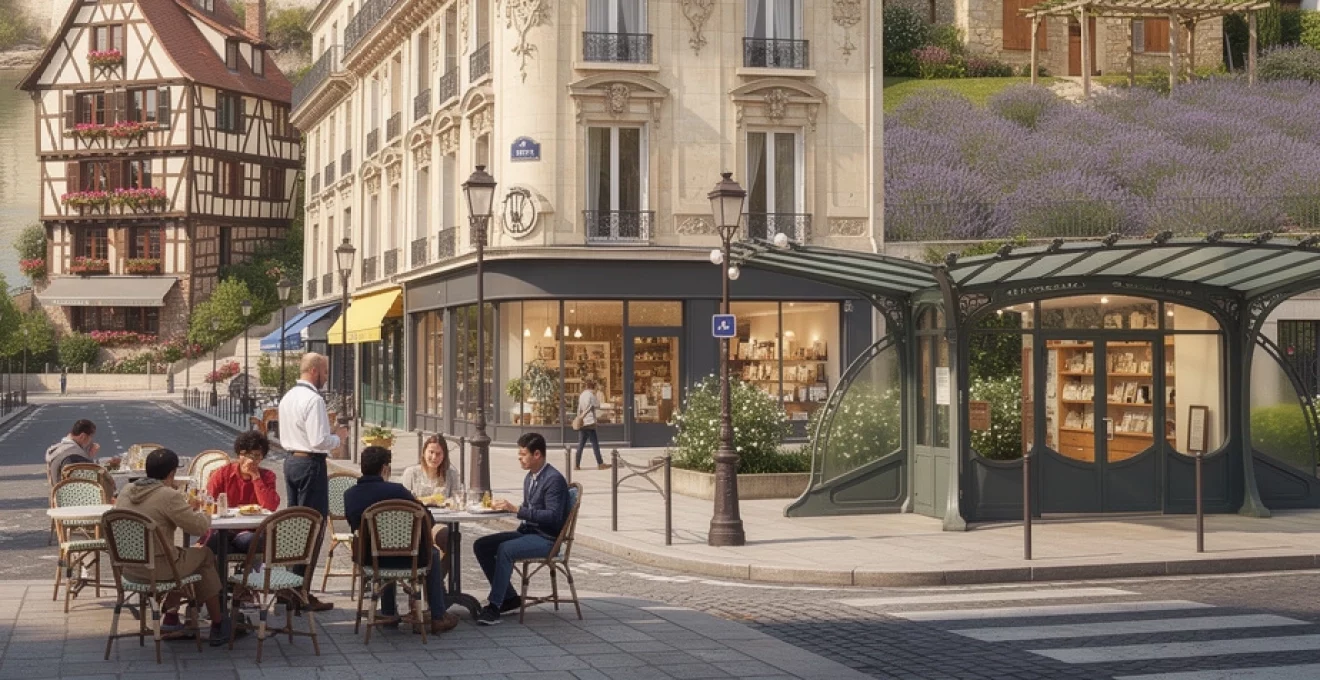
French architecture stands as one of the most eloquent expressions of national character, weaving together centuries of cultural evolution, social values, and lifestyle preferences into the very fabric of its buildings. From the imposing Gothic cathedrals that reach towards heaven to the intimate café terraces that foster daily social interaction, every architectural element tells a story about how the French have chosen to live, work, and connect with one another. The built environment serves as both a mirror and a catalyst for French society, reflecting deep-seated values of craftsmanship, social cohesion, and aesthetic refinement whilst simultaneously shaping how communities gather, families dwell, and individuals navigate their daily routines.
The relationship between French architecture and lifestyle extends far beyond mere functionality. Each regional variation, from the sun-drenched mas of Provence to the timber-framed houses of Alsace, demonstrates how local communities have adapted their building practices to harmonise with climate, available materials, and cultural traditions. This architectural diversity reveals a fundamental aspect of French identity: the celebration of regional distinctiveness within a unified national framework, much like the varied terroir that produces France’s renowned wines.
Classical french architectural orders and regional vernacular traditions
The foundation of French architectural expression lies in its masterful synthesis of classical principles with distinctly regional interpretations. This unique approach has created a built environment that maintains coherent national identity while celebrating local diversity and adaptation to specific geographical and cultural conditions.
Mansard roofing systems and dormer window configurations
The mansard roof represents perhaps the most recognisable element of French residential architecture, embodying both practical ingenuity and aesthetic elegance. Developed by François Mansart in the 17th century, this distinctive roofing system maximises usable space within buildings whilst maintaining harmonious proportions that define French urban landscapes. The steep lower slope and gentler upper section create additional floor space without increasing the building’s apparent height, reflecting the French preference for efficient use of urban property.
Dormer windows punctuating these rooflines serve multiple purposes beyond mere illumination. They provide natural ventilation for upper floors, create visual rhythm across building facades, and establish a human scale that makes even grand structures feel approachable. The careful positioning and proportioning of these elements demonstrates the French commitment to architectural savoir-faire – the intuitive understanding of how buildings should relate to their inhabitants and surroundings.
Loire valley château design principles and defensive architecture
The châteaux of the Loire Valley exemplify the evolution of French aristocratic lifestyle from medieval fortress living to Renaissance refinement. These magnificent structures chronicle the transformation of defensive architecture into pleasure palaces designed for court life, entertaining, and the display of cultural sophistication. The progression from thick defensive walls to expansive windows reflects changing social conditions and the growing confidence of French nobility in their security and status.
The architectural language of these châteaux established principles that continue to influence French residential design: symmetrical facades that project order and stability, carefully proportioned windows that balance privacy with light, and the integration of formal gardens that extend living spaces into the landscape. The emphasis on axial planning and visual connections between interior and exterior spaces reveals the French understanding of architecture as a stage for social interaction and ceremonial life.
Provençal mas construction techniques and climate adaptation
In southern France, the traditional mas represents a perfect synthesis of architecture and environment, demonstrating how building design can enhance quality of life through intelligent response to climate and landscape. These substantial stone farmhouses employ thick walls of local limestone that provide thermal mass, keeping interiors cool during blazing summers and warm during mild winters. Small windows positioned strategically minimise heat gain whilst ensuring adequate natural light for daily activities.
The mas typically features a single-storey design that promotes natural ventilation and reduces construction complexity, whilst courtyards create protected outdoor spaces for work and relaxation. The integration of practical elements such as pigeonnier (dovecotes) and wine cellars illustrates how French vernacular architecture seamlessly combines domestic and productive functions. This holistic approach to building design reflects the French appreciation for art de vivre – the art of living well through thoughtful integration of all life’s necessities and pleasures.
Als
Alsatian colombage timber framing and germanic influences
Alsatian maisons à colombage embody a distinctive fusion of French and Germanic traditions, revealing how border regions crystallise complex cultural identities in built form. Their visible timber skeletons, infilled with plaster, brick, or cob, express a pragmatic use of local forests and clay soils while creating façades that feel almost graphic in their patterning. Each beam, brace, and post is both structural and decorative, speaking to a mentality in which construction technique and visual character are inseparable.
The way these houses are organised tells us much about everyday life in Alsace. Ground floors historically housed workshops, wine cellars, or stables, with family rooms and sleeping spaces raised above the damp streets for better light and hygiene. Overhanging upper storeys and irregular angles, often the result of incremental additions, show how families expanded their homes organically over generations. Walking through towns like Colmar, Riquewihr, or Strasbourg, you can almost read social history in the street elevations: carved beams indicating former guild houses, corner oriels signalling commercial prestige, painted motifs revealing religious affiliations or local folklore.
Haussmann’s urban planning revolution and modern french living patterns
The 19th-century remodelling of Paris under Baron Haussmann reshaped not only the capital’s skyline but also the rhythms of French urban life. What might appear today as a picturesque backdrop of stone façades and tree-lined avenues was, in its time, a radical infrastructure project that prioritised hygiene, circulation, and social order. The Haussmannian city plan still determines how Parisians move, meet, and inhabit space, from daily commutes along wide boulevards to weekend strolls through interconnected squares and parks.
Boulevard hierarchy systems and radial street networks
Haussmann’s street network introduced a clear hierarchy of boulevards, avenues, and side streets, replacing tangled medieval lanes with a legible urban structure. Major axes radiating from key nodes such as the Opéra, the Étoile, or the Gare de Lyon were designed to facilitate rapid movement of people, goods, and even troops, reflecting both economic ambitions and political concerns. This radial pattern, combined with cross-cutting ring roads, created a city that could be read and navigated intuitively, encouraging walking as well as the later integration of trams and cars.
For contemporary residents, this organisation translates into a daily experience of vistas and framed perspectives: long views towards monuments, glimpses of domes or towers at the end of a boulevard, and generous sightlines that admit light deep into the city fabric. The boulevard hierarchy also shapes social life; large arterial streets support department stores, cinemas, and cafés, while quieter side streets cater to neighbourhood bakeries, schools, and small workshops. In this way, French architecture and planning combine to balance metropolitan scale with local intimacy, a principle that still guides many French cities beyond Paris.
Standardised façade regulations and balcony integration
Haussmann’s reforms extended beyond the street grid to include strict façade regulations that produced the iconic “Haussmann building” still associated with Parisian elegance. Developers were required to follow guidelines on cornice heights, window alignments, and stone types, resulting in harmonious streetscapes where individual buildings contribute to a larger urban composition. This standardisation did not erase individuality entirely; differences in balcony detailing, door carvings, and wrought-iron railings allowed subtle expressions of taste and status within a shared architectural language.
Balconies play a particularly revealing role in expressing the French way of life. Continuous balconies often run along the second and fifth floors, forming horizontal ribbons that emphasise the unity of the façade while offering precious outdoor space in a dense city. These ledges become extensions of domestic life: places for potted plants, a bistro chair, or simply a moment of fresh air overlooking the street theatre below. In many ways, the balcony is the urban equivalent of a village doorstep or farmhouse courtyard, enabling visual participation in city life without leaving home.
Six-storey building heights and commercial ground floor mandates
The characteristic six- to seven-storey height of Haussmannian blocks was not arbitrary; it reflected the limits of masonry construction, fire-fighting technology, and the reach of natural light before elevators became widespread. This scale has enduring appeal because it preserves a human proportion: buildings are tall enough to support dense, walkable neighbourhoods but not so high as to overwhelm pedestrians or sever the connection between street and sky. Many French cities still favour this mid-rise model to reconcile urban density with quality of life.
Equally significant is the functional mix encoded into these blocks. Ground floors were typically reserved for commerce and services—shops, cafés, workshops—while upper levels housed apartments stratified by status, with the étage noble (usually the second floor) offering the most generous ceilings and prestige. This arrangement sustains the active street fronts that define French urbanism, where daily errands, social encounters, and architectural appreciation all unfold at pavement level. For anyone seeking to understand modern French living patterns, the Haussmann block remains a key reference: it is both a home and a compact urban ecosystem.
Place vendôme architectural uniformity as social cohesion model
Place Vendôme offers a concentrated example of how architectural uniformity can foster a sense of collective identity and social choreography. Designed under Louis XIV and later integrated into Haussmann’s renewed city, the square is framed by rigorously similar façades: arcades at ground level, pilasters on upper storeys, rhythmic windows, and steep slate roofs with dormers. Behind this apparent sameness lies a variety of uses—from luxury hotels and boutiques to legal offices—but the public face remains coherent.
This deliberate uniformity sends a cultural message: individual ambitions are staged within a shared civic framework. Much like a well-orchestrated performance in which actors wear variations of the same costume, the architecture of Place Vendôme aligns personal prestige with collective order. For visitors, the space feels both grand and legible; for residents and workers, it reinforces the French preference for public settings that are aesthetically controlled yet socially animated. The model has inspired countless squares and developments where consistency of envelope supports diversity of life within.
Art nouveau movement and french domestic spatial concepts
At the turn of the 20th century, the Art Nouveau movement reimagined French architecture and interiors as continuous works of art, blurring boundaries between structure, decoration, and everyday objects. This was not only a stylistic flourish but also a statement about how people should live: surrounded by beauty, close to nature, and in spaces where craftsmanship is visible in every detail. Domestic architecture became a laboratory for these ideas, from door handles and stair rails to window frames and built-in furniture.
Hector guimard’s métro entrances and public space integration
Hector Guimard’s celebrated entrances for the Paris Métro demonstrate how even infrastructure can reflect a society’s aspirations about everyday life. Rather than hiding underground transport behind anonymous stairwells, Guimard turned stations into sculptural landmarks, using sinuous ironwork, organic motifs, and glazed canopies that resemble giant leaves or petals. These structures invite commuters to experience the city as a garden of forms, softening the transition between street and subterranean network.
From a lifestyle perspective, Guimard’s work suggests that functionality need not preclude delight. When you descend into the Métro through one of his entrances, you participate in a vision of public space where art and utility are intertwined. This approach has influenced how French cities continue to design bus stops, tram stations, and street furniture: not as purely technical equipment but as components of a coherent urban aesthetic that acknowledges the emotional dimension of daily routines.
Nancy school decorative arts and interior-exterior continuity
In eastern France, the Nancy School extended Art Nouveau principles into a complete philosophy of domestic life. Architects, glassmakers, and furniture designers—Émile Gallé, Louis Majorelle, and others—collaborated to create houses where façades, windows, furniture, and even tableware followed related botanical and geometric motifs. Homes became total artworks, in which stepping from garden to salon felt like moving within a single, unfolding composition.
This focus on continuity between interior and exterior resonates strongly with the French appreciation for seasonal living and garden culture. Large windows open onto terraces, stained glass echoes the colours of surrounding foliage, and curved wooden joinery mimics the growth of vines or branches. For contemporary designers inspired by French architecture, the Nancy School offers a reminder that a home’s character does not stop at the front door; it flows from landscape to threshold, from entrance hall to dining room, like a story told in several chapters.
Curved glass applications and natural light optimisation
Art Nouveau architects in France experimented extensively with curved glass to soften transitions between spaces and to harness daylight in more fluid ways. Bow windows, oriels, and gently arched bays allowed light to penetrate deep into rooms while providing panoramic views of gardens or streets. Instead of treating glass as a rigid boundary, designers bent it into organic shapes that seemed almost liquid, echoing the movement of water or the sweep of a plant stem.
The way these windows modulate light speaks volumes about French domestic preferences. Interiors are neither harshly exposed nor gloomily enclosed; rather, they receive filtered, nuanced illumination that changes throughout the day, supporting activities from reading to dining. In modern sustainable architecture in France, you can see echoes of this approach in the careful orientation of glazing and the use of shading devices. The goal remains the same: to cultivate interior atmospheres that are comfortable, visually rich, and closely attuned to natural cycles.
Wrought iron craftsmanship and artisanal building methods
Wrought iron became one of the signature materials of French Art Nouveau, visible in stair rails, balcony guards, canopy supports, and even door grilles. Far from being merely decorative, these elements demonstrate how artisanal skill can enhance both safety and beauty. The flowing lines of leaves, tendrils, and flowers are meticulously calculated to provide structural rigidity, showing that in French architecture craftsmanship is as much about engineering intelligence as about ornament.
For homeowners and architects today, this tradition offers practical lessons. Choosing well-crafted metalwork—whether traditional or contemporary—can elevate a façade or staircase from ordinary to memorable, while also ensuring long-term durability. It is akin to wearing a finely made watch: the object serves a clear function, but its detailing also communicates values of care, precision, and respect for time. When you notice a Parisian balcony or a Lyonnais stair balustrade, you glimpse a culture that still prizes the human hand in an increasingly industrial world.
Le corbusier’s modernist philosophy and contemporary french housing
With Le Corbusier, French architecture entered a new era in which housing was rethought from first principles to respond to industrialisation, urban growth, and changing social structures. His modernist philosophy—often summarised by his “Five Points of Architecture” and the notion of the house as a “machine for living”—sought to optimise living conditions through rational planning, abundant light, and integration of green space. Whether one embraces or questions his legacy, it is impossible to understand contemporary French housing without considering his influence.
Le Corbusier’s Unité d’Habitation in Marseille, for example, reimagined the apartment block as a vertical village with internal streets, shared facilities, and a rooftop terrace that includes a running track, paddling pool, and nursery. The idea was not simply to stack dwellings, but to foster community and well-being through collective amenities and generous outdoor access. Many post-war French social housing developments adopted similar principles, incorporating schools, shops, and parks into their layouts, even if the execution sometimes lacked the finesse of the original vision.
At the scale of the individual apartment, modern French housing continues to reflect Le Corbusier’s emphasis on light, proportion, and flexibility. Open-plan living areas, large glazing, and balconies or loggias have become standard expectations, even in modest developments. As you move through contemporary districts in cities like Lyon, Nantes, or Bordeaux, you can see how architects balance these modernist legacies with local materials and regulations. The ongoing debate—how to reconcile high-density living with the French desire for conviviality, privacy, and outdoor space—remains one of the central questions of housing policy and design.
French café culture architecture and social interaction design
Few architectural settings illustrate the French way of life as vividly as the café terrace. The configuration of tables, awnings, and façades might seem casual, yet it is carefully tuned to support a culture of conversation, observation, and unhurried time. In almost every town, from Paris to Perpignan, the local café-tabac or brasserie acts as an informal living room where neighbours meet, workers pause, and visitors absorb the city’s rhythm.
Architecturally, several elements recur. Ground floors open widely onto the street with large glazed windows and folding doors, dissolving the barrier between interior and exterior. Narrow two-person tables align in rows facing outwards, so that sitting down is an act of both socialising and people-watching. Awnings and parasols extend the usable space in all seasons, providing shelter from rain and summer sun while marking the café’s territory on the pavement. This spatial arrangement turns the sidewalk into a semi-public, semi-private threshold where you can be simultaneously alone and among others.
On a broader level, café architecture supports a particular French attitude to time and sociability. Because terraces encourage lingering rather than rapid turnover, they foster weak ties between regulars, staff, and passers-by—those casual connections that sociologists associate with urban well-being. For designers of contemporary mixed-use projects, the lesson is clear: modest architectural gestures—continuous canopies, wide pavements, transparent façades—can significantly enhance opportunities for spontaneous social interaction. When we ask why French cities feel so alive, the answer often lies in these fine-grained interfaces between buildings and public space.
Sustainable french building standards and environmental consciousness
In recent decades, French architecture has increasingly integrated environmental performance into its core values, extending long-standing traditions of climatic adaptation into a more explicit sustainability agenda. National regulations such as the RT 2012 and the more recent RE 2020 set ambitious targets for energy efficiency, carbon reduction, and occupant comfort. New residential projects must now consider insulation, thermal bridges, solar gain, and ventilation strategies from the earliest design stages, aligning contemporary practice with global climate commitments.
This shift does not represent a break with the past so much as an evolution of it. Traditional Provençal mas, Breton longères, and Alpine chalets were already tuned to local climates through thick walls, small north-facing openings, and carefully oriented roofs. Today, architects reinterpret these vernacular lessons with modern materials: high-performance glazing replaces tiny windows while external shutters, brise-soleil, and planted loggias provide shading similar to that once offered by deep eaves or climbing vines. The result is a sustainable French architectural style that feels both technologically advanced and culturally rooted.
On the ground, sustainability also shapes how neighbourhoods are planned. Eco-districts in cities like Grenoble, Montpellier, or Paris’s Rive Gauche prioritise pedestrian circulation, integrated green corridors, and shared gardens. Buildings incorporate green roofs, rainwater harvesting, and communal spaces designed to encourage shared use rather than duplication of resources. For residents, this means that caring for the environment is not an abstract duty but a daily practice—composting in a shared courtyard, tending herbs on a balcony, or cycling along shade-lined paths to work.
Ultimately, the growing emphasis on sustainable building standards reinforces a long-standing French conviction: that architecture is a public responsibility as much as a private choice. When you look at a low-energy timber apartment building in Bordeaux or a carefully renovated stone house in the Dordogne, you are seeing more than technical compliance. You are seeing a way of life that seeks equilibrium between comfort and restraint, innovation and memory, individual desire and collective future—a balance that has always been at the heart of French architectural culture.