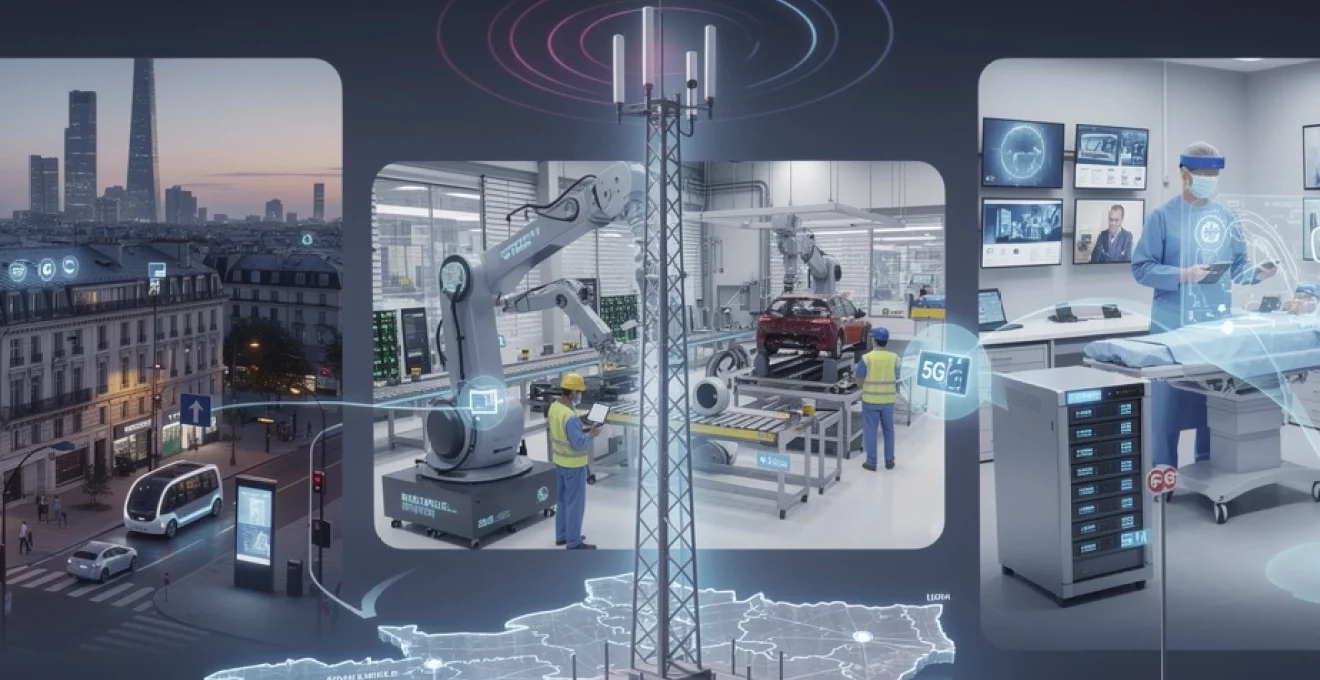
The rapid deployment of fifth-generation mobile networks across France represents far more than a simple upgrade from 4G connectivity. With over 50,000 authorised 5G sites and 84% operational coverage by early 2025, France is experiencing a fundamental restructuring of how industries, healthcare systems, transportation networks, and agricultural operations leverage digital infrastructure. The technology’s capacity to deliver ultra-low latency communication—reducing response times from 60 milliseconds in 4G to just 10 milliseconds—combined with bandwidth increases of up to 100 times faster than previous generations, creates unprecedented opportunities for innovation. French operators have invested €2.8 billion in 3.5 GHz spectrum licences alone, signalling substantial confidence in the transformative potential of this infrastructure. As the France 2030 strategy positions the nation to compete in critical digital markets, 5G has evolved from a telecommunications advancement into a cornerstone of national digital sovereignty and industrial competitiveness.
5G network infrastructure rollout across french metropolitan areas and territories
The landscape of 5G infrastructure deployment in France demonstrates remarkable progress alongside persistent challenges in achieving equitable national coverage. By 2025, approximately 79% of the population benefits from 5G connectivity, yet significant disparities remain between metropolitan centres and rural territories. The regulatory framework established by ARCEP mandates that 25% of sites must serve low-density areas by 2025, a requirement that has proven challenging to meet whilst maintaining commercial viability. In regions such as Normandy, the urban-rural throughput gap stands at just 5.8%, demonstrating what’s achievable with coordinated infrastructure planning. Conversely, Centre-Val de Loire experiences a 27% disparity, whilst Corsica faces a substantial 39.9% gap in download speeds between urban and rural zones. These differences reflect not merely technical deployment challenges but also fundamental questions about resource allocation and digital inclusion priorities.
Orange, bouygues telecom, SFR, and free mobile: comparative deployment strategies
The four major French operators have adopted markedly different strategic approaches to 5G deployment, each reflecting distinct business models and target demographics. Orange has prioritised technical excellence through its focus on the 3.5 GHz band, achieving average data rates of 319 Mb/s—more than double Germany’s 151.8 Mb/s. This premium positioning justifies higher subscription costs, with plans ranging from €30-40 monthly. Free Mobile, by contrast, has deployed the largest number of antennas at 34,435 sites, concentrating on the 700 MHz band to maximise geographical coverage, particularly in underserved rural areas. This strategy prioritises accessibility over peak performance, though it inevitably compromises on maximum throughput capabilities. Bouygues and SFR occupy intermediate positions, delivering speeds between 151-160 Mb/s whilst attempting to balance coverage breadth with performance quality. The divergence in these approaches reveals competing visions for 5G’s role: as a premium service commanding higher prices versus a ubiquitous utility democratising access.
Millimetre wave and sub-6 GHz spectrum allocation by ARCEP
ARCEP’s spectrum allocation strategy has fundamentally shaped the technical capabilities and limitations of French 5G networks. The regulator has authorised deployment across multiple frequency bands, each offering distinct trade-offs between coverage, penetration, and data throughput. The 700 MHz band provides extensive geographical reach and superior building penetration, making it ideal for rural deployment and baseline coverage. The 3.5 GHz band delivers substantially higher data rates whilst maintaining reasonable coverage characteristics, positioning it as the primary workhorse frequency for urban and suburban deployments. However, the 26 GHz millimetre wave spectrum—capable of exceeding 1 Gbps data rates with sub-millisecond latency—remains unallocated as of 2025. This frequency band would enable truly transformative applications in industrial automation and augmented reality but requires dense infrastructure deployment due to limited propagation characteristics. The delayed allocation reflects both technical deployment complexities and the need for European-level coordination to ensure cross-border compatibility and roaming capabilities.
Smart city implementations in paris, lyon, and marseille using 5G infrastructure
France’s major metropolitan areas are leveraging 5G
to pilot smart city platforms that depend on reliable, high-capacity mobile networks. In Paris, 5G supports intelligent traffic management systems around major hubs such as La Défense and Gare de Lyon, where real-time analytics optimise traffic lights, public transport flows, and pedestrian safety. Lyon has focused on environmental monitoring and smart energy, deploying IoT sensors connected via 5G to track air quality, noise levels, and energy consumption across municipal buildings. In Marseille, port operations are a major use case: connected cranes, drones, and logistics assets rely on 5G for continuous data exchange, improving throughput and safety in one of the Mediterranean’s busiest harbours. Together, these initiatives illustrate how 5G-enabled smart city implementations are shifting from experimental pilots to mission-critical urban infrastructure.
Rural connectivity challenges in nouvelle-aquitaine and occitanie regions
While metropolitan areas push ahead with advanced 5G use cases, regions such as Nouvelle-Aquitaine and Occitanie continue to wrestle with basic connectivity challenges. Sparse population density, complex topographies, and limited return on investment make it difficult for operators to justify dense infrastructure rollout. In many rural communes, 5G still relies on low-band spectrum re-used from 4G, offering incremental rather than transformative improvements in mobile broadband. This digital divide has direct implications for telemedicine, precision agriculture, and remote education, limiting the pace of digital transformation outside major cities. Bridging this gap requires a mix of targeted public subsidies, infrastructure-sharing between operators, and innovative solutions such as neutral-host networks and 5G fixed wireless access for underserved households.
Policy makers increasingly view rural 5G connectivity as a prerequisite for territorial cohesion rather than a purely commercial venture. Programmes under the France 2030 strategy and regional development funds are being mobilised to co-finance sites in white and grey zones, where market forces alone are insufficient. Some départements in Occitanie are experimenting with public-private partnerships to deploy shared 5G infrastructure along key transport corridors and industrial zones, enabling local SMEs to adopt cloud services and industrial IoT tools. Nouvelle-Aquitaine, with its extensive agricultural base, is prioritising coverage for vineyards, livestock farms, and food-processing facilities that can benefit from connected sensors and autonomous machinery. Without these targeted interventions, 5G risks reinforcing existing inequalities rather than driving inclusive digital transformation.
Industrial IoT and manufacturing 4.0 transformations enabled by ultra-low latency networks
Industry 4.0 in France is increasingly anchored in the convergence of 5G, edge computing, and industrial IoT platforms. Ultra-low latency networks allow factories to move from periodic, batch-style data collection to continuous, real-time monitoring of machines, production lines, and logistics flows. Where traditional Wi-Fi or wired networks can be fragile or complex to reconfigure, 5G provides robust, flexible connectivity that scales with new machines, robots, and sensors. This shift is comparable to moving from static photographs of a production process to a live, high-definition video stream: anomalies can be detected instantly, and corrective actions can be automated. As a result, French manufacturers are using 5G not just to digitise existing processes but to redesign how plants operate, collaborate, and respond to market fluctuations.
Predictive maintenance systems in airbus toulouse and PSA mulhouse facilities
At Airbus in Toulouse, predictive maintenance is a prime example of how 5G accelerates industrial digital transformation. Aircraft assembly involves thousands of components, tools, and mobile platforms, each of which can be equipped with sensors transmitting continuous data on vibration, temperature, and usage patterns. Through 5G connectivity, these data streams are aggregated in real time and analysed by AI models that flag emerging issues long before they lead to downtime. Instead of following rigid, calendar-based maintenance schedules, Airbus can adapt interventions to the actual condition of equipment, improving uptime and reducing spare parts inventory.
Similarly, at the PSA (now Stellantis) plant in Mulhouse, predictive maintenance on stamping presses, welding robots, and conveyor systems is enabled by dense networks of industrial IoT sensors. 5G’s low latency and high reliability make it possible to correlate signals across entire production lines without overloading the network. Engineers receive alerts on handheld devices or augmented reality headsets, guiding them directly to at-risk components. This shift from reactive fixes to proactive interventions not only cuts unplanned outages but also extends asset lifetimes, contributing to more sustainable manufacturing operations. For plant managers, the business case is clear: fewer stoppages, more predictable output, and richer data for continuous improvement.
Edge computing integration with 5G for real-time quality control
Real-time quality control is one of the most demanding industrial applications for connectivity, and this is where 5G combined with edge computing truly shines. High-resolution cameras and 3D scanners generate massive volumes of data that are impractical to send to a distant cloud for analysis. By installing edge servers directly within or near the factory, manufacturers can process these data locally, with 5G providing the high-speed, low-latency link between machines, sensors, and edge nodes. Think of it as moving the “brain” of your quality system from a faraway data centre to a control room inside the factory, where decisions can be taken in milliseconds.
French automotive and aerospace suppliers are already deploying such architectures. Defect detection systems powered by computer vision can identify micro-cracks, surface anomalies, or assembly errors on production lines running at full speed. When an issue is detected, the line can be automatically slowed, stopped, or reconfigured, reducing scrap and rework. For SMEs, managed 5G and edge solutions offered by operators and integrators lower the barrier to adoption: instead of building complex IT infrastructures from scratch, they can subscribe to industrial connectivity and analytics “as a service”. This model accelerates the diffusion of advanced manufacturing capabilities across France’s broader industrial ecosystem.
Private 5G networks deployment in renault and schneider electric production lines
Private 5G networks—sometimes called campus networks—are becoming central to the digital transformation strategies of French industrial champions such as Renault and Schneider Electric. Unlike public networks, private 5G systems are tailored to the specific needs of a factory or industrial site, with full control over coverage, quality of service, and security policies. In Renault plants, private 5G is used to connect autonomous guided vehicles, collaborative robots, and mobile inspection units that move across large workshops. Because the network is dedicated, critical traffic can be prioritised, and interference risks are minimised compared with shared Wi-Fi.
Schneider Electric, a global leader in energy management and automation, is using private 5G both in its own smart factories and in demonstration facilities for clients. Production lines equipped with modular machines can be reconfigured quickly, with 5G providing the backbone for flexible automation. Network slicing—a key 5G capability—allows Schneider to create virtual sub-networks for different applications, such as safety systems, maintenance data, or video analytics, all running over the same physical infrastructure. This approach simplifies network management while ensuring that each application receives the performance and security it requires. For industrial operators, private 5G offers a way to align connectivity with operational technology (OT) requirements rather than adapting OT to the limits of legacy networks.
Supply chain optimisation through mmwave connectivity in french logistics hubs
Beyond factory walls, 5G is transforming French logistics hubs and distribution centres, particularly through the potential of millimetre wave (mmWave) connectivity. Although the 26 GHz band is not yet fully allocated, early trials in major hubs near Paris, Lille, and Lyon show how ultra-high bandwidth links can support dense fleets of autonomous vehicles, drones, and smart pallets. In a large warehouse, mmWave 5G acts like an invisible conveyor system for data, ensuring that every movement of goods is tracked and optimised in real time. High-definition video from loading docks, yard management systems, and automated storage and retrieval systems can be analysed instantly to detect bottlenecks or safety risks.
French logistics operators are also exploring 5G for cross-docking optimisation and route planning. By combining real-time inventory visibility with traffic data from connected trucks, algorithms can dynamically adjust shipment consolidation and delivery schedules. For retailers and manufacturers, this means shorter lead times, lower safety stocks, and more resilient supply chains—an increasingly critical advantage in the face of global disruptions. As ARCEP advances towards full mmWave spectrum allocation, we can expect French logistics platforms to become testbeds for next-generation supply chain innovation, tightly coupled to national and European transport corridors.
Healthcare sector revolution through 5g-enabled telemedicine and remote surgery
Healthcare is one of the sectors where 5G’s promise is most tangible for citizens, bridging the gap between cutting-edge medical expertise and patients wherever they live. Ultra-reliable, low-latency connectivity supports remote diagnostics, teleconsultations, and even remote-assisted surgery, fundamentally changing how care is delivered. In a sense, 5G turns the hospital into a distributed network of capabilities rather than a single physical location: medical imaging, specialist advice, and monitoring devices can follow the patient, not the other way around. For an ageing population and overstretched healthcare system, this shift is both a necessity and an opportunity.
Assistance publique-hôpitaux de paris remote diagnostics platform implementation
Assistance Publique–Hôpitaux de Paris (AP-HP), Europe’s largest hospital network, has been at the forefront of 5G-enabled remote diagnostics. Building on the lessons from early 5G pilots such as the Rennes CHU cardiac intervention simulation, AP-HP has rolled out platforms that combine high-definition video, real-time imaging, and secure data exchange with regional hospitals and clinics. With 5G, bandwidth constraints that previously limited tele-expertise—especially for complex imaging like ultrasound or CT scans—are greatly reduced. Specialists in Paris can review scans and guide examinations in real time, improving diagnostic accuracy and reducing the need for patient transfers.
These remote diagnostics platforms are particularly valuable for peripheral hospitals in regions with limited specialist coverage. A patient in a smaller facility can receive near-instant input from a university hospital expert, sometimes changing the course of treatment within minutes. From an operational perspective, AP-HP is also using 5G-connected devices for remote patient monitoring, tracking vital signs of high-risk patients at home or in outpatient settings. By integrating these data into hospital information systems, clinicians can intervene earlier when readings deviate from expected ranges. For healthcare managers, the combination of 5G and telemedicine helps reduce congestion in emergency departments and optimises bed usage across the network.
Augmented reality surgical guidance systems at institut gustave roussy
At Institut Gustave Roussy, a leading cancer centre near Paris, 5G is enabling advanced augmented reality (AR) systems that support surgeons in complex oncological procedures. AR overlays tumour boundaries, blood vessels, and critical structures onto the surgeon’s field of view, based on pre-operative imaging and real-time sensor data. For this to work safely, latency must be minimal and image streams must remain perfectly synchronised with surgical instruments. Here, 5G acts as the “nervous system” linking imaging devices, tracking systems, and AR headsets, ensuring that guidance remains precise even during long, intricate operations.
These AR-guided surgeries are not only an illustration of technological ambition but also a concrete step towards more personalised medicine. By integrating genomic data, imaging, and intraoperative feedback, surgical teams can adapt their approach to each patient’s unique anatomy and tumour characteristics. While such systems are still in early deployment, they offer a glimpse of how 5G-enabled healthcare could combine human expertise and digital augmentation. For hospitals considering similar innovations, key success factors include robust cybersecurity frameworks, clinician training on AR tools, and close collaboration with telecom operators to guarantee network performance in surgical theatres.
Connected ambulance networks and emergency response coordination
Emergency medical services represent another area where 5G can save crucial minutes—and potentially lives. Connected ambulances equipped with 5G routers, cameras, and medical devices can stream patient data to hospital teams while en route. ECGs, ultrasound scans, vital signs, and even live video of the patient’s condition are transmitted with low latency, allowing emergency physicians to prepare treatment protocols before arrival. For stroke, cardiac arrest, or severe trauma patients, this early information can influence decisions on which hospital to choose and which specialists to mobilise.
In several French regions, pilot projects are testing integrated 5G emergency response platforms that link ambulances, fire brigades, police, and hospital control centres. Real-time geolocation and data sharing improve coordination, especially during large-scale incidents or natural disasters. For example, traffic light prioritisation for ambulances could be controlled via 5G to shorten response times in congested urban areas. As these systems evolve, questions around data privacy, interoperable standards, and the role of artificial intelligence in triage decisions will need careful consideration. Yet the direction of travel is clear: emergency care will become more connected, data-driven, and anticipatory.
Autonomous vehicle development and intelligent transport systems on french roads
France’s transport networks are undergoing a structural transformation as 5G-enabled intelligent transport systems (ITS) and autonomous vehicle projects move from research labs to real-world environments. Vehicle-to-everything (V2X) communication—linking vehicles with infrastructure, pedestrians, and cloud services—is central to this shift. Just as 5G is redefining factories as cyber-physical systems, it is turning roads and railways into dynamic, data-rich environments. The objective is not only to enable self-driving cars but also to improve safety, reduce congestion, and cut emissions through smarter traffic management.
Vehicle-to-everything communication standards in île-de-france mobility projects
In Île-de-France, where congestion and pollution are persistent challenges, regional authorities and operators are piloting V2X communication based on 5G to support safer and more efficient mobility. Roadside units equipped with 5G connectivity exchange data with vehicles about traffic conditions, roadworks, and incidents ahead, allowing drivers—or onboard driver assistance systems—to adapt in real time. Standardisation efforts around technologies such as C-V2X (cellular vehicle-to-everything) are crucial to ensure interoperability between different vehicle brands, infrastructure providers, and telecom networks.
These projects often focus on critical use cases such as collision avoidance at intersections, cooperative adaptive cruise control, and dynamic speed management on busy ring roads. For public transport, buses and trams equipped with V2X modules can receive priority at traffic lights, improving schedule reliability and making public transport more attractive. As we look ahead to higher levels of vehicle automation, 5G-based V2X will provide the ultra-reliable, low-latency communication layer that autonomous systems rely on to make split-second decisions in complex urban environments.
SNCF 5g-connected rail infrastructure monitoring and management
SNCF, France’s national railway company, is also capitalising on 5G to modernise infrastructure monitoring and train operations. Rail networks extend across thousands of kilometres, with tracks, signalling equipment, and rolling stock requiring continuous inspection and maintenance. Traditionally, much of this work was manual and periodic; with 5G, SNCF can deploy fleets of sensors, drones, and inspection robots that transmit high-resolution data in real time. Bridges, switches, and overhead lines can be monitored continuously for signs of wear or deformation, enabling predictive maintenance strategies similar to those used in advanced manufacturing.
Inside trains, 5G supports both passenger connectivity and operational communication. Real-time data on speed, braking performance, and energy consumption can be analysed to optimise driving profiles and reduce energy use. In high-speed lines and busy commuter corridors, 5G-based communication systems also contribute to future signalling architectures that allow trains to run closer together safely, increasing capacity without building new tracks. For SNCF and regional transport authorities, these innovations are essential to meet rising demand while keeping costs and environmental impact under control.
Navya and easymile autonomous shuttle trials in la défense and lyon confluence
French autonomous vehicle pioneers Navya and EasyMile are leveraging 5G in shuttle trials across sites such as La Défense business district and Lyon Confluence. These autonomous shuttles operate on predefined routes, transporting passengers at low speeds in mixed traffic or semi-pedestrian environments. While the vehicles carry onboard sensors and computing power, 5G connectivity provides an additional layer of situational awareness and remote supervision. Control centres can receive continuous telemetry and video feeds, intervene if anomalies are detected, and update routes or software over the air.
For urban planners, these pilot projects are a way to test new forms of shared, on-demand mobility that complement traditional public transport. 5G enables shuttles to communicate with traffic lights, pedestrian crossings, and other vehicles, improving safety in dense, dynamic environments like La Défense. As trials gather data on user acceptance, operational reliability, and cost structures, cities will be better equipped to decide how and where autonomous services can be scaled. Here again, the interplay between advanced connectivity, AI, and regulatory frameworks will determine how quickly these innovations move from experimentation to daily reality.
Agricultural technology advancement through precision farming and remote monitoring
In France’s vast rural landscapes, 5G is poised to become a foundational technology for precision agriculture and smart farming. Modern farms increasingly rely on data from soil sensors, weather stations, drones, and connected machinery to optimise inputs such as water, fertiliser, and pesticides. Yet without robust connectivity, these tools cannot reach their full potential. 5G, especially when combined with low-power IoT networks and edge computing, allows farmers to monitor fields and livestock in real time, even across large and dispersed properties. The result is better yields, reduced environmental impact, and improved resilience to climate variability.
In wine-growing regions like Bordeaux and Burgundy, connected sensors track soil moisture, temperature, and disease risks at a micro-plot level, enabling highly targeted irrigation and treatment. Livestock farms in Occitanie and Auvergne-Rhône-Alpes are deploying collar-mounted sensors and smart feeders that monitor animal health, movement, and nutrition, with alerts sent via 5G to farmers’ smartphones or management platforms. Drones equipped with multispectral cameras can upload high-resolution imagery directly to cloud analytics tools, which generate prescription maps for variable-rate application of inputs. For cooperatives and agri-food companies, aggregated data from multiple farms support better forecasting, logistics planning, and traceability.
However, as we noted earlier, the success of 5G in agriculture depends heavily on addressing rural coverage gaps. Public support programmes, satellite-5G hybrid solutions, and shared rural infrastructure models will be essential to ensure that small and medium-sized farms can benefit, not just large agribusinesses. Training and advisory services also play a crucial role: a sophisticated sensor or drone is of little value if farmers lack the skills to interpret data and adjust practices. In this sense, 5G-enabled precision farming is as much about human capacity building as it is about technology deployment.
Cybersecurity framework adaptations for 5G network slicing and virtualised infrastructure
As 5G networks in France evolve towards fully virtualised, software-defined architectures, cybersecurity becomes both more complex and more critical. Traditional telecom networks were largely hardware-based and relatively static; by contrast, 5G relies on network function virtualisation (NFV), software-defined networking (SDN), and cloud-native cores. While these technologies enable powerful features such as network slicing and rapid service deployment, they also expand the attack surface and introduce new categories of risk. Securing a 5G ecosystem is akin to protecting not just a single building but an entire, constantly changing city of interconnected microservices.
Network slicing, which allows operators to create multiple virtual networks on top of shared physical infrastructure, is particularly transformative—and challenging from a security standpoint. A dedicated industrial slice for a factory, a slice for emergency services, and a slice for consumer broadband may all coexist on the same hardware. Ensuring strong isolation between slices is therefore essential to prevent lateral movement by attackers. French regulators and agencies such as ANSSI have emphasised rigorous security-by-design principles, mandating robust authentication, encryption, and monitoring across the 5G stack. For enterprises consuming 5G services, due diligence now involves assessing not only coverage and speed but also how security policies are enforced within and across slices.
Virtualised and cloud-based 5G cores also require new operational security practices. Continuous vulnerability management, automated patching, and runtime threat detection become day-to-day necessities rather than occasional tasks. Telecom operators are deploying advanced security analytics platforms that leverage AI to identify anomalies in signalling traffic, control-plane operations, and user behaviour. At the same time, they must comply with strict data protection rules under the GDPR, especially when handling sensitive health, industrial, or location data. For businesses adopting 5G, practical steps include segmenting critical applications, implementing zero-trust access controls, and integrating 5G-related logs into existing Security Information and Event Management (SIEM) systems.
Ultimately, the success of 5G-enabled digital transformation in France will depend on maintaining trust—trust that networks are resilient, that data are protected, and that critical services will function even under attack. Cybersecurity is not a peripheral concern but a central design constraint for 5G use cases in smart cities, industry, healthcare, transport, and agriculture. As we move towards 6G and even more pervasive connectivity, the frameworks and best practices being developed today around 5G security will form the foundation for the next generation of digital infrastructure.