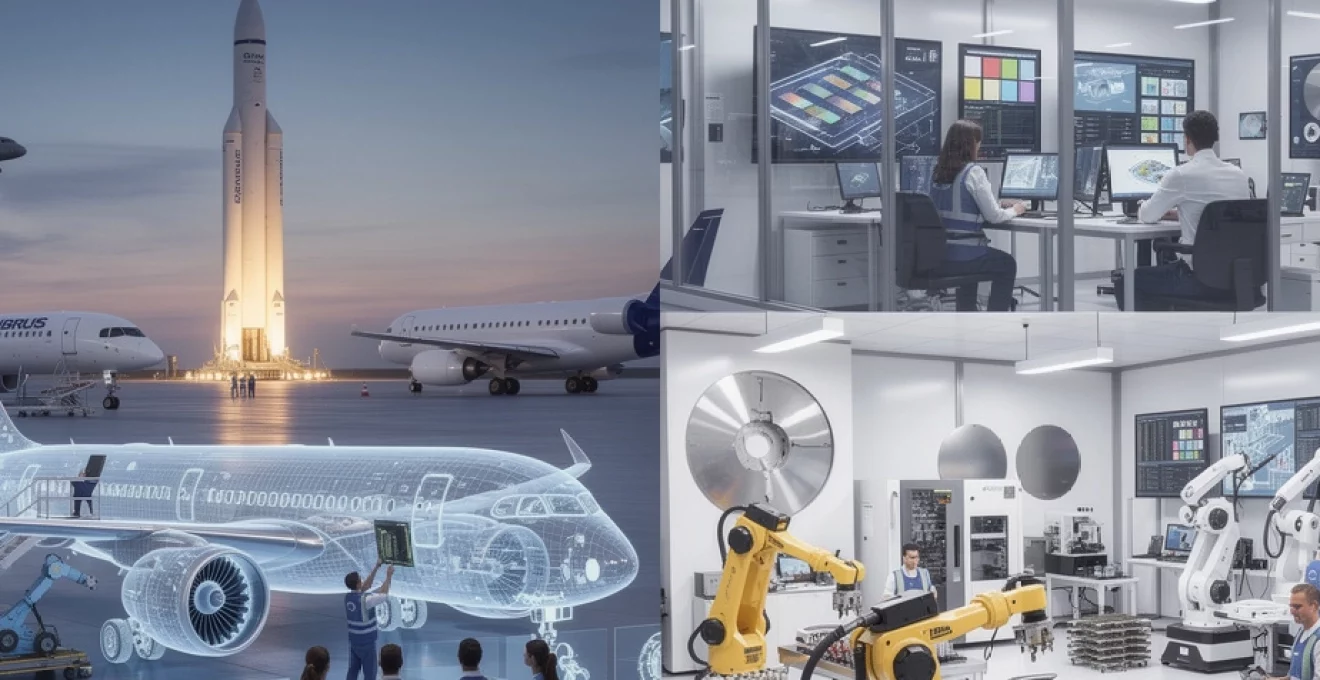
# From Aerospace to Robotics: France’s Industrial Innovation Strength
France has long held a distinguished position at the forefront of European industrial innovation, commanding respect across sectors ranging from aerospace engineering to advanced robotics. With manufacturing revenues exceeding €155 billion and a thriving ecosystem of specialized small and medium enterprises supporting industry giants, the French industrial landscape represents a compelling blend of heritage craftsmanship and cutting-edge technological advancement. The nation’s strategic investments in automation, artificial intelligence, and digital manufacturing are reshaping traditional production paradigms while maintaining the precision and quality standards for which French industry has become internationally renowned. From the aerospace facilities in Toulouse to the robotics innovation hubs across Paris-Region, France continues to demonstrate that industrial excellence requires both preserving proven engineering principles and embracing transformative technologies.
France’s aerospace engineering legacy: airbus, dassault aviation, and ariane group
The French aerospace sector stands as a testament to decades of sustained engineering excellence and strategic industrial policy. This industry segment has consistently outperformed other manufacturing sectors, maintaining growth trajectories even during economic turbulence that affected automotive and chemical industries. The aerospace defence sector currently represents one of France’s most resilient industrial pillars, with major manufacturers expanding production capabilities to meet both civilian aviation demand and increased defence procurement across European nations.
What distinguishes French aerospace engineering is the comprehensive integration across the entire value chain, from raw materials processing to final assembly and flight testing. This vertical integration allows manufacturers to maintain exacting quality standards while optimizing production efficiency. The sector employs sophisticated supply chain management systems that coordinate thousands of specialized suppliers, many of them small and medium-sized enterprises that have developed niche expertise in specific components or manufacturing processes. This ecosystem approach creates resilience and fosters continuous innovation as smaller firms compete to provide increasingly advanced solutions to prime contractors.
Airbus A350 XWB and A380 manufacturing excellence in toulouse
The Toulouse aerospace complex represents perhaps the most concentrated hub of aviation manufacturing expertise anywhere in the world. Here, final assembly lines for the A350 XWB wide-body aircraft showcase advanced composite manufacturing techniques, with carbon-fibre reinforced polymer structures comprising more than 50% of the airframe by weight. These manufacturing processes require temperature-controlled environments and precision robotic systems that can handle delicate composite materials while maintaining tolerances measured in fractions of millimetres.
The A380 programme, while facing commercial challenges, demonstrated unprecedented manufacturing coordination across multiple European sites. Wing components manufactured in the United Kingdom, fuselage sections from Germany and France, and tail assemblies from Spain converge at Toulouse for final integration. This cross-border production model required developing sophisticated logistics solutions and standardized manufacturing protocols that have since influenced aerospace production methodologies globally. The lessons learned from coordinating A380 production have been applied to subsequent programmes, improving efficiency and reducing integration complexity.
Dassault rafale fighter jet programme and falcon business aircraft development
Dassault Aviation’s dual focus on military and civilian aircraft demonstrates France’s capability to excel in both high-performance defence systems and luxury business aviation. The Rafale multi-role fighter programme has secured substantial export orders, validating decades of development investment and showcasing French expertise in avionics integration, aerodynamic design, and systems engineering. The aircraft’s advanced sensor fusion capabilities and network-centric warfare systems represent the convergence of aerospace engineering with sophisticated software development.
The Falcon business jet line continues Dassault’s tradition of combining performance with operational efficiency. Recent models incorporate fly-by-wire control systems derived from military programmes, demonstrating how defence technology development creates spillover benefits for civilian applications. Manufacturing these aircraft requires precision machining capabilities, advanced materials processing, and rigorous testing protocols that maintain safety standards while achieving the performance characteristics demanded by discerning corporate operators. The production facilities employ a mix of traditional skilled craftsmanship and modern automated manufacturing systems, preserving artisanal quality while benefiting from technological advancement.
Ariane 6 launch vehicle development at ArianeGroup’s vernon facility
European space access depends significantly on France’s rocket propulsion expertise, centred at ArianeGroup’s Vernon facility. The Ariane 6 development programme represents a comprehensive redesign aimed at reducing launch costs while maintaining the reliability standards established by previous Ariane generations. Manufacturing rocket engines demands extreme precision in machining, welding, and materials processing
to withstand extreme thermal and mechanical loads. Engineers at Vernon leverage advanced digital simulation, additive manufacturing for complex injector geometries, and non-destructive testing methods to validate each component long before it reaches the launch pad. In practice, this means that every turbopump, combustion chamber, and nozzle segment is treated as a critical system in its own right, with traceability and quality control processes that rival those of the nuclear industry.
Beyond propulsion hardware, Ariane 6 development has pushed France’s industrial ecosystem to refine its approach to modular design and concurrent engineering. Subsystems are designed in parallel by geographically dispersed teams that rely on shared digital models, common configuration baselines, and standardized interfaces. This approach reduces integration risk and allows incremental upgrades over the launcher’s life cycle. For industrial partners and suppliers, participation in the Ariane 6 supply chain serves as a powerful catalyst for upgrading their own manufacturing practices, quality assurance techniques, and project management capabilities.
Safran aircraft engines: LEAP turbofan technology and advanced propulsion systems
Safran Aircraft Engines, in partnership with GE Aerospace, has become a global benchmark in high-efficiency turbofan technology through the LEAP engine family. Designed for single-aisle aircraft such as the Airbus A320neo and Boeing 737 MAX, LEAP engines incorporate advanced composite fan blades, ceramic matrix composites, and highly optimized compressor stages to deliver up to 15% lower fuel burn compared to previous-generation engines. These gains are not purely incremental; they result from decades of cumulative research in aerodynamics, materials science, and digital design tools.
Manufacturing LEAP engines in France involves tightly controlled processes that combine precision casting, 5-axis machining, and robotic welding with sophisticated inspection systems. Safran facilities integrate automated production cells supervised by technicians who manage quality parameters in real time. As you might expect, any deviation in blade geometry or surface finish can have outsized effects on performance and safety, so metrology and data analytics are deeply embedded in every production step. The same factories are also ramping up work on hybrid-electric and hydrogen-ready architectures, positioning France at the forefront of the next generation of propulsion systems.
Safran’s approach illustrates how industrial innovation in France increasingly hinges on a fusion of physical and digital capabilities. Engineers rely on high-fidelity simulation to model airflow, thermal loads, and combustion stability before cutting any metal, much like a composer writes and refines a score before the orchestra rehearses. Once engines enter service, in-flight data streams support predictive maintenance programmes that help airlines optimize engine life cycles and avoid unplanned downtime. For industrial buyers and partners, this data-driven propulsion ecosystem offers a model of how advanced manufacturing, analytics, and service can be tightly integrated.
Advanced robotics integration in french manufacturing ecosystems
While aerospace remains the flagship of French industrial innovation, robotics and automation are transforming factories across sectors such as automotive, pharmaceuticals, logistics, and food processing. France installed a record 7,380 new industrial robot systems in 2022 alone, representing a 13% increase over 2021 and confirming its position as the third-largest robotics market in the EU. This momentum reflects both the pressure to enhance productivity and quality, and the government’s strategic push through initiatives like France 2030 and France Relance to modernize production assets.
In practical terms, we see a shift from isolated robot cells to fully connected automation ecosystems that combine industrial robots, collaborative robots (cobots), autonomous mobile robots (AMRs), and advanced control platforms. The aim is not just to “replace” manual tasks, but to redesign workflows for flexibility and resilience. For manufacturers wondering how to start their automation journey, French examples show that incremental deployment—beginning with high-impact use cases such as material handling or welding—can deliver rapid ROI while building internal skills for more complex projects.
Stäubli robotics solutions for precision assembly and pharmaceutical applications
Stäubli, headquartered in Faverges, has emerged as a reference player in high-speed, high-precision robotics tailored to demanding industrial environments. Its articulated and SCARA robots are widely deployed in electronics assembly, plastics processing, and metalworking, where cycle time reduction and repeatability are critical. In many French factories, Stäubli systems handle delicate components that would be impractical to manipulate manually at consistent quality levels, such as micro-connectors or precision-molded parts.
The company’s influence is especially visible in pharmaceutical and life sciences applications, a field where France has strong industrial capabilities. Cleanroom-rated Stäubli robots operate in aseptic filling lines, sterile packaging, and laboratory automation, combining high throughput with stringent contamination control. Here, robot design must account not only for mechanical performance but also for surface finish, ease of cleaning, and compatibility with sterilization protocols. For pharmaceutical players under regulatory pressure, such automation can significantly reduce human error and improve traceability.
Stäubli’s solutions also illustrate how French robotics suppliers are embracing Industry 4.0 principles. Robots are increasingly connected to manufacturing execution systems (MES) and quality systems via standardized interfaces, streaming operational data that can be used for process optimization and predictive maintenance. As we look ahead, this convergence of robotics, data, and regulatory compliance will likely broaden automation adoption in sectors—like pharma and medical devices—that historically relied heavily on manual labor.
Collaborative robot deployment at renault’s cleon and flins production sites
Renault’s Cleon and Flins plants offer concrete examples of how collaborative robots can reshape automotive manufacturing in France. At Cleon, a key site for electric motor and powertrain production, cobots assist operators with tasks such as bolt tightening, gasket application, and component handling. These are operations that demand both precision and ergonomics; by letting cobots perform repetitive or awkward motions while humans focus on inspection and problem-solving, Renault has been able to reduce musculoskeletal strain and improve overall line performance.
Flins, which has undergone a significant transformation as part of Renault’s circular economy and remanufacturing strategy, uses cobots in battery disassembly, component sorting, and quality inspection. Because the plant handles a wide variety of parts and configurations, flexibility is paramount. Cobots can be reprogrammed quickly, almost like reassigning a skilled worker to a new station, making them ideal for low-volume, high-mix environments. For manufacturers hesitant about full automation, this model shows how you can introduce robotics without sacrificing adaptability.
These deployments also underline the importance of workforce upskilling. At both sites, operators have been trained to configure and supervise cobots rather than merely work alongside them. This human–robot collaboration requires careful risk assessment and safety design, but when done well it turns automation into a tool that augments workers rather than displaces them. The lesson for other industrial sectors is clear: successful cobot adoption is as much about change management and skills development as it is about hardware selection.
Automated guided vehicles and cobots in PSA groupe’s industry 4.0 factories
PSA Groupe, now part of Stellantis, has been another early mover in integrating advanced robotics into French automotive manufacturing. In plants such as Sochaux and Mulhouse, automated guided vehicles (AGVs) and autonomous mobile robots support just-in-time delivery of components to assembly lines. Instead of fixed conveyors and manually operated forklifts, PSA uses fleets of mobile robots that can adapt routes in real time based on production priorities and traffic conditions on the shop floor.
These AGVs work in tandem with cobots that handle tasks like screwdriving, sealing, and sub-assembly, particularly in final assembly zones where space is limited and workflows are complex. By combining mobile robotics with collaborative systems, PSA has increased line flexibility, making it easier to adjust to new vehicle variants or sudden demand changes. It is a bit like replacing a rigid railway network with a fleet of autonomous vehicles—you gain the ability to reroute flows as conditions change, without expensive reconfiguration.
From an Industry 4.0 perspective, PSA’s factories highlight the importance of real-time data integration. AGVs and cobots are connected to central control systems that orchestrate production, inventory, and quality in a coordinated manner. For suppliers and technology partners, this environment creates strong demand for interoperable solutions, cybersecurity measures, and robust wireless networks capable of handling mission-critical traffic. It also demonstrates that the path to “smart factory” status is not a single leap, but a series of coordinated upgrades across equipment, software, and organization.
Schneider electric’s EcoStruxure platform for smart manufacturing automation
Schneider Electric, headquartered near Paris, plays a systemic role in France’s industrial digitalization through its EcoStruxure platform. EcoStruxure integrates programmable logic controllers (PLCs), industrial PCs, sensors, drives, and electrical distribution into a unified architecture that supports data collection, analytics, and remote management. For French manufacturers seeking to adopt robotics and automation, this platform offers a backbone that can connect legacy equipment with new robotic cells and IoT devices.
In practice, EcoStruxure-enabled factories can monitor energy consumption, machine health, and production KPIs from a single interface, enabling proactive decision-making. For example, a plant might use EcoStruxure to orchestrate when robots run at full speed, when they slow down to match upstream constraints, and when non-essential loads can be shed to reduce energy costs. This kind of fine-grained control is increasingly important as energy prices fluctuate and sustainability regulations tighten.
Schneider also collaborates closely with OEMs, system integrators, and end-users to build reference architectures for common use cases, such as packaging lines or flexible assembly cells. If you are planning an automation upgrade in France, engaging with such ecosystems can significantly reduce integration risk and shorten deployment timelines. The broader implication is that industrial innovation today is less about isolated machines and more about interoperable, data-rich systems that can evolve over time.
Digital twin technology and simulation-driven engineering at dassault systèmes
Dassault Systèmes has become a global leader in digital twin technology, providing software platforms—most notably 3DEXPERIENCE—that underpin much of France’s advanced engineering and manufacturing. A digital twin is a virtual replica of a physical asset, process, or system that can be used to simulate behavior, test scenarios, and optimize performance before and after deployment. For French industries facing tight regulatory, cost, and time-to-market pressures, this approach can be transformative.
In aerospace, automotive, and industrial equipment, engineers use Dassault Systèmes tools to design everything from airframes and powertrains to factory layouts and maintenance procedures. Instead of building multiple physical prototypes, teams iterate in a virtual environment, testing aerodynamics, structural loads, thermal behavior, and manufacturability. Think of it as the engineering equivalent of a flight simulator—allowing you to explore edge cases and “what if” scenarios without risking real hardware or safety.
Beyond product design, digital twins are increasingly used to model manufacturing systems and entire plants. French companies simulate robot trajectories, material flows, and operator interactions to identify bottlenecks and test reconfigurations before implementing changes on the shop floor. When combined with real-time data from sensors and industrial IoT devices, these models evolve into “living twins” that reflect the current state of operations and support predictive maintenance and continuous improvement. For decision-makers, this simulation-driven engineering provides a powerful way to de-risk investments and align engineering, production, and service teams around shared, data-backed assumptions.
Composite materials innovation: CFRP and advanced thermoplastics in french industry
France has also built strong competencies in composite materials, particularly carbon-fibre reinforced polymers (CFRP) and advanced thermoplastics, which play a central role in lightweighting and performance optimization. In aerospace, CFRP structures in aircraft such as the Airbus A350 help reduce weight and fuel consumption while maintaining or enhancing structural strength. These same materials are now spreading into wind energy, automotive, and rail applications, driven by decarbonization targets and efficiency requirements.
French research centers and industrial players work together in clusters to push the boundaries of composite manufacturing. Automated fiber placement (AFP), resin transfer molding (RTM), and out-of-autoclave curing processes are being refined to cut cycle times and reduce scrap. As composite parts grow in size and complexity, digital tools and robotics take on greater importance; robots must place fibers with millimetric precision over large surfaces, while process simulations predict curing behavior and residual stresses.
Advanced thermoplastics, such as PEEK and PEKK, are another key area of innovation. These materials combine high temperature resistance and mechanical strength with the possibility of welding and recycling, addressing both performance and sustainability concerns. In aerospace interiors, medical devices, and high-performance automotive components, French manufacturers are exploring how thermoplastic composites can replace metal or thermoset parts. The challenge lies in scaling production while maintaining consistent quality—an area where France’s experience in process control, metrology, and automation provides a competitive edge.
Microelectronics and embedded systems: STMicroelectronics and soitec leadership
Behind every advanced robot, aircraft, or smart factory lies a sophisticated layer of microelectronics and embedded systems. France has nurtured globally relevant champions in this domain, notably STMicroelectronics and Soitec, which form the backbone of many European semiconductor and system-on-chip initiatives. Their technologies power applications ranging from automotive power electronics and industrial drives to smartphones and edge AI devices.
Over the past decade, France has actively supported investment in semiconductor fabrication and substrate manufacturing through substantial public–private funding. This strategic focus is driven both by economic opportunity and by a desire for greater technological sovereignty in critical components. For industrial companies operating in or with France, this ecosystem offers not only secure supply, but also opportunities for co-development of application-specific solutions in power management, sensing, and embedded intelligence.
Stmicroelectronics’ 300mm FD-SOI wafer manufacturing in crolles
STMicroelectronics’ Crolles facility, near Grenoble, is one of Europe’s most advanced semiconductor fabs, specializing in 300mm fully depleted silicon-on-insulator (FD-SOI) technologies. FD-SOI offers a compelling balance of energy efficiency, performance, and cost, making it particularly attractive for low-power edge computing, automotive control units, and industrial IoT applications. In essence, FD-SOI chips can deliver high performance at lower voltages, which is critical in battery-powered devices and in environments where thermal constraints are strict.
The Crolles plant exemplifies cutting-edge semiconductor manufacturing, with extreme precision lithography, ultra-clean environments, and highly automated material handling systems. Robots and AMRs operate in the fab’s sub-fab and cleanroom areas, transporting wafers through hundreds of process steps with minimal human intervention. For France’s wider industrial landscape, the know-how generated here spills over into domains such as quality control, data analytics, and advanced equipment maintenance, reinforcing the country’s reputation for high-tech manufacturing.
STMicroelectronics collaborates closely with automotive OEMs, industrial equipment makers, and consumer electronics firms to tailor FD-SOI platforms to specific application needs. Whether you are designing a motor drive controller or a sensor fusion module for autonomous systems, these partnerships can significantly shorten development cycles and improve performance-per-watt metrics. As Europe seeks to boost its semiconductor independence, Crolles stands as a strategic asset—and a powerful illustration of how microelectronics underpin industrial innovation.
Soitec’s SmartCut technology for silicon-on-insulator substrate production
Complementing STMicroelectronics, Soitec has become a world leader in engineered substrates through its SmartCut technology, also rooted in the Grenoble region. SmartCut enables the precise transfer of thin silicon layers onto insulating substrates, creating silicon-on-insulator (SOI) wafers with tightly controlled electrical properties. These wafers are essential for FD-SOI nodes, RF components, power management ICs, and image sensors used across automotive, telecom, and consumer markets.
The SmartCut process involves ion implantation, wafer bonding, and layer splitting, followed by surface conditioning and quality assurance steps. Each stage demands nanometric precision and ultra-clean conditions; a defect invisible to the naked eye can compromise yields over thousands of chips. Soitec’s industrial success therefore rests on a combination of advanced materials science, high-throughput manufacturing equipment, and sophisticated metrology. Much like crafting optical lenses for telescopes, tiny imperfections can dramatically distort performance.
From the perspective of France’s industrial ecosystem, Soitec’s leadership underscores the strategic importance of substrates and materials that sit “upstream” of visible end-products. By anchoring critical elements of the semiconductor value chain in France, the country enhances its resilience against supply shocks and builds strong linkages between materials research, equipment suppliers, and device manufacturers. For companies exploring custom electronics or specialized sensors, collaboration with Soitec and its partners can open up avenues for differentiation at the silicon level.
Kalray MPPA manycore processors for edge computing and autonomous systems
Kalray, another French technology player, focuses on manycore processors designed for high-performance, low-latency edge computing. Its MPPA (Massively Parallel Processor Array) architecture integrates dozens or even hundreds of cores on a single chip, optimized for parallel workloads such as real-time data processing, AI inference, and sensor fusion. These capabilities are crucial in applications like autonomous vehicles, industrial automation, and data-intensive storage systems, where decisions must be made within milliseconds.
Unlike general-purpose CPUs or GPUs, Kalray’s processors are tailored for deterministic performance and energy efficiency, a combination that industrial users value when deploying safety-critical or mission-critical systems. For example, an autonomous shuttle operating in a smart city or a robotic inspection system in a refinery cannot afford unpredictable latency or thermal runaway. Manycore architectures, combined with carefully designed software toolchains, help manage this complexity while keeping power budgets under control.
Kalray’s work highlights how France’s industrial innovation extends beyond hardware to include system architectures and software ecosystems. The company collaborates with automotive suppliers, cloud providers, and storage specialists, creating reference platforms that accelerate adoption. For French manufacturers exploring edge AI and autonomous systems, such processors provide a bridge between raw sensor data and actionable intelligence at the point of operation, reducing dependence on centralized cloud resources and enhancing resilience.
France’s strategic industrial clusters: aerospace valley and systematic Paris-Region
Underlying all these technological strengths is a deliberate strategy of clustering industrial, academic, and research capabilities. France’s competitiveness in aerospace, robotics, microelectronics, and digital technologies is amplified by dedicated clusters that foster collaboration and accelerate innovation. Two of the most emblematic examples are Aerospace Valley in the southwest and Systematic Paris-Region around the capital.
Aerospace Valley, spanning the Occitanie and Nouvelle-Aquitaine regions, brings together more than a thousand members, including Airbus, Dassault Aviation, Safran, Thales, and countless SMEs and research institutes. The cluster supports projects across aircraft, space systems, drones, and embedded software, often co-funded by national and European programmes. For foreign companies eyeing partnerships or market entry, Aerospace Valley offers a structured gateway to the French aerospace ecosystem, with access to testbeds, R&D partners, and skilled suppliers.
Systematic Paris-Region focuses on deep tech domains such as digital engineering, AI, cybersecurity, and embedded systems, linking global primes like Schneider Electric, Thales, and Atos with startups and academic labs. Here, initiatives around smart manufacturing, Industry 4.0, and AI robotics intersect, enabling cross-pollination between software and hardware experts. If you are developing solutions in digital twins, industrial cybersecurity, or AI-powered robotics, participation in Systematic can open doors to pilot projects with major industrial users.
These clusters do more than simply group companies by geography. They curate collaborative projects, facilitate technology transfer, and ensure that SMEs can plug into large-scale industrial programmes—from France 2030 initiatives to EU-funded IPCEIs in hydrogen, semiconductors, and advanced manufacturing. As industrial challenges grow more complex, France’s cluster model shows how coordinated ecosystems can out-innovate isolated actors, turning the country’s diverse capabilities—from aerospace to robotics—into a cohesive industrial advantage.