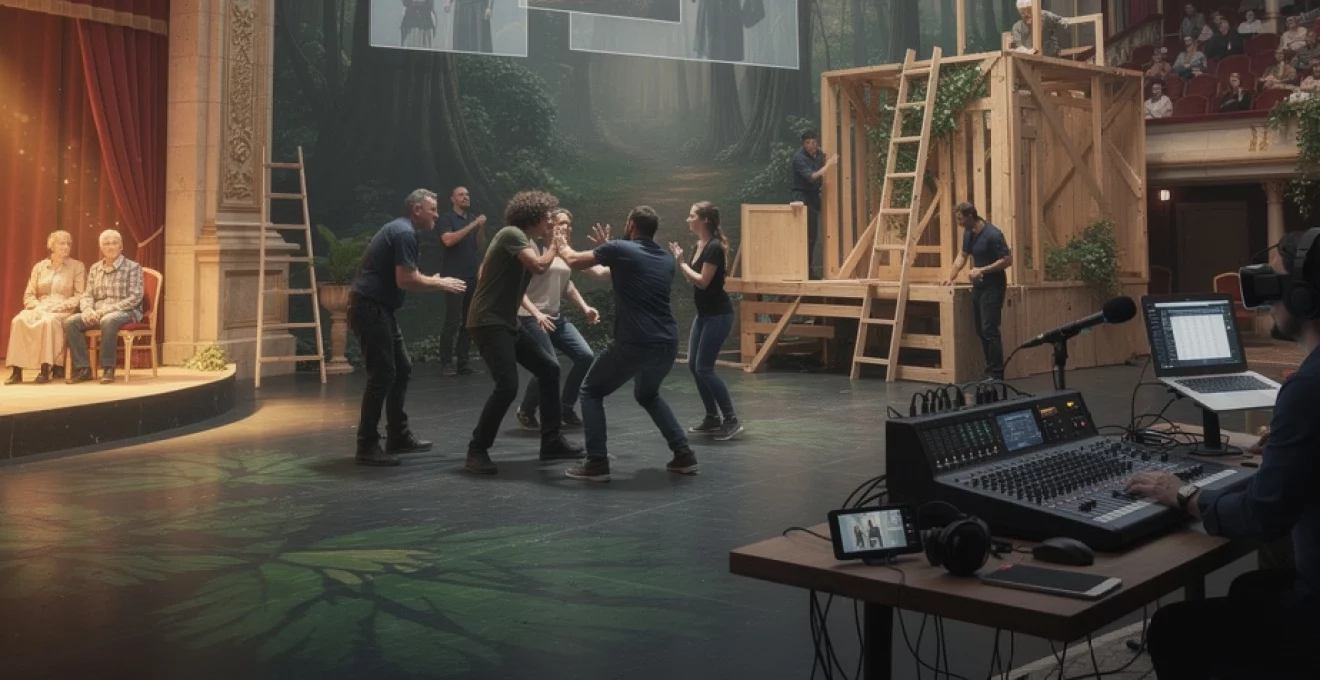
Contemporary French theatre stands at a fascinating crossroads where centuries of dramatic tradition meet bold experimental innovation. This dynamic tension between heritage and modernity defines the current theatrical landscape in France, creating a vibrant ecosystem where classical institutions embrace cutting-edge practices whilst emerging artists draw inspiration from their illustrious predecessors. The result is a theatrical scene that maintains its cultural prestige whilst actively engaging with contemporary global conversations about identity, technology, and social transformation.
French theatre’s unique position in world culture stems from its ability to seamlessly blend reverence for its past with an unwavering commitment to artistic evolution. From the state-subsidised national theatres to the experimental venues of the Avignon Festival, French theatrical institutions demonstrate remarkable adaptability without sacrificing their core artistic values. This balance has attracted international attention and collaboration, positioning France as a crucial player in the global theatre community.
Classical french theatre institutions and their contemporary evolution
France’s prestigious theatrical institutions have undergone significant transformations to remain relevant in the 21st century. These venerable establishments, once bastions of traditional repertoire, now serve as laboratories for theatrical innovation whilst maintaining their commitment to classical excellence. The evolution represents a calculated response to changing audience expectations and the need to attract younger demographics without alienating traditional supporters.
Comédie-française’s repertoire modernisation under eric ruf’s direction
The Comédie-Française, France’s oldest active theatre company, has embraced contemporary programming under the leadership of administrator Eric Ruf. This institution, traditionally associated with Molière, Racine, and Corneille, now regularly features works by living playwrights alongside classical masterpieces. Ruf’s approach involves commissioning new works that engage with classical themes through modern perspectives, creating dialogue between past and present.
Recent seasons have showcased this evolution through productions that reinterpret classical texts with contemporary staging techniques. Directors are encouraged to explore innovative approaches to familiar works, often incorporating multimedia elements and non-traditional casting choices. This strategy has resulted in increased attendance amongst younger audiences whilst maintaining the loyalty of traditional theatre-goers who appreciate the institution’s commitment to excellence.
Théâtre national de strasbourg’s Avant-Garde programming strategy
The Théâtre National de Strasbourg has positioned itself as a pioneer in experimental theatre programming, consistently pushing boundaries whilst maintaining its status as a national institution. Under successive artistic directors, the theatre has developed a reputation for risk-taking productions that challenge conventional theatrical forms. This approach reflects Strasbourg’s unique position as a European cultural crossroads.
The theatre’s programming strategy emphasises interdisciplinary collaborations, bringing together theatre practitioners with artists from dance, visual arts, and digital media. These cross-pollinations have resulted in productions that expand the definition of theatrical performance, attracting audiences who might not traditionally attend theatre whilst educating existing audiences about contemporary artistic practices.
Odéon-théâtre de l’europe’s transnational Co-Production models
The Odéon-Théâtre de l’Europe has developed sophisticated international co-production models that facilitate cultural exchange whilst maintaining artistic integrity. These collaborations involve partnerships with theatres across Europe and beyond, creating productions that reflect diverse cultural perspectives whilst remaining distinctly theatrical in their execution.
These transnational projects often address universal themes through culturally specific lenses, creating works that resonate with international audiences whilst maintaining local relevance. The theatre’s approach demonstrates how French institutions can maintain their cultural identity whilst actively participating in global artistic conversations, setting a model for other national theatres seeking international engagement.
Théâtre du soleil’s collective creation methodology under ariane mnouchkine
Ariane Mnouchkine’s Théâtre du Soleil continues to exemplify collective creation methodologies that have influenced theatrical practice worldwide. The company’s approach involves extended collaborative processes where actors, directors, and designers work together to develop performances organically. This methodology challenges traditional hierarchical structures in theatre-making whilst producing works of exceptional artistic quality.
The company’s recent productions demonstrate how collective creation can address contemporary political and social issues through theatrical metaphor and physical expression. Their work often incorporates elements from various cultural traditions, creating performances that speak to universal
questions and foregrounds marginalised voices. By privileging ensemble work, long rehearsal periods, and a strong ethical framework, Théâtre du Soleil demonstrates how a historically rooted troupe can remain radically contemporary. For many observers, it serves as a living example of how French theatre today negotiates between collective utopia and practical constraints of production and touring.
Contemporary french playwrights redefining dramatic literature
Alongside institutional change, contemporary French playwrights are reshaping what we mean by “dramatic literature.” Rather than simply updating classical forms, many of today’s authors experiment with fragmented narratives, hybrid genres, and post-dramatic structures that blur the lines between theatre, performance art, and prose. These writers demonstrate that French theatre today can honour its literary heritage while questioning the very notion of what a play should look like in a digital, globalised world.
Yasmina reza’s Post-Dramatic writing techniques and international success
Yasmina Reza exemplifies how contemporary French playwriting can achieve both critical acclaim and broad international appeal. Her works such as Art and God of Carnage rely on razor-sharp dialogue, compressed timeframes, and meticulously constructed conflicts that unfold in real time. Although her plays appear traditional at first glance, their stripped-down plots and psychological intensity align with post-dramatic concerns, focusing less on external action and more on the microscopic dissection of social behaviour.
Reza’s success on Broadway, the West End, and in numerous translations proves that French theatre today can speak directly to global audiences without abandoning its specificity. Her plays often revolve around seemingly trivial incidents—a painting, a schoolyard fight—that unravel deeper anxieties about status, identity, and moral responsibility. By keeping her scenography minimal and her language precise, she creates a sort of theatrical laboratory where we observe how fragile our civilised façades really are.
Olivier py’s poetic theatre and religious symbolism integration
Olivier Py, former director of the Festival d’Avignon, represents another facet of contemporary French playwriting: a return to overtly poetic language and metaphysical questioning. His texts combine lyrical monologues, choral passages, and dense intertextual references that evoke both liturgical ritual and modern political discourse. Religious symbolism and questions of faith, redemption, and sacrifice run throughout his work, yet they are refracted through a resolutely critical and often ironic lens.
In productions such as Les Parisiens or his adaptations of biblical stories, Py uses theatre almost like a cathedral built from light, sound, and bodies rather than stone. For spectators, this poetic theatre can feel like walking into a dream where myths, politics, and intimate confession coexist. His approach illustrates how French theatre today can reclaim spiritual and religious imagery without reverting to dogma, instead using it to interrogate contemporary crises of meaning and collective responsibility.
Wajdi mouawad’s Multi-Generational narrative structures
Wajdi Mouawad, a Lebanese-Canadian author long associated with the French stage, has profoundly influenced how multi-generational narratives are handled in contemporary French theatre. Works like Incendies, Littoral, and the tetralogy Le Sang des promesses weave together past and present, Europe and the Middle East, personal trauma and historical violence. His dramaturgy often unfolds across decades and continents, using theatrical time like an accordion that stretches and contracts to reveal buried secrets.
Mouawad’s writing shows how French theatre today can address migration, war, and exile through gripping family sagas rather than didactic discourse. Characters frequently discover that their identities are built on silences and lies inherited from previous generations. By gradually revealing these hidden histories on stage, Mouawad invites us to consider how our own familial and national narratives might be constructed—and what happens when we start to question them.
Joël pommerat’s collaborative text development process
Joël Pommerat has become a reference point for a new model of authorship in French theatre today. Rather than writing a finished script before rehearsals, he develops his texts directly with his company, Compagnie Louis Brouillard, through a long process of improvisation and rewriting. The result is a theatre where staging, acting, and writing emerge simultaneously, each informing the other at every step.
In works like La Réunification des deux Corées or his reimagined fairy tales (Pinocchio, Cendrillon), Pommerat crafts scenes that feel both meticulously composed and startlingly immediate. His language is economical yet emotionally charged, and his minimalist aesthetic—precise lighting, sparse sets, controlled movement—turns the stage into a kind of darkroom where human relationships slowly develop before our eyes. For artists and audiences alike, his collaborative text development process suggests that playwriting today can be as much a collective craft as a solitary literary pursuit.
Innovative staging technologies and scenographic approaches
While the text remains central, innovative staging technologies now play a crucial role in defining French theatre today. Directors and scenographers are increasingly integrating digital tools, sophisticated sound design, and new training methods into their work. These developments do not simply add visual spectacle; they transform how stories are told, how actors move, and how audiences experience time and space inside the theatre.
Digital projection mapping in philippe quesne’s environmental theatre
Philippe Quesne is renowned for crafting stage environments that feel like self-contained ecosystems, somewhere between scientific experiment and poetic landscape. Digital projection mapping has become one of his key tools, allowing him to sculpt light and imagery directly onto sets, props, and even performers. Instead of functioning as mere background decoration, projections in his work often behave like living organisms that respond to the actors and the evolving narrative.
For instance, in pieces where nature, climate, or urban ruin play a central role, projection mapping can make walls appear to breathe, snow to fall, or landscapes to mutate before our eyes. The effect is akin to walking inside a graphic novel that redraws itself in real time. By integrating these technologies subtly rather than as showy gimmicks, Quesne demonstrates how digital scenography can support ecological and philosophical questions at the heart of French theatre today.
Immersive audio design techniques in contemporary french productions
Sound design has undergone a quiet revolution in recent years, becoming as dramaturgically significant as lighting or set design. Many French productions now experiment with immersive audio techniques, using surround systems or even individual headphones to create highly personalised listening experiences. Instead of simply hearing dialogue and music from a frontal perspective, spectators may feel enveloped by whispers, environmental noises, or inner monologues that seem to pass directly through their bodies.
This immersive audio can transform how we relate to a performance. A monologue delivered in a near whisper, amplified and spatialised around the audience, creates an intimacy closer to cinema or radio drama than to traditional stage projection. For creators, it opens new possibilities: how might a character’s subconscious sound, or what if the city outside the theatre gradually invades the auditorium through sound alone? These techniques help French theatre today to explore psychological and sensory dimensions that text and image alone cannot fully capture.
Biomechanical performance training methods in french acting schools
Behind the scenes, actor training in France has also evolved, drawing on biomechanical performance methods that emphasise precision, physical awareness, and energy dynamics. Influenced by traditions such as Meyerhold’s biomechanics and contemporary movement research, several drama schools and conservatoires now integrate rigorous physical training into their curricula. The goal is not acrobatics for its own sake, but a body that can react with the same nuance and responsiveness as the voice.
For audiences, the impact is often felt in the clarity of gesture and the heightened presence of performers on stage. A biomechanically trained actor can shift from stillness to explosive movement as smoothly as a musician changes tempo. This kind of training proves particularly valuable in visually driven productions and in devised theatre, where the body often carries as much narrative weight as the spoken word. It illustrates how French theatre today continues to refine the craft of acting in dialogue with both historical techniques and contemporary sciences of movement.
Sustainable set design practices at festival d’avignon
As environmental concerns become increasingly urgent, sustainable scenography has moved from the margins to the centre of French theatre debates. The Festival d’Avignon, a major barometer for trends in French theatre today, has taken notable steps in this direction. Set designers and technical teams are encouraged to reuse materials, favour modular structures, and consider the carbon footprint of touring large-scale productions.
For example, some productions opt for minimalist, multi-purpose elements that can be reconfigured across different shows, rather than building entirely new sets each season. Others work with recycled wood, fabrics, or locally sourced materials to reduce transport emissions. This shift towards eco-responsible scenography is not only ethical but also aesthetic: how might scarcity and constraint inspire new visual languages on stage? In this sense, sustainability becomes less a limitation than a creative challenge integrated into the very DNA of French theatre today.
Festival circuits and cultural policy impact on french theatre
Any analysis of French theatre today would be incomplete without considering the dense network of festivals and the country’s distinctive cultural policy. Public funding, administered through the Ministry of Culture and regional authorities, continues to underpin a large part of theatrical activity. This system enables long rehearsal periods, risk-taking in programming, and the maintenance of permanent ensembles, but it also creates competition for limited resources and ongoing debates about criteria for support.
Festival circuits such as Avignon, the Festival d’Automne in Paris, and numerous regional events function as showcases where new works are tested, discovered, and circulated. For many companies, being selected by a major festival can mean the difference between local visibility and international touring. Yet these circuits also shape the aesthetics of French theatre today: curators favour certain formal innovations or political themes, indirectly encouraging artists to align with or react against those expectations.
From a spectator’s perspective, festivals offer an intense immersion in contemporary creation, sometimes allowing you to see three or four performances in a single day. They also turn historic cities into temporary cultural laboratories where professionals, critics, and audiences debate the role of theatre in society. Should public funds prioritise experimental work, popular entertainment, or socially engaged projects? The answers to these questions, negotiated year after year, strongly influence which voices and aesthetics come to define French theatre on the national and international stage.
Cross-cultural collaborations and international Co-Productions
In an era marked by global mobility and digital communication, cross-cultural collaboration has become a defining feature of French theatre today. Co-productions between French institutions and partners in Europe, Africa, the Middle East, Asia, and the Americas are now common. These projects share not only financial burdens but also artistic responsibility, resulting in works that are genuinely co-authored across borders rather than simply exported in one direction.
Such collaborations can take many forms: joint residencies where artists develop a piece in several countries, multilingual productions that mix languages on stage, or long-term partnerships with theatre laboratories abroad. At their best, they avoid the trap of cultural tourism by engaging deeply with local contexts and power dynamics. For artists, this means learning to work within different rehearsal cultures and aesthetic expectations; for audiences, it offers access to hybrid forms that expand what “French theatre” can mean.
Of course, international co-production also raises practical and ethical challenges. How do companies ensure equitable credit and payment structures across unequal economies? What happens when a piece created in one political context tours to another where its message resonates differently—or even becomes dangerous? Navigating these questions requires as much diplomatic sensitivity as artistic vision, but the result is a theatre ecosystem that is more porous, self-reflective, and responsive to global realities.
Audience development strategies in Post-Digital theatre landscape
Finally, French theatre today must grapple with a post-digital landscape in which streaming platforms, social media, and gaming compete fiercely for attention. Rather than resisting these changes, many theatres are experimenting with new audience development strategies that combine digital tools with the irreplaceable experience of live performance. The challenge is to attract younger and more diverse spectators without diluting artistic ambition.
Some institutions have developed dynamic online presences, sharing rehearsal footage, podcasts with artists, or short educational videos that demystify complex productions. Others experiment with hybrid formats—live-streamed performances, interactive online components, or post-show discussions conducted on social platforms—that extend the theatrical event beyond the physical venue. For potential spectators, these initiatives reduce the intimidation factor that sometimes surrounds “serious” theatre, making it easier to take the first step into the auditorium.
At the same time, audience outreach continues in more traditional forms: school programmes, partnerships with community organisations, and ticketing policies that favour accessibility, such as low-cost seats for students or unemployed spectators. Many theatres now build long-term relationships with specific groups, inviting them to follow several productions over a season rather than attending a single show. In this way, French theatre today is not only about producing innovative work; it is also about patiently cultivating the conditions for that work to be seen, discussed, and shared by as wide a public as possible.