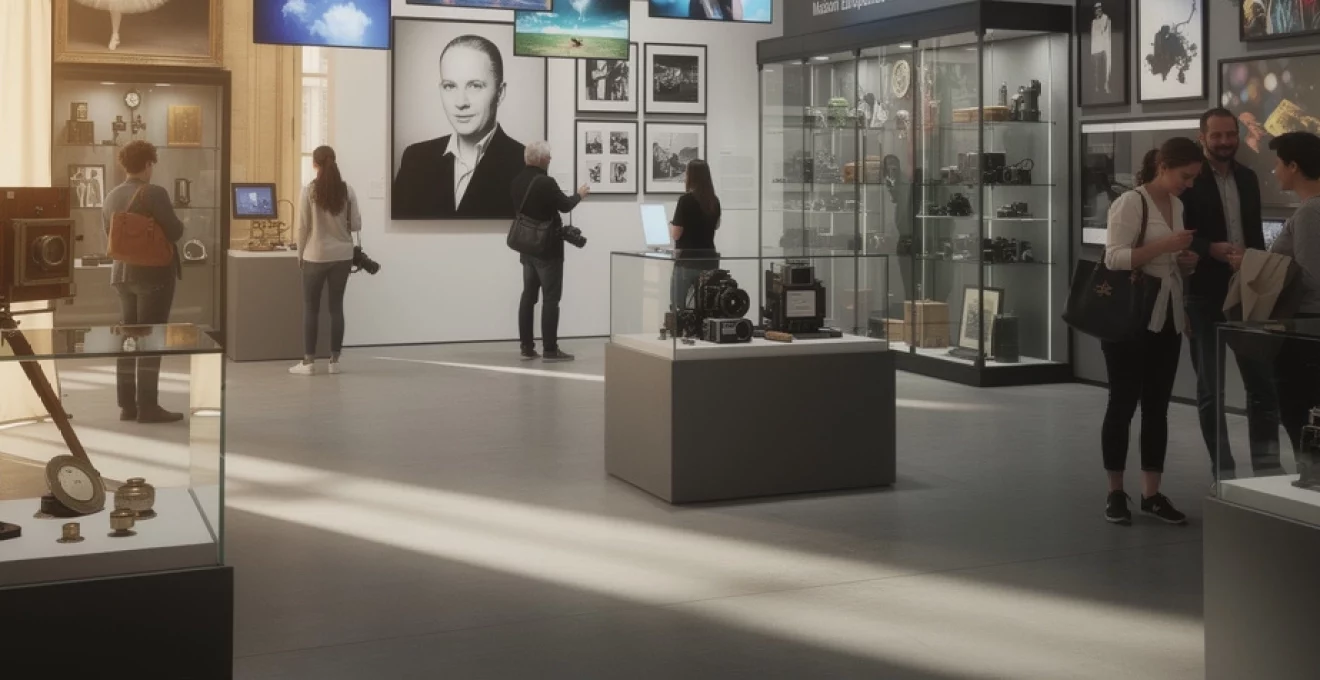
Paris stands as the undisputed global capital of photography, where the medium first gained recognition as a legitimate art form during the 1859 Exposition Universelle. The city’s cobblestone streets have witnessed legendary photographers like Louis Daguerre, Hippolyte Bayard, and Eugène Atget capture fleeting moments that now define photographic history. From the surrealist experiments of Man Ray and Brassaï in the 1920s to the pioneering photojournalism of Robert Capa and Henri Cartier-Bresson, Paris continues to nurture and celebrate visual storytelling through its exceptional museum collections. Today’s photography enthusiasts can explore an extraordinary network of institutions that house everything from 19th-century daguerreotypes to cutting-edge digital installations, making the City of Light an essential pilgrimage destination for anyone passionate about the photographic arts.
Musée d’orsay: impressionist photography collections and historical daguerreotype archives
The Musée d’Orsay’s photography collection represents one of Europe’s most significant repositories of 19th and early 20th-century photographic works, housing over 45,000 prints and negatives that chronicle the medium’s artistic evolution. Originally constructed as a railway station for the 1900 Exposition Universelle, this architectural marvel now serves as a temple to visual arts, where photography shares space with Impressionist masterpieces. The museum’s photographic holdings span from the earliest daguerreotypes of the 1840s to the pictorialist movement of the early 1900s, offering visitors an unprecedented journey through photography’s formative decades.
The museum’s approach to displaying photography emphasises the medium’s relationship with painting and sculpture, demonstrating how early photographers sought artistic legitimacy by emulating established art forms. Visitors can explore rotating exhibitions that showcase the museum’s extensive archives, including works by pioneering photographers who helped establish photography’s artistic credentials. The collection particularly excels in documenting the technical innovations that transformed photography from a scientific curiosity into a powerful means of artistic expression.
Nadar’s portrait photography studio reconstructions and original equipment displays
Félix Nadar’s reconstructed photography studio provides an immersive glimpse into 19th-century portrait photography practices, complete with period-authentic equipment and lighting arrangements. The museum has meticulously recreated Nadar’s working environment, featuring original cameras, glass plate negatives, and the elaborate props that defined Victorian-era portrait sessions. Visitors can examine the massive wooden cameras and brass lenses that required subjects to remain motionless for several minutes, understanding the physical challenges that early portrait photographers and their clients faced.
The studio reconstruction demonstrates Nadar’s innovative use of artificial lighting, which allowed him to create dramatic portrait effects that influenced generations of photographers. Original albumen prints display the exceptional quality achievable with 19th-century techniques, while interactive displays explain the complex chemical processes required to produce lasting photographic images. This exhibition space effectively bridges the gap between historical documentation and hands-on learning, allowing contemporary visitors to appreciate the craftsmanship required for early photographic success.
Degas photography experiments: ballet dancers and movement capture techniques
Edgar Degas’s photographic experiments reveal a lesser-known aspect of the master painter’s artistic practice, showcasing his innovative approaches to capturing movement and spontaneous moments. The museum displays Degas’s original photographs alongside his paintings and pastels, demonstrating how photographic techniques influenced his revolutionary compositional choices. These works illustrate Degas’s fascination with unconventional viewpoints, cropped figures, and the challenge of freezing motion in static images.
The exhibition explores how Degas used photography as a research tool, creating reference images for his paintings while simultaneously developing a distinct photographic aesthetic. His ballet dancer photographs demonstrate early experiments with available light photography, capturing rehearsal moments with an intimacy that formal studio portraits could never achieve. The juxtaposition of photographic studies and finished paintings reveals Degas’s sophisticated understanding of both mediums and their unique expressive capabilities.
Pictorialist movement exhibitions: robert demachy and constant puyo works
The museum’s pictorialist photography collection represents the movement’s attempts to establish photography as a fine art equal to painting and sculpture. Robert Demachy and Constant Puyo’s
soft-focus prints, gum bichromate processes, and carefully manipulated negatives embody the pictorialist desire to rival the texture and mood of painting. Demachy’s deliberately blurred figures and expressive brush-like marks on the emulsion show how photographers of the period refused the idea of “mechanical objectivity” and instead embraced subjectivity and interpretation. Nearby, Puyo’s lyrical landscapes and portraits reveal how carefully controlled lighting, tonality, and composition could turn even ordinary scenes into dreamlike visions.
For visitors interested in the history of photography as an art rather than as simple documentation, this section of the Musée d’Orsay offers an invaluable case study. You can trace how pictorialists debated issues that still concern contemporary photographers today: Should a photograph tell the truth, or is it closer to a painting made with light? The collection also provides practical inspiration, with wall texts explaining techniques such as bromoil printing and soft-focus lenses, which many modern photographers now emulate through digital filters and post-processing.
Camera obscura demonstrations and 19th century photographic process workshops
To fully understand how revolutionary early photography was, the Musée d’Orsay offers educational displays that walk visitors through pre-photographic optical devices such as the camera obscura. This simple darkened box, projecting an inverted image of the outside world through a small aperture, acted as both scientific tool and artist’s aid long before light-sensitive materials were invented. Seeing the camera obscura in action helps you grasp how photography emerged from centuries of experimentation with lenses, mirrors, and perspective.
Alongside these optical demonstrations, the museum regularly hosts workshops dedicated to 19th-century photographic processes, from daguerreotypes to wet collodion plates. Participants can observe how glass plates are sensitised, exposed, and developed in real time, revealing images that slowly appear like ghosts in the developer tray. These sessions demystify historical techniques and highlight the physical labour involved, from handling toxic chemicals to precisely timing exposures in changing light. For photographers used to instant digital previews, watching a single image take minutes—or even hours—from capture to completion is as eye-opening as stepping into a fully equipped darkroom for the first time.
Centre pompidou: contemporary photography and multimedia installation spaces
While the Musée d’Orsay focuses on the early years of the medium, the Centre Pompidou looks firmly toward photography’s present and future. Its Galerie de Photographies, with free entry and a collection of nearly 40,000 prints and 60,000 negatives, traces the evolution of modern and contemporary photography from the 1920s onward. Rotating exhibitions draw connections between experimental photography, conceptual art, and new media, often pairing vintage prints with large-scale installations and video works.
For visitors exploring photography museums in Paris, the Centre Pompidou offers an essential counterpoint to more traditional collections. Here, you’ll encounter artists who question what a photograph can be in an age of screens, algorithms, and virtual reality. The displays often break out of the classic “framed print on a white wall” model, instead transforming galleries into immersive environments of sound, projected images, and interactive elements. As you walk through these spaces, you not only look at photographs—you move inside them, much as you might step into a film set or a digital landscape.
Digital photography evolution: from analogue to pixel-based art forms
One of the most compelling threads at the Centre Pompidou is its exploration of the transition from analogue to digital photography. Rather than treating this shift as a simple change of tools, the museum presents it as a profound transformation in how we see, store, and share images. Wall texts and curated series highlight how artists responded to the rise of scanners, inkjet printers, and editing software, often embracing digital “imperfections” such as pixelation or compression artefacts as new aesthetic possibilities.
What does this mean for you as a visiting photographer? As you study these works, you can see how early digital pioneers treated the pixel much like a painter treats the brushstroke, foregrounding its structure instead of hiding it. Comparisons between analogue prints and their digital reinterpretations show how colour, grain, and resolution shape our emotional response to an image. It’s a useful reminder that even in a world saturated with smartphone photos, conscious technical choices—file format, printing method, screen presentation—still deeply influence the story an image tells.
Cindy sherman self-portrait series and conceptual photography galleries
The Centre Pompidou holds important series by Cindy Sherman, a key figure for anyone interested in conceptual self-portraiture. Her staged photographs, in which she transforms herself into a multitude of characters, question identity, gender roles, and the power of visual stereotypes. Instead of straightforward self-portraits, you encounter what feels like a one-woman cast of an entire film studio, from film noir heroines to suburban matrons and historical figures.
These galleries reveal how photography can function less as a mirror and more as a mask, or even a theatre stage. As you move from one Sherman image to the next, you may find yourself asking: How much of what we see in any portrait is performance? For photographers, Sherman’s work offers concrete ideas for using costumes, lighting, and framing to construct fictional narratives from scratch. Her practice also underlines an important contemporary trend: the shift from recording external reality toward exploring inner psychological landscapes using the camera as a tool of role-play.
Interactive photography installations and augmented reality experiences
Beyond traditional prints, the Centre Pompidou frequently programs interactive photography installations that invite you to become part of the artwork. These might include rooms where your movements trigger projected images, or screens that recombine your portrait in real time with archival photographs, creating a living collage. Unlike classic photography exhibitions, where touching is forbidden, here you are often encouraged to step closer, move, speak, or even use your own smartphone to activate certain sequences.
Augmented reality experiences push this interactivity further by overlaying digital content on the physical museum space. With a tablet or your phone, you might point your camera at a seemingly empty wall only to reveal hidden images, animated scenes, or layers of historical documentation. It’s a bit like using X-ray vision to see beneath the surface of the museum. For visitors interested in the future of photography, these installations show how images can escape the frame and extend into architecture, performance, and gaming, blurring the line between viewer and participant.
Video art collections: bill viola and nam june paik multimedia works
Photography museums in Paris increasingly acknowledge that still images and moving images form part of the same visual ecosystem, and the Centre Pompidou is at the forefront of this approach. Its extensive video art holdings include major works by Bill Viola and Nam June Paik, two artists who helped redefine what it means to work with electronic images. Viola’s slow-motion, large-scale projections convert tiny gestures and flickers of light into epic, almost spiritual experiences, inviting viewers to contemplate time as if it were a still photograph stretched into minutes.
In contrast, Paik’s playful, often chaotic installations of stacked televisions, manipulated broadcast signals, and early video synthesizers highlight the technological side of image-making. Together, these works function like a bridge between classic cinema, television, and digital photography. For photographers used to composing within a single frame, watching how these artists orchestrate sequences of images over time can feel like moving from writing haiku to composing an entire novel. It offers a compelling reminder that today’s photographic practice often overlaps with video, performance, and sound.
Maison européenne de la photographie: technical equipment heritage and documentary archives
The Maison Européenne de la Photographie (MEP), located in the Marais district, is one of Paris’s flagship institutions dedicated entirely to photography. Its collection of nearly 20,000 works—from the 1950s to the present—covers everything from classic black-and-white prints to experimental colour series, photobooks, and video works. Exhibitions rotate several times a year, often pairing established masters with emerging voices from Europe and beyond.
In addition to its public galleries, the MEP preserves an important heritage of cameras, lenses, and printing equipment that charts the technological evolution of modern photography. Although not all of this material is on permanent display, special shows regularly spotlight these tools alongside contact sheets, work prints, and archive documents. For anyone curious about how photographers actually build long-term projects, the MEP’s documentary collections—letters, notebooks, dummy books, and press materials—offer a behind-the-scenes view. You can study how a single series evolves from first idea to final exhibition, much as an architect’s design progresses from sketch to finished building.
The MEP also stands out for its strong focus on documentary photography and socially engaged work. Exhibitions frequently address themes such as migration, urban life, environmental change, and identity politics, showing how the camera serves not just as an artistic instrument but as a tool for testimony. If you are planning a photography-focused trip to Paris, checking the MEP’s exhibition calendar in advance is worthwhile, as its shows often coincide with major events such as Paris Photo or PhotoSaintGermain. Many visiting professionals also take advantage of the MEP’s talks, screenings, and book signings, which create valuable opportunities to meet artists, editors, and curators in person.
Jeu de paume gallery: experimental photography exhibitions and avant-garde collections
Situated at the edge of the Tuileries Garden, the Jeu de Paume is a cornerstone for anyone exploring photography museums in Paris. Once a royal tennis court, later a wartime storage site for looted art, it is now a leading venue for experimental photography and media art. Rather than maintaining a fixed permanent collection on view, the institution focuses on ambitious temporary exhibitions that span historical avant-gardes to the latest digital practices.
Jeu de Paume’s curatorial approach often foregrounds artists who challenge conventional boundaries between photography, cinema, and installation. Retrospectives here have reintroduced lesser-known pioneers to international audiences, while thematic group shows ask pressing questions about surveillance, colonial archives, representation, and the politics of images. As a visitor, you might move from small vintage prints to monumental wall-sized projections within a single floor, experiencing how scale and display strategies transform your relationship to a photograph. The museum also collaborates closely with festivals and international institutions, making it a dynamic place to encounter global visual cultures without leaving central Paris.
Musée carnavalet: historical paris photography documentation and urban development archives
The Musée Carnavalet, dedicated to the history of Paris, houses one of the richest photography collections in France, with around 150,000 historical images. Tucked inside beautifully restored townhouses in the Marais, the museum offers a visual time machine that lets you wander through streets and neighbourhoods long since transformed or demolished. For photographers and historians alike, its holdings are a reminder that the city has always been both a subject and a stage for the camera.
Rather than treating photographs as isolated artworks, Carnavalet integrates them into broader narratives about architecture, politics, daily life, and memory. You might encounter an 1860s street scene next to a map showing the same area before Haussmann’s demolition, or a series of shopfronts paired with period objects from the businesses they depict. This documentary approach turns the photography collection into a kind of “evidence room” for urban history, where every print functions like a witness statement about how Paris once looked and felt. For anyone planning to photograph the city today, seeing these archives can change the way you frame your own images, encouraging you to think of them as future historical documents.
Eugène atget street photography collection: old paris documentation project
At the heart of Carnavalet’s photography holdings lies the legendary collection of Eugène Atget, who spent decades at the turn of the 20th century documenting what he called “Old Paris.” His methodical project covered narrow streets, small courtyards, shop windows, and architectural details that were already disappearing under modernisation. Atget worked with large-format cameras and glass plates, often in the early morning light, producing images that combine apparent neutrality with a quiet, haunting atmosphere.
Seeing Atget’s prints in person offers a very different experience from encountering them in books or online. The delicate tonal range, the subtle blur from long exposures, and the occasional presence of ghostly figures all reveal a patient, almost meditative approach to urban photography. As you look at a deserted street or a modest façade, you may find yourself imagining the lives that unfolded there. For contemporary street photographers, Atget’s work is a reminder that powerful city images do not always depend on dramatic events; they can emerge from patient observation and a consistent, long-term vision, almost like a novelist returning to the same characters over many years.
Haussmann renovation photography: before and after urban transformation records
The museum’s archives also document the sweeping urban transformations led by Baron Haussmann in the mid-19th century, when medieval neighbourhoods gave way to the wide boulevards we associate with Paris today. Photographers were commissioned to record buildings slated for demolition, newly constructed avenues, and major public works such as bridges and parks. These systematic series function much like architectural plans translated into images, capturing the city in a state of constant transition.
For visitors, comparing “before and after” photographs can be as striking as watching a time-lapse film of urban change. Narrow, winding alleys suddenly open into broad, sunlit vistas; cramped courtyards are replaced by elegant façades and uniform balconies. If you walk with copies or digital snapshots of these historical images, you can hunt for the exact vantage points in today’s streets, creating your own diptychs that span more than a century. It is a powerful exercise in visual storytelling, showing how photography, like archaeology, can uncover buried layers of a city’s past.
Liberation photography archives: robert capa and henri Cartier-Bresson war documentation
Another major chapter of the Musée Carnavalet’s photography collection covers the Second World War and the Liberation of Paris in 1944. Iconic images by Robert Capa, Henri Cartier-Bresson, and other photojournalists capture moments ranging from street battles and resistance actions to spontaneous celebrations on newly freed boulevards. These photographs combine the urgency of news reporting with the compositional strength of fine art, which is why many have become defining visual symbols of the period.
Encountering these war and liberation photographs in a museum devoted to the city’s history gives them particular resonance. You are not just seeing anonymous soldiers and civilians; you are often looking at recognisable corners of Paris—bridges, cafés, metro entrances—that you may have passed earlier in the day. This juxtaposition underlines how photography can collapse time, allowing you to imagine sirens, barricades, and improvised flags where there is now everyday traffic. For anyone interested in documentary photography, these archives offer a masterclass in how to balance clarity, emotion, and narrative in the midst of fast-moving events.
Photography museum navigation: opening hours, ticketing systems and professional photography tours
Planning a visit to multiple photography museums in Paris can feel a bit like designing a complex photo shoot: the more preparation you do, the more freedom you have on the day. Most major institutions—Musée d’Orsay, Centre Pompidou, MEP, Jeu de Paume, and Musée Carnavalet—offer updated opening hours and ticketing information on their official websites. Many are closed on Mondays or Tuesdays, and late-night openings are common one or two evenings a week, which can be ideal if you want to avoid crowds or combine museum visits with golden-hour shooting outdoors.
Timed-entry tickets have become increasingly standard, especially for blockbuster exhibitions, so it’s wise to reserve your slots in advance, particularly during peak seasons such as spring and autumn. Some museums are included in city passes or offer combined tickets with partner institutions, allowing you to plan a cost-effective route through several venues in a single day. If you intend to photograph inside, always check the current policy: in many temporary exhibitions, personal photography without flash is allowed, but tripods, monopods, and large camera bags may be restricted for safety and conservation reasons. Think of it like working on location with a minimal kit—one camera, a versatile lens, and careful attention to the light.
For visitors who want deeper insight, joining a specialised photography tour can transform a simple museum stroll into a structured learning experience. Some guides are working photographers who focus on helping you develop your eye, suggesting vantage points, and discussing composition as you move between galleries and nearby streets. Others emphasise history, tracing lines from Atget to Cartier-Bresson, or from early pictorialism to contemporary digital art, much like a curator would do in a masterclass. Whether you prefer to wander solo or in a small group, approaching Paris’s photography museums with intention—taking notes, sketching ideas, even making quick reference shots on your phone—can help you translate the inspiration you find on the walls into your own future projects.