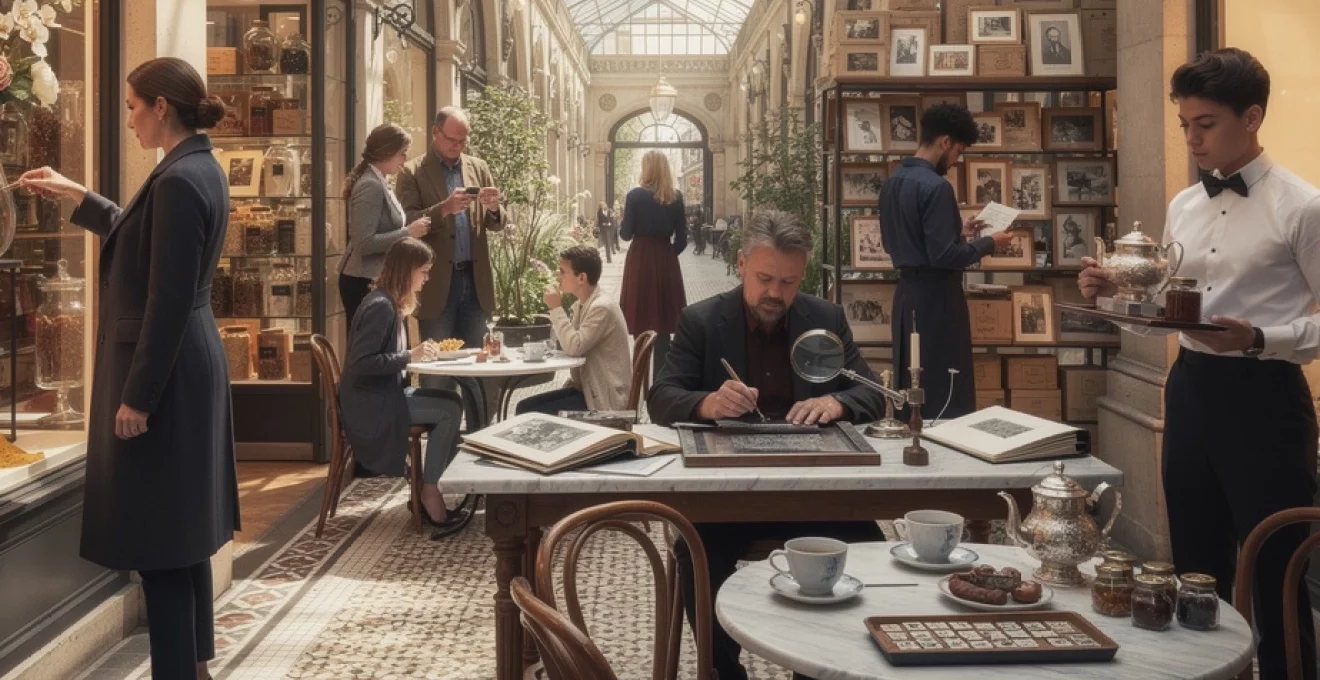
Paris’s covered passages represent some of the most enchanting shopping experiences in the world, offering a unique blend of 19th-century architecture and contemporary commercial vitality. These glass-roofed galleries, originally conceived as elegant shortcuts for well-heeled Parisians seeking shelter from unpredictable weather and muddy streets, have evolved into sophisticated retail destinations that captivate both locals and visitors alike. With their ornate ironwork, marble floors, and atmospheric lighting, these architectural gems house an extraordinary collection of boutiques, ateliers, and specialty shops that you simply cannot find anywhere else in the city.
The covered passages of Paris emerged during the early 1800s as ingenious solutions to urban challenges, transforming into proto-shopping centres that pioneered modern retail concepts. Today, these historic corridors continue to thrive as bastions of artisanal craftsmanship, luxury goods, and cultural heritage, making them essential destinations for discerning shoppers and culture enthusiasts.
Galerie vivienne: art nouveau architecture and luxury boutique shopping experience
Galerie Vivienne stands as perhaps the most celebrated of all Parisian covered passages, a testament to Second Empire elegance that continues to enchant visitors with its spectacular mosaic floors and soaring glass canopy. Built in 1823, this 176-metre gallery showcases the perfect marriage of architectural grandeur and commercial sophistication, featuring intricate neoclassical details that frame each boutique like precious jewels in an ornate setting.
The passage’s distinctive black and white diamond-patterned floor creates a mesmerising visual pathway that draws you deeper into this retail wonderland. Natural light cascades through the arched glass ceiling, illuminating the carefully curated selection of luxury boutiques that have made Galerie Vivienne their home. From haute couture fashion houses to specialist antiquarian booksellers, every shop within these walls contributes to an atmosphere of refined exclusivity.
The interplay of natural light and architectural detail in Galerie Vivienne creates an almost theatrical setting where shopping becomes a cultural experience rather than mere commerce.
Gaultier paris flagship store and jean paul gaultier legacy collections
The Jean Paul Gaultier boutique within Galerie Vivienne represents a pinnacle of fashion retail theatre, where the designer’s revolutionary aesthetic finds perfect expression within the passage’s historic setting. This flagship location showcases limited edition pieces and exclusive collections that reflect Gaultier’s distinctive approach to haute couture, blending punk sensibilities with classical French tailoring techniques.
Visitors to this boutique can explore archival pieces alongside current collections, creating opportunities to acquire truly unique garments that embody decades of fashion innovation. The store’s interior design pays homage to both Gaultier’s avant-garde vision and the passage’s architectural heritage, resulting in a retail environment that feels more like a fashion museum than a traditional shop.
Emilio robba silk flower atelier and artisanal botanical creations
The Emilio Robba atelier represents the epitome of artificial botanical artistry, where skilled craftspeople create silk flowers so realistic they challenge the very notion of artificial versus natural beauty. Each bloom undergoes meticulous hand-finishing processes that can take hours to complete, resulting in decorative pieces that grace luxury hotels, haute couture fashion shows, and discerning private residences worldwide.
The workshop’s techniques remain closely guarded secrets, passed down through generations of artisans who understand the subtle interplay between fabric texture, colour gradation, and natural form. Emilio Robba’s creations transcend mere decoration, becoming sculptural works that capture the essence of botanical perfection in permanent form.
A priori thé salon and rare tea merchant heritage since 1980
A Priori Thé has established itself as one of Paris’s most respected tea merchants, offering an extensive collection of rare and vintage teas sourced from traditional gardens across Asia and beyond. The salon’s expertise extends far beyond simple retail, encompassing tea education, tasting ceremonies, and consultation services for both novice enthusiasts and seasoned connoisseurs.
The establishment’s commitment to authenticity manif
ests in everything from single-origin oolongs to aged pu-erh cakes, with staff guiding you through tasting notes much like a sommelier would for fine wine. Settle into the salon with a pot of Darjeeling or a smoked Lapsang and you quickly realise that this is not simply a café, but a place where time slows and conversation deepens. For shoppers, it is also a refined pause between boutiques, turning Galerie Vivienne into one of the best covered passages in Paris for a combined shopping and gastronomic experience.
Wolff et descourtis fine engravings and historical print authentication
Just a few steps away, Wolff et Descourtis caters to collectors of engravings, maps, and antique prints, adding a scholarly dimension to your stroll through Galerie Vivienne. The gallery specialises in works from the 18th and 19th centuries, carefully catalogued and accompanied by provenance notes when available. Staff are well-versed in techniques such as etching, aquatint, and lithography, and can explain how to distinguish an original impression from a later restrike or reproduction.
If you are considering investing in historical prints, this is an ideal place to learn the basics of authentication: paper quality, plate marks, watermarks, and period hand-colouring all offer clues. Think of it as the equivalent of reading terroir in a glass of Burgundy: subtle details that reveal origin and age. Even if you are not ready to buy, browsing the drawers and portfolios is an education in art history and a reminder that covered passages in Paris have always been spaces where culture and commerce intertwine.
Passage des panoramas: historic commerce corridor and philatelic trading hub
Crossing to the Grands Boulevards, Passage des Panoramas immerses you in one of the oldest and liveliest covered passages in Paris. Opened around 1800, this arcade once dazzled visitors with enormous panoramic paintings; today, it captivates with its dense mix of stamp dealers, coin shops, bistros, and specialist boutiques. The atmosphere is more bohemian than polished, with uneven floors and weathered façades that speak to two centuries of continuous trade.
For collectors, this is still the reference point in Paris for philately and numismatics, with a concentration of dealers rare even by international standards. But you do not need to be a serious collector to enjoy it: browsing boxes of postcards and stamps from around the world can feel like leafing through a tactile history book. The passage also houses several notable workshops and eateries that make it a must on any itinerary of covered passages.
Stern engraving workshop traditional copperplate techniques
The Stern engraving workshop, recognised as a Entreprise du Patrimoine Vivant (Living Heritage Company), is one of the most emblematic artisans in Passage des Panoramas. Founded in the 19th century, the atelier preserves traditional copperplate engraving techniques used for luxury stationery, bookplates, and heraldic crests. Copper plates are hand-engraved using burins and gravers, with each line incised by steady, practised hands—an intensely time-consuming process that few workshops still master.
Watching engravers at work, you appreciate why hand-engraved stationery feels so different from digitally printed invitations. The ink sits in the recessed lines and transfers to paper with a crisp relief, a tactile depth similar to letterpress. Clients range from grandes maisons to private individuals looking for monogrammed cards or wedding suites with true heirloom quality. If you are fascinated by craft, ask about the difference between intaglio engraving and modern laser etching; the contrast is as stark as between hand-tailored garments and mass-produced clothing.
L’arbre à cannelle spice merchant and exotic condiment sourcing
Further along the passage, L’Arbre à Cannelle brings the spice routes into this historic arcade. Shelves are lined with jars of whole spices, custom blends, and rare condiments sourced from small producers in India, North Africa, Southeast Asia, and the Middle East. Rather than focusing on volume, the shop prioritises freshness and traceability—staff can usually tell you the harvest period and origin region of key spices such as cinnamon, cardamom, or Sichuan pepper.
For home cooks and professionals alike, this is an opportunity to upgrade your pantry with ingredients that simply do not compare to supermarket offerings. You can smell before you buy, and ask for advice on pairings—what works best with roasted vegetables, which peppercorns lift a steak, which spice blends transform a simple lentil dish. In many ways, visiting a specialist spice merchant in a covered passage in Paris is like consulting a perfumer: nuance, memory, and personal preference all play a role.
Maison moderne vintage postcards and collectible paper ephemera
Paper ephemera—tickets, posters, postcards, menus—once considered disposable, has become one of the most charming collectible categories in Passage des Panoramas. Maison Moderne specialises in exactly this, with boxes and binders filled with vintage postcards from every corner of France, advertising cards from the Belle Époque, and mid-century graphic design pieces. Prices range from just a few euros for common cards to higher sums for rare or historically significant items.
If you are new to collecting, start by focusing on a theme that resonates with you: perhaps old Paris cafés, train stations, or Art Deco typography. The staff can explain how condition, postmarks, and print runs influence value, much as a bookseller would discuss edition and dust jackets. For travellers, these small, flat pieces make ideal souvenirs—easy to pack, rich in history, and endlessly evocative once framed at home. You may find that browsing here changes how you look at everyday printed objects.
Restaurant noglu gluten-free gastronomy and dietary innovation
Amid the antique shops and stamp dealers, Noglu stands out as a pioneer of gluten-free dining in Paris, with a kitchen that proves “sans gluten” can be synonymous with indulgence. The menu rotates seasonally but often features dishes such as chestnut flour cakes, gluten-free quiches, and carefully sourced meat and fish, all prepared with a bistro sensibility. For travellers with coeliac disease or gluten sensitivity, finding a dedicated gluten-free restaurant in a historic covered passage is a rare luxury.
Reservations are recommended at peak hours, and it is wise to mention any additional dietary requirements when you book. Even if you eat everything, Noglu offers a useful reminder that dietary innovation in Paris goes far beyond salad bowls and smoothie bars. Think of it as part of a broader evolution in the passages couverts, where 19th-century frameworks now host 21st-century culinary experiments.
Galerie colbert: bibliothèque nationale proximity and academic book trade
Directly adjacent to Galerie Vivienne, Galerie Colbert offers a strikingly different atmosphere: more institutional, more contemplative, and deeply rooted in France’s academic life. Rebuilt in the 1980s to house cultural institutions linked to the Bibliothèque nationale de France, the gallery centres on a dramatic rotunda crowned by a glass dome. Rather than commercial boutiques, you will find offices and reading rooms dedicated to art history, archaeology, and heritage studies.
For visitors, the main appeal lies in its architecture and its quiet. You can walk through the gallery (after a light security check), admire the dome, and enjoy the sense of space that contrasts with the denser retail passages nearby. Around the edges of the complex and in the neighbouring streets, specialist academic bookshops cater to students and researchers, offering monographs, exhibition catalogues, and rare out-of-print titles. If you are passionate about art or history, combining a stroll through Galerie Colbert with a visit to these bookshops turns this corner of the 2nd arrondissement into an open-air campus.
Passage jouffroy: antique dealers network and wax museum tourism integration
Heading north towards Boulevard Montmartre, Passage Jouffroy introduces a lighter, more playful face of the covered passages. Built in 1846 using iron and glass, it was one of the first passages to fully exploit new industrial materials, and its gently sloping floor and split-level design create an engaging sense of movement. Today, it forms a bridge between traditional antique dealers, family-run toy shops, and one of Paris’s most popular attractions, the Musée Grévin wax museum.
Antique and curiosity shops here tend to be smaller and more eclectic than the blue-chip dealers around the Louvre, favouring affordable vintage objects, decorative pieces, and books over museum-grade masterpieces. This makes Passage Jouffroy a good hunting ground if you are starting a collection or looking for distinctive home décor. Meanwhile, the Musée Grévin brings a steady stream of visitors, which helps sustain cafés and shops and ensures the passage remains lively well into the evening.
One of the joys of Passage Jouffroy is its toy shop Pain d’Épices, a wonderland of wooden toys, dollhouses, and traditional games that feels straight out of a 19th-century illustration. Even adults find it hard to leave empty-handed. For those interested in hospitality history, the charming Hôtel Chopin, with its reception opening directly onto the passage, offers an atmospheric and relatively budget-friendly place to stay. Where else can you step from your hotel into a glass-roofed arcade before breakfast?
Galerie véro-dodat: luxury leather goods and artisanal craftsmanship heritage
Back on the Right Bank near the Palais Royal, Galerie Véro-Dodat encapsulates the intimate scale and refined aesthetics that make covered passages in Paris so alluring. Its polished black-and-white marble floor, globe lamps, and painted ceilings create a jewel-box environment that suits the high-end artisans and boutiques that occupy its units. Unlike larger shopping streets, this is a place where you can hear your own footsteps and admire each shopfront in detail.
Historically, the passage linked the Palais Royal district to Les Halles, serving travellers arriving by coach. Today, it links luxury fashion and contemporary craft, from world-famous shoe designers to specialist instrument makers and fine art galleries. For shoppers interested in leather goods, footwear, and vintage fashion, Galerie Véro-Dodat offers both inspiration and insight into the craftsmanship behind iconic French luxury.
Christian louboutin shoe atelier and red sole manufacturing process
Christian Louboutin’s boutique in Galerie Véro-Dodat is more than a flagship store; it is a showcase for a modern legend of French design. While the actual manufacturing occurs in specialised workshops in Italy and elsewhere in Europe, the passage serves as a theatrical backdrop for the brand’s signature red-soled shoes. Displays highlight the sculptural quality of the heels and the richness of leathers and fabrics, underlining the artisanal labour behind each pair.
The now-iconic red sole was reportedly inspired by the application of red nail polish to a prototype, a spontaneous gesture that became a global visual signature. Production involves multiple stages: pattern design, last making, cutting, stitching, lasting, and finishing, with strict quality controls at each step. Visiting the boutique allows you to examine details such as hand-placed embellishments, precise stitching, and the lacquered finish of the soles. Even if you do not buy, it is a vivid lesson in how branding, design, and craft intertwine to create desire.
Maroquinerie traditional leather working techniques and tool selection
Beyond the big names, Galerie Véro-Dodat and neighbouring streets host smaller leather goods workshops (maroquinerie) where artisans still cut, stitch, and burnish hides by hand. Traditional leather working relies on a compact but precise toolkit: awls for piercing, pricking irons for evenly spaced stitching holes, edge bevelers, bone folders for shaping, and burnishers—often simple pieces of hardwood—for polishing edges. Each tool leaves a characteristic mark that sets hand-made pieces apart from factory output.
If you are considering commissioning a bespoke bag, belt, or small accessory in Paris, ask the artisan about their choice of leather (full-grain vs. corrected-grain), tanning method (vegetable vs. chrome), and thread (linen vs. synthetic). These decisions affect durability and patina over time, much as grape variety and oak ageing affect a wine. Many workshops also offer minor repairs, re-dyeing, or handle replacement, giving a second life to well-loved items. For shoppers who value sustainability, investing in repairable, hand-crafted leather goods is a logical extension of slow fashion principles.
Vintage fashion curation and authentication methods for collectors
Several dealers in and around Galerie Véro-Dodat specialise in vintage and pre-owned designer fashion, catering to collectors who seek out past-season runway pieces and archival garments. Unlike simple second-hand shops, these curated boutiques focus on condition, rarity, and historical interest. Garments are inspected for fabric integrity, original labels, intact seams, and period-appropriate hardware such as zips and buttons. When possible, sellers research lookbooks, runway images, and brand archives to contextualise each piece.
As a buyer, you can apply a few basic authentication methods: compare labels and tags to known originals from the same era, examine lining and finishing (high-end pieces often have hand-finished details), and be wary of items whose branding feels inconsistent with their supposed age. Many dealers are happy to explain why they deem an item authentic and how they arrived at their pricing, which can be an education in itself. Building a relationship with a trusted vintage curator in Paris can pay off over time with early access to exceptional finds.
Shopping navigation strategies for covered passage networks in central paris
With so many arcades clustered in the 1st, 2nd, and 9th arrondissements, how do you make the most of your time without feeling rushed? One of the most effective strategies is to plan your route as a loose chain rather than a rigid checklist. For example, you might start at Galerie Véro-Dodat, move through the Palais Royal, continue to Galerie Vivienne and Galerie Colbert, then head up to Passage des Panoramas, Jouffroy, and Verdeau along the Grands Boulevards. This creates a natural walking loop that minimises backtracking.
Keep in mind that opening hours vary: many galleries close on Sundays and public holidays, and individual boutiques may shut for lunch or for part of August. It is wise to focus on two or three covered passages per half-day, leaving room for spontaneous detours—an inviting café terrace, a side street with a promising bookshop, or an unexpected courtyard. Think of the passages as the spine of your itinerary, with neighbourhood explorations as the ribs.
Practical considerations can make your experience much smoother. Wear comfortable shoes; marble and tile floors can be slippery when wet, and you may find yourself covering more distance than expected. If you plan to buy fragile items—prints, ceramics, or glassware—bring a small, padded tote or ask shops whether they can pack for travel. For those relying on public transport, note key métro stops along your route: Palais Royal–Musée du Louvre and Bourse for Galerie Vivienne and Véro-Dodat, Quatre-Septembre or Richelieu–Drouot for Passage des Panoramas and Jouffroy, and Grands Boulevards for the Grands Boulevards cluster.
Finally, remember that the greatest pleasure of exploring covered passages in Paris often lies in slowing down. Rather than racing to “see them all,” allow yourself to linger in a tea salon, chat with a gallery owner, or leaf through boxes of old postcards. These micro-interactions transform the passages from pretty backdrops into living, breathing parts of the city—places where history, craftsmanship, and contemporary life meet under glass.