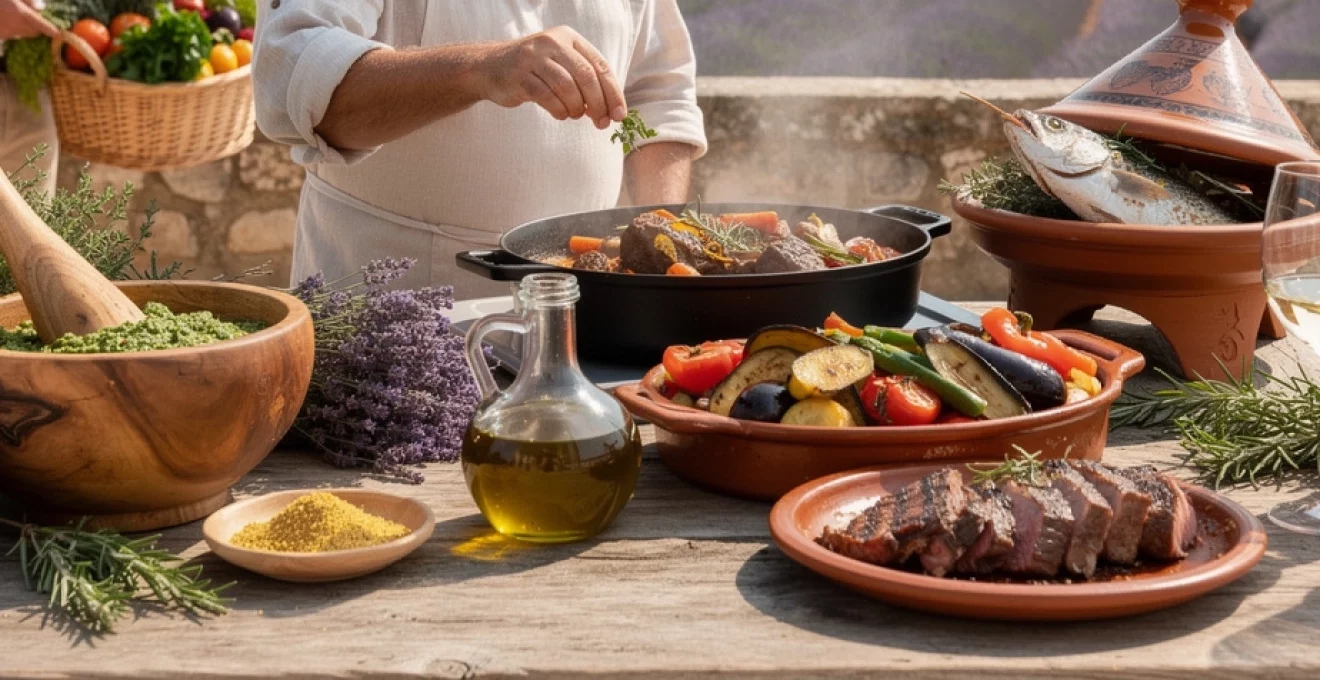
The sun-drenched landscapes of Provence have nurtured one of France’s most distinctive culinary traditions for centuries. This Mediterranean region, stretching from the Italian border to the Rhône delta, offers a gastronomic heritage that celebrates the marriage of fresh ingredients, ancient techniques, and an unwavering respect for seasonal produce. From the lavender fields of the Luberon to the bustling fish markets of Marseille, Provençal cuisine represents more than mere sustenance—it embodies a philosophy of living that prioritises quality, authenticity, and the simple pleasure of sharing exceptional food.
What sets Provençal cooking apart from other French regional cuisines is its profound connection to the Mediterranean climate and the abundance of wild herbs that carpet the hillsides. The cuisine has evolved through centuries of cultural exchange, influenced by Roman settlers, Italian merchants, and North African spice traders, creating a unique culinary language that speaks fluent flavour. Today’s Provençal kitchens continue to honour these time-tested traditions whilst adapting to modern palates and contemporary dining expectations.
Essential aromatics: herbes de provence and mediterranean seasonings
The aromatic foundation of Provençal cuisine rests upon the wild herbs that flourish in the region’s limestone soils and Mediterranean microclimate. These herbs, collectively known as herbes de Provence, form the backbone of countless traditional recipes and represent the essence of the region’s gastronomic identity. Understanding how to properly harvest, prepare, and utilise these aromatics is fundamental to mastering authentic Provençal cookery.
The traditional blend varies considerably depending on the specific terroir and family traditions, but typically includes thyme, rosemary, oregano, marjoram, and sometimes lavender. Each herb contributes distinct flavour compounds that, when combined, create the complex aromatic profile that defines Provençal cuisine. Professional chefs recommend sourcing these herbs from specific microclimates within Provence, as soil composition and elevation significantly impact their essential oil content and flavour intensity.
Wild thyme (thymus serpyllum) harvesting techniques from luberon hillsides
Wild thyme harvesting in the Luberon requires precise timing and traditional knowledge passed down through generations of local foragers. The optimal collection period occurs during late spring when the plant’s essential oil concentration peaks, typically between May and early June. Professional harvesters recommend early morning collection, when dew has evaporated but before the Mediterranean sun intensifies the plant’s volatile compounds.
The harvesting technique involves cutting stems at approximately one-third of their length, ensuring the plant’s regenerative capacity remains intact. This sustainable approach allows the same thyme patches to produce quality aromatics year after year. Once collected, the thyme undergoes a careful drying process in well-ventilated, shaded areas where air circulation prevents mould whilst preserving the herb’s potent flavour compounds.
Lavender culinary applications: lavandula angustifolia in savoury preparations
Culinary lavender application extends far beyond the popular honey and dessert preparations that many associate with Provence. Lavandula angustifolia, the true lavender variety preferred for cooking, offers subtle floral notes that enhance meat marinades, vegetable gratins, and even certain fish preparations. The key to successful lavender integration lies in understanding its potency—a little goes a remarkably long way in transforming a dish from ordinary to extraordinary.
Professional chefs recommend using lavender flowers sparingly, typically no more than half a teaspoon per serving, as excessive quantities can overwhelm other flavours with an overly perfumed character. The flowers work particularly well in slow-braised lamb dishes, where extended cooking time allows the lavender’s volatile compounds to mellow and integrate harmoniously with garlic, rosemary, and wine-based sauces.
Rosemary-infused olive oil production methods from nyons varietals
Creating authentic rosemary-infused olive oil requires premium Nyons olive varieties and fresh rosemary harvested at peak potency. The traditional method involves gently heating extra virgin olive oil to approximately 60°C, then introducing fresh rosemary spr
ing stems. The warmed oil helps release fat-soluble aromatic compounds without cooking the rosemary, preserving both freshness and complexity. After several hours of maceration, the mixture is cooled, then transferred to sterilised glass bottles with a fresh sprig of rosemary added for visual appeal and a gentle, ongoing infusion.
For home cooks seeking to replicate this Provençal technique, controlling temperature is critical: overheating the Nyons olive oil will flatten its fruity notes and can introduce bitterness. Many artisanal producers in the Drôme and northern Vaucluse now favour a cold-infusion alternative, leaving rosemary to steep in oil for two to three weeks in a cool, dark place. Whichever method you choose, using small batches and tasting regularly ensures the final rosemary-infused olive oil enhances grilled fish, focaccia-style breads, and roasted vegetables without overpowering them.
Fennel pollen collection and preservation in vaucluse markets
Fennel pollen, often called the “spice of angels”, has become a sought-after seasoning in contemporary Provençal cuisine, prized for its concentrated anise and citrus notes. In Vaucluse, particularly around the Mont Ventoux foothills, wild fennel thrives along stone walls and vineyard edges. Local foragers harvest the umbels at full bloom in late summer, gently shaking them over muslin cloths or shallow baskets to collect the delicate yellow pollen.
Because fennel pollen is extremely volatile, careful preservation is essential to maintain its aromatic intensity. Traditional practice dictates drying it in a single, thin layer in shaded, well-ventilated rooms before transferring it to small, airtight glass jars. You will often find these jars at weekly markets in Carpentras or L’Isle‑sur‑la‑Sorgue, sold in tiny quantities due to the labour involved. A pinch added just before serving can elevate grilled sea bass, roasted carrots, or a simple salad of oranges and olives, much like a final brushstroke completes a painting.
Traditional provençal cooking techniques and equipment
Beyond ingredients, authentic Provençal cuisine is defined by the tools and techniques that have shaped it over centuries. The region’s cooks have always worked with what the land provided: clay from local quarries, iron from nearby forges, and olive wood from pruned groves. These traditional vessels are not mere rustic props; each one controls heat and moisture in a specific way, helping to coax maximum flavour from humble ingredients. Understanding how to use them allows you to recreate the textures and aromas of a Provençal kitchen wherever you live.
Terracotta tagine applications in marseille fish cookery
While the tagine is more commonly associated with North African cuisine, terracotta tagines have found a natural place in Marseille fish cookery thanks to centuries of maritime exchange. Their conical lids circulate steam and condensed vapours back into the dish, making them ideal for gently poaching firm white fish with tomatoes, olives, and aromatic herbs. In many home kitchens around the Vieux‑Port, a tagine now sits alongside traditional copper fish pans, used for weekday versions of poisson à la provençale that require minimal supervision.
To adapt Provençal recipes to a terracotta tagine, chefs recommend reducing added liquid by around one third, as condensation continuously returns to the base. Fish fillets are layered over a bed of onions, fennel, and peppers, then drizzled with olive oil, white wine, and a squeeze of lemon. The low, even heat and closed environment prevent the fish from drying out, much like a mini steam oven, while the porous clay helps regulate temperature. For home cooks without access to ultra-fresh rock fish for bouillabaisse, this method offers a practical, flavourful alternative that still honours Marseille’s maritime heritage.
Cast iron rondeau usage for daube de bœuf preparation
The cast iron rondeau—a wide, shallow, lidded pot—remains the workhorse of traditional daube de bœuf à la provençale. Its heavy base ensures consistent browning of meat and vegetables, while its volume comfortably accommodates long, slow braises. In contrast to narrow Dutch ovens, the rondeau’s larger surface encourages gentle reduction, concentrating flavours without risk of scorching. Many Provençal families still pass down their rondeaux, seasoned by decades of red wine, olives, and beef simmering gently over low flames.
For an authentic daube, butchers typically recommend collagen-rich cuts such as beef chuck, shoulder, or even beef cheek, which transform into melting tenderness after several hours at low temperature. The classic technique involves marinating the meat overnight in red wine with carrots, onions, garlic, and orange zest, then searing it in the rondeau before returning the marinade to the pot. Maintaining a barely perceptible simmer, rather than a rolling boil, helps preserve the delicate aromatics of thyme, bay, and sometimes a hint of cinnamon. The result is a stew that embodies the Provençal philosophy: simple ingredients, patiently transformed into deep, layered flavour.
Olive wood mortar and pestle for authentic pistou creation
The olive wood mortar and pestle is more than a decorative utensil; it is central to the traditional preparation of pistou, Provence’s answer to pesto. Unlike food processors, which tend to bruise basil and oxidise it quickly, the slow grinding action of a wooden pestle releases essential oils while keeping the mixture cool and vibrant. In Provençal households, making pistou is almost ceremonial, often done just before serving soupe au pistou so the raw garlic and basil retain their characteristic freshness.
To create an authentic pistou, garlic and coarse sea salt are first crushed to a smooth paste, forming a kind of abrasive base. Fresh basil leaves are then added in small handfuls, worked patiently around the mortar walls until they break down into a vivid green slurry. Only at this stage is extra virgin olive oil incorporated in a thin stream, followed optionally by grated hard cheese such as aged goat’s cheese or Parmesan. The tactile control afforded by the mortar and pestle lets you decide the final texture—silky and loose for drizzling over vegetable soup, or slightly thicker for spreading on grilled bread.
Clay cazuela vessels for slow-braised vegetable medleys
Clay cazuela dishes, shallow and wide with slightly flared sides, are widely used across the Mediterranean and have been embraced in Provence for slow-braised vegetable dishes. Their unglazed interiors absorb a thin film of oil over time, creating a naturally seasoned surface that encourages gentle caramelisation. When used for preparations like tian de légumes or oven-braised fennel with olives and orange, cazuelas offer a distinct advantage: they heat evenly yet retain enough moisture to keep vegetables tender inside and lightly crisp on top.
Home cooks who are accustomed to metal roasting pans are often surprised by the subtle flavour difference that clay introduces. Much as a seasoned cast iron pan adds depth to seared meats, a well-used cazuela imparts a faint earthy note that complements tomatoes, aubergines, and courgettes. To avoid thermal shock, producers recommend soaking new cazuelas in water for several hours and always placing them in a cold oven before bringing them up to temperature. Once seasoned, these vessels become indispensable for building richly flavoured vegetable medleys with minimal added fat, perfectly aligned with the healthful Mediterranean diet.
Signature dishes from alpes-maritimes to bouches-du-rhône
From the steep terraces of the Alpes‑Maritimes to the sun-baked shores of the Bouches‑du‑Rhône, each corner of Provence boasts emblematic dishes shaped by landscape and history. Along the Côte d’Azur, light, vegetable-forward recipes dominate, influenced by nearby Liguria and the abundance of seaside produce. Further west, around Arles and Marseille, heartier preparations emerge, blending inland ingredients with the daily catch from the Mediterranean. Exploring these signature dishes is like tracing a culinary map of Provence, each recipe telling you exactly where you are.
In Nice and its hinterland, classics such as socca (a chickpea flour pancake baked in wood‑fired ovens), salade niçoise, and pan bagnat showcase pantry staples—tuna, olives, anchovies, and sun-ripened vegetables—transformed into portable meals for fishermen and market workers. Travel west to Marseille and Cassis, and bouillabaisse takes centre stage: once a humble fishermen’s stew of unsold rock fish, it has evolved into an iconic dish with carefully codified service and species lists. Inland, in the Alpilles and around Avignon, dishes such as gardianne de taureau (bull stew from the Camargue), lamb roasted with thyme and garlic, and aïoli garni reflect both pastoral traditions and monastic influences.
What unites these regional specialities is not a rigid set of recipes but a shared logic: seasonal vegetables, olive oil instead of butter, and generous aromatic herbs. Rather than chasing complex plating, Provençal cooks focus on depth of flavour and conviviality, serving dishes in generous platters meant to be shared. As a home cook, you can capture this spirit by choosing one or two regional classics—perhaps pissaladière from Nice and daube de bœuf from the Vaucluse—and building a menu around them, pairing local wines and simple desserts like fresh goat’s cheese with honey.
Artisanal ingredients sourcing: markets and producers
Authentic Provençal cuisine begins long before you light the stove; it starts at the market stall, the olive mill, and the small family-run fromagerie. Weekly markets in towns such as Aix‑en‑Provence, Uzès, and Saint‑Rémy‑de‑Provence are not just places to buy food—they are living institutions where relationships between producers and cooks are forged. Statistics from the French Ministry of Agriculture show that Provence‑Alpes‑Côte d’Azur remains one of the top regions for organic farming in France, with more than 30% of vineyards and a growing share of vegetable farms certified organic, offering you an exceptional base for healthy Mediterranean cooking.
When sourcing ingredients, it pays to think like a Provençal chef: prioritise freshness, provenance, and seasonality over strict shopping lists. Rather than deciding in advance to cook ratatouille and forcing supermarket vegetables to comply, you might visit a farmers’ market and let the best-looking aubergines, courgettes, and tomatoes dictate your menu. Ask vendors about harvest dates, varieties, and recommended uses—many will happily share cooking tips passed down through their families. This dialogue does more than secure higher quality produce; it connects you to the same social fabric that sustains Provençal village life.
Outside France, recreating this network of small producers can seem daunting, but it is increasingly feasible. Many American and British cities now host weekly farmers’ markets where you can find unfiltered olive oil, heritage tomatoes, and artisanal breads that echo Provençal quality. Speciality shops and online retailers offer herbes de Provence, Camargue sea salt, and sometimes even Nyons olives, allowing you to stock a Provençal pantry wherever you live. The key is to focus on a few high-impact ingredients—excellent olive oil, ripe seasonal vegetables, and good bread—because, as Provençal cooks know, these are the building blocks of most meals.
Wine pairing principles with côtes de provence and châteauneuf-du-pape
Wine is an inseparable companion to Provençal cuisine, acting as both an ingredient and an accompaniment. The region’s vineyards, from the sunlit slopes of Côtes de Provence to the stony terraces of Châteauneuf‑du‑Pape, produce wines that mirror the food: aromatic, expressive, and designed for the table. Rather than rigid rules, Provençal wine pairing is guided by balance—matching the weight and intensity of a dish with that of the wine, and seeking complementary herbal and fruity notes. Think of it as a conversation between plate and glass, where neither should dominate.
Grenache-based rosé selections for bouillabaisse enhancement
Rosé may be synonymous with leisurely Provençal lunches, but Grenache‑based rosés in particular offer surprising versatility at the table. Modern Côtes de Provence rosés tend to be pale in colour yet structured, with bright acidity, red berry notes, and often a faint hint of herbs that echo the surrounding garrigue. For a dish as complex as bouillabaisse—with its saffron-scented broth, garlicky rouille, and rich rock fish—these rosés provide enough backbone to stand up to intensity without overshadowing delicate marine flavours.
When choosing a rosé for bouillabaisse, look for cuvées that blend Grenache with Cinsault or Syrah, offering both freshness and subtle tannic grip. Wines from cooler, higher‑altitude vineyards around La Londe or the Sainte‑Victoire appellation often bring an extra lift of acidity that cleanses the palate between spoonfuls of broth. If you cannot find a Provençal bottle, seek a dry, Grenache‑driven rosé from another Mediterranean region; avoid sweet or overly aromatic styles, which can clash with garlic and saffron. Served well-chilled but not icy, such a wine turns bouillabaisse from a single dish into a multi-sensory experience.
Syrah and mourvèdre combinations with grilled lamb preparations
For grilled or roasted lamb seasoned with thyme, rosemary, and garlic, red blends dominated by Syrah and Mourvèdre are a natural choice. These grapes, prominent in many Côtes de Provence and neighbouring appellations, deliver dark fruit, pepper, and savoury herbal notes that mirror the lamb’s marinade. Mourvèdre, in particular, thrives near the Mediterranean, contributing structure and a gamey complexity that pairs beautifully with charred, smoke-kissed meat.
Châteauneuf‑du‑Pape reds, often blends of Grenache with Syrah and Mourvèdre, offer a more powerful option for slow-roasted shoulders or gigot d’agneau. Their higher alcohol and concentration call for richer preparations—think lamb cooked with black olives and tomatoes or finished with anchovy and garlic. As a general principle, the more robust the cooking method and seasoning, the more structured the wine can be. If you are grilling lamb cutlets simply over charcoal with a sprig of rosemary, a lighter Côtes du Rhône or a fruit-forward Côtes de Provence rouge will usually suffice, ensuring harmony rather than competition on the palate.
Vermentino and rolle varietals complementing seafood terrines
White wines based on Vermentino, known locally as Rolle, have gained prominence across Côtes de Provence for their citrus, stone fruit, and subtle saline notes. These qualities make them ideal companions for seafood terrines, shellfish platters, and lightly cooked fish dishes that favour freshness over richness. With their crisp acidity and moderate alcohol, Rolle-based wines act almost like a squeeze of lemon—brightening flavours, cutting through gentle fattiness, and leaving the palate refreshed.
When pairing Rolle with Provençal seafood, consider the dish’s texture and seasoning. A delicate terrine of sea bream with herbs and fennel calls for a lean, mineral-driven wine, perhaps from cooler inland sites where nights are fresher. By contrast, a richer preparation featuring salmon or monkfish with olive oil mayonnaise might benefit from a slightly fuller-bodied bottling, sometimes aged briefly on lees to add creaminess. Outside Provence, you can look for Vermentino from Sardinia or Liguria as a close stylistic cousin. In every case, the goal remains the same: to let both wine and dish express the same coastal character that defines Provençal cuisine.