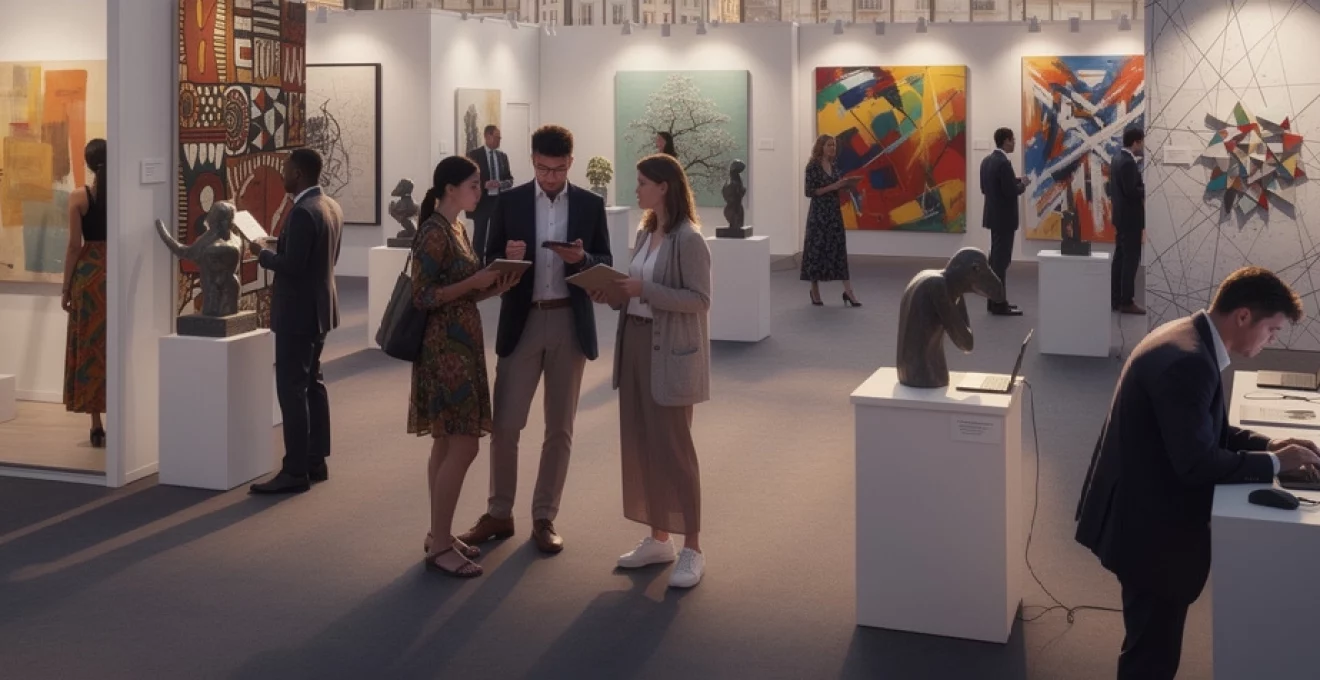
Paris stands as one of the world’s most influential art markets, where emerging international artists find their first significant platform for global recognition. The city’s prestigious art fairs serve as vital launching pads for creative talents from across the globe, offering unprecedented opportunities for career advancement and international exposure. These carefully curated events bring together galleries, collectors, and industry professionals who actively seek fresh perspectives and innovative artistic voices that define contemporary culture.
The transformation of Paris’s art fair landscape over recent years reflects a broader shift towards inclusivity and cultural diversity. Alternative fair models have emerged alongside established institutions, creating multiple pathways for artists to enter the international market. This evolution mirrors historical movements like the Salon des Refusés, where artists challenged traditional gatekeepers and established new paradigms for artistic recognition.
Premier parisian art fair venues and their curatorial strategies
The architectural grandeur of Paris provides exceptional venues that enhance the presentation of contemporary art while creating memorable experiences for visitors and participants alike. Each location contributes to the unique character and positioning of different art fairs within the city’s cultural ecosystem.
Art basel paris at grand palais éphémère: international gallery selection criteria
Art Basel Paris has rapidly established itself as a cornerstone event in the international art calendar, attracting 206 galleries from around the world in its latest edition. The selection process emphasises a careful balance between established galleries with proven track records and emerging spaces that bring fresh perspectives to the market. Gallery applications undergo rigorous evaluation based on their artist rosters, exhibition history, and commitment to supporting emerging talent from diverse cultural backgrounds.
The fair’s three distinct sectors create opportunities for galleries at different stages of development. The main section showcases established international galleries, while emerging galleries receive dedicated space designed to maximise visibility and reduce financial barriers. This strategic approach ensures that collectors encounter both market favourites and undiscovered talents within the same prestigious environment.
FIAC legacy and transformation into contemporary art exhibition models
The transformation from FIAC to newer exhibition models reflects changing dynamics within the international art market. This evolution has created space for more experimental approaches to fair organisation, emphasising collaborative models that prioritise artistic excellence over purely commercial considerations. The shift has particularly benefited international artists who may not have fitted traditional fair formats but possess exceptional creative vision.
Contemporary exhibition models now incorporate digital elements, extended programming, and community engagement initiatives that extend far beyond traditional booth presentations. These innovations create multiple touchpoints for emerging artists to connect with collectors, curators, and fellow artists from around the world.
Salon des indépendants: historical foundation for emerging artist discovery
The historical precedent set by the Salon des Indépendants continues to influence contemporary art fair practices in Paris. This founding principle of providing exhibition opportunities without jury selection has evolved into modern approaches that prioritise accessibility and diversity over established hierarchies. Current fair organisers draw inspiration from this democratic tradition while adapting selection criteria to meet contemporary market demands.
Modern iterations of this philosophy manifest in initiatives like free-entry fairs, collaborative presentation models, and reduced financial barriers for emerging galleries. These approaches create pathways for international artists who might otherwise struggle to access prestigious Parisian exhibition opportunities.
Drawing now art fair: specialised medium focus and market positioning
Specialised fairs focusing on specific mediums provide unique opportunities for artists working in particular disciplines to achieve concentrated visibility among targeted collector groups. Drawing Now Art Fair exemplifies how medium-specific events can create intense market focus that benefits emerging practitioners who excel in traditional or experimental drawing practices.
This specialisation allows for deeper curatorial exploration of contemporary drawing practices from international perspectives, showcasing how artists from different cultural backgrounds interpret and innovate within established mediums. The focused approach often leads to more meaningful collector engagement and sustained career development for participating artists.
Gallery scouting networks and artist discovery mechanisms
The sophisticated networks that connect galleries, curators, and emerging artists operate through multiple channels that extend far beyond traditional exhibition spaces. These systems create opportunities for international artists to gain representation and exhibition opportunities within the competitive Parisian art scene.
International gallery partnership programmes with emerging market focus
These partnership programmes frequently prioritise emerging markets in Africa, Asia, Latin America, and Eastern Europe, where vibrant scenes may be underrepresented in mainstream European fairs. Paris-based galleries collaborate with local spaces through exchange exhibitions, co-curated booths at major fairs, and shared artist development strategies. For emerging international artists, such alliances can mean simultaneous exposure in Paris and their home region, accelerating recognition across multiple markets.
In practice, these networks function like a relay system: a young artist might first be shown in a regional gallery, then introduced to a Parisian partner for inclusion in an art fair booth. Over time, consistent collaboration builds trust between galleries, enabling them to take greater risks on experimental practices that might not yet have a proven market track record. For collectors, this translates into access to carefully vetted, early-career artists who are already supported by a transnational ecosystem.
Artist residency connections: cité internationale des arts and fair participation
Residency programmes play a crucial role in connecting emerging international artists to Paris art fairs. The Cité Internationale des Arts, one of the largest artist residency hubs in Europe, hosts more than 300 artists at any given time, drawn from over 50 countries. Many of these residents are scouted by curators and gallerists who visit studios with a view to integrating standout practices into their Paris art fair presentations.
For artists, residency periods often function as testing grounds where they can experiment with new mediums or site-responsive projects before presenting them in the high-stakes environment of an art fair. Galleries may time a resident’s solo show or project room presentation to coincide with a major fair, leveraging the heightened international attention in the city. This overlap allows visiting collectors and curators to see both fair booths and in-depth exhibitions, creating a richer context for understanding an artist’s work.
Connections between residencies and fairs also encourage curatorial risk-taking. Because residencies emphasise research and process, they frequently surface practices that challenge market-ready formats. When galleries bring these residency-developed projects into art fairs, they widen the definition of what can be sold, collected, or commissioned, particularly in areas like performance, moving image, and socially engaged art.
Digital portfolio submission systems and jury selection processes
Alongside physical networks, digital portfolio submission systems have become a key mechanism for identifying emerging artists suitable for Paris art fairs. Many galleries and curated fair sections now invite online submissions, using structured application forms that request artist statements, high-resolution images, and links to video documentation. These tools expand the scouting radius beyond personal networks, enabling artists from regions with limited infrastructure to be considered on equal footing.
Selection juries, which may include curators, art critics, and established artists, evaluate these digital portfolios according to criteria such as conceptual rigour, technical execution, and relevance to the fair’s curatorial theme. In some cases, blind review processes help minimise bias linked to geography, training, or institutional pedigree. While competition is intense, artists who invest in clear documentation, concise texts, and coherent series have a distinct advantage in this environment.
From the perspective of an emerging artist, understanding how these juries operate can be transformative. Treat your portfolio as a curated exhibition: group works that tell a coherent story, ensure professional-quality photography, and articulate how your practice contributes to global conversations in contemporary art. In many ways, the digital portfolio has become your first “mini art fair booth” in front of a selection committee.
Cross-cultural curatorial exchange programmes
Cross-cultural curatorial exchanges are another powerful engine behind emerging artist discovery in Paris. Institutions and fairs host visiting curators from regions such as West Africa, South Asia, and Central America, inviting them to co-develop sections or thematic projects. These guest curators bring deep contextual knowledge of local scenes and introduce artists who might otherwise remain invisible to European audiences.
Such programmes often work in both directions. Paris-based curators travel to biennials, regional fairs, and artist-run spaces abroad, then translate their research into focused presentations in Paris art fairs and galleries. The result is a layered approach to international artist representation that goes beyond tokenism, favouring sustained engagement and reciprocal visibility. Over time, this cross-pollination reshapes collecting habits, with more diversified acquisitions reflecting a truly global contemporary art landscape.
For artists, engaging with these exchange programmes can open doors that one-off fair appearances cannot. Participating in curator-led workshops, open studios, or public programmes associated with exchange initiatives increases the likelihood of being shortlisted for future thematic booths, institutional shows, or commissioned projects tied to major Paris art events.
Market valuation dynamics for emerging international artists
The market valuation of emerging international artists in Paris is shaped by a complex interplay of curatorial endorsement, gallery positioning, and collector appetite. At art fairs, initial price points typically reflect a combination of factors: the artist’s exhibition history, institutional recognition, critical reception, and the economic context of their home country. Because Paris sits at the intersection of European and global art markets, it often becomes the stage where early valuations crystallise into more stable benchmarks.
Curated sections dedicated to discovery—such as “Promises” at Art Paris or emerging gallery sectors in Art Basel Paris—play a pivotal role in anchoring these valuations. When a young artist is featured in a tightly curated thematic project, collectors perceive their work as part of a broader historical or conceptual narrative, which can justify higher price brackets. A well-placed solo booth or concentrated wall display often triggers a rapid shift from four-figure to low five-figure prices within just a few fair cycles.
However, sustainable valuation requires more than a successful debut. Savvy galleries in Paris favour gradual price increases aligned with meaningful milestones such as museum acquisitions, strong critical reviews, or participation in major biennials. This measured approach protects both artists and collectors by avoiding speculative bubbles that can damage long-term careers. If you are an emerging artist, working with a gallery that prioritises stability over quick gains is often the wisest path to building a resilient market presence.
Secondary market activity also feeds back into valuation dynamics. While most emerging artists in Paris art fairs are traded exclusively on the primary market, early resales—often at charity auctions or benefit sales—can provide indicative signals of demand. When resale prices align with or exceed primary prices, confidence increases among collectors and advisors. Conversely, steep discounts in secondary contexts may prompt galleries to reassess pricing strategies, edition sizes, or production methods to preserve value.
Cultural bridge-building through francophone and non-western art representation
One of the most impactful aspects of art fairs in Paris is their role as cultural bridges between Francophone contexts and a wide spectrum of non-Western art scenes. The city’s colonial history, multilingual communities, and large diaspora populations ensure that questions of cultural representation are never far from the surface. In response, many fairs and galleries have made a conscious effort to foreground artists whose practices speak to migration, identity, and decolonial narratives.
When a fair highlights voices from the African continent, Asia, Latin America, or Eastern Europe, it is not simply adding geographic diversity. It is reshaping the visual vocabulary of the Paris art market and challenging entrenched hierarchies about where “serious” contemporary art is produced. Through focused sections, curated exhibitions, and dedicated talks programmes, these events create spaces where artists can articulate their own histories and frameworks rather than being interpreted solely through Western lenses.
For visitors, this bridge-building often takes the form of guided tours, bilingual catalogues, and conversations with artists and curators that unpack cultural references embedded in the work. As you move through different booths or curated sections, you are effectively crossing borders—linguistic, political, and aesthetic—without leaving the city. Over time, these encounters help to normalise a plural, multi-centred understanding of contemporary art.
African contemporary art spotlight: galerie magnin-a and 1-54 paris connections
Paris has become a key node for African contemporary art, with galleries like Galerie Magnin-A championing artists from across the continent and its diaspora. Known for long-term relationships with artists rather than short-lived trends, Magnin-A has helped introduce figures from West, Central, and Southern Africa to European institutions and collections. Their participation in major Paris fairs reinforces this visibility, positioning African contemporary art as central rather than peripheral to the city’s cultural discourse.
The arrival of 1-54 Contemporary African Art Fair in Paris further strengthened these connections. While originally founded in London, its Paris editions have fostered dialogue between African, European, and global galleries, often hosted in partnership with leading auction houses or museums. At these events, emerging artists benefit from focused attention on African perspectives, yet they also gain access to the wider Paris ecosystem through parallel programming and gallery collaborations.
For collectors interested in discovering emerging African artists in Paris, paying attention to the intersection between Galerie Magnin-A’s programme, 1-54 presentations, and broader fair circuits can be particularly fruitful. You are likely to encounter artists whose careers are carefully stewarded through solo shows, institutional exhibitions, and cross-continental fair appearances—an ecosystem that supports both artistic development and market growth.
Asian art market integration: perrotin gallery’s emerging artist pipeline
The integration of Asian contemporary art into the Paris scene owes much to galleries that operate across continents. Perrotin, with spaces in Paris, Seoul, Tokyo, Hong Kong, and Shanghai, exemplifies how a global gallery can nurture an emerging artist pipeline that flows in both directions. Younger artists from East and Southeast Asia might first gain recognition in their regional hubs before being introduced to Paris through carefully staged exhibitions and fair presentations.
Within major Paris art fairs, Perrotin and similar galleries often juxtapose emerging Asian artists with more established names from Europe or North America. This curatorial strategy invites comparative readings while subtly recalibrating hierarchies of influence. Over time, collectors who originally visited a booth to see a blue-chip artist may find themselves drawn to new voices experimenting with digital media, post-internet aesthetics, or hybrid traditional techniques.
For artists in Asia seeking fair exposure in Paris, building relationships with galleries that already maintain transnational infrastructures can be a strategic move. These galleries understand the logistics of shipping, customs, and time zones, but more importantly, they know how to frame culturally specific practices for diverse audiences without flattening nuance. In an age where cultural translation is as crucial as artistic quality, this kind of support can be decisive.
Latin american artist representation through specialised gallery networks
Latin American artists have a visible and growing presence at Paris art fairs, often mediated through specialised gallery networks based in cities such as Mexico City, São Paulo, Bogotá, and Buenos Aires. These galleries bring a deep understanding of local histories—dictatorships, social movements, indigenous traditions—and present artists whose works weave political urgency with experimental form. When they participate in Paris fairs, they extend these narratives into a European context, engaging viewers who may be unfamiliar with the underlying histories.
Some Paris-based galleries have also developed sustained relationships with Latin American scenes, frequently travelling to regional fairs and biennials to scout talent. This fieldwork translates into co-representations, shared solo shows, and collaborative booths where artists benefit from both local advocacy and international leverage. For example, a young painter from Bogotá might have a first European presentation in a group show in Paris, followed by an appearance in a curated section at a major fair the following year.
If you are a collector interested in Latin American contemporary art, fairs in Paris can function as efficient discovery platforms. Look for booths where curatorial statements address specific social or historical issues, and do not hesitate to ask galleries about the artist’s exhibition history in their home region. Often, works that appear “new” to European eyes are part of a much longer conversation unfolding in Latin American institutions and independent spaces.
Eastern european contemporary art movement documentation
Eastern European contemporary art has undergone significant transformation since the end of the Cold War, and Paris art fairs have become important stages for documenting this evolution. Galleries from Poland, Romania, the Czech Republic, Hungary, and the Balkans bring artists whose practices reflect post-socialist transitions, shifting national identities, and the tensions of EU integration. Their work often employs conceptual strategies, archival materials, and performative gestures to interrogate both personal and collective memory.
In Paris, these presentations challenge lingering stereotypes about Eastern Europe as a cultural periphery. Instead, they position the region as a laboratory for experimental practices that grapple with censorship legacies, economic precarity, and contested histories. Curated booths may feature artists who rework propaganda imagery, revisit underground queer cultures, or reconstruct lost architectural projects, effectively turning art fairs into temporary research platforms.
For emerging artists from Eastern Europe, participation in Paris art fairs can serve as a form of documentation in itself—each catalogue entry, review, or acquisition adds another layer to how their regional movements are perceived globally. Over time, this cumulative record helps to anchor Eastern European practices within broader accounts of contemporary art, ensuring they are recognised as contributors, not merely respondents, to international discourse.
Digital innovation in art fair presentation and artist promotion
Digital innovation has fundamentally reshaped how Paris art fairs present artworks and promote emerging international artists. Hybrid formats that combine physical booths with virtual viewing rooms allow galleries to reach collectors who cannot travel, extending the fair’s lifespan beyond a single week. High-resolution images, 3D walkthroughs, and embedded video interviews provide additional context that is often impossible to access in a crowded exhibition hall.
For artists, these digital platforms function as parallel exhibition spaces where their work can be encountered on its own terms. Curators and collectors browsing online can filter by medium, price range, region, or theme, which often benefits lesser-known artists whose practices align with specific interests such as eco-criticism, queer theory, or new media art. In effect, well-designed digital interfaces act as tailored discovery engines within the broader Paris art ecosystem.
Social media and content marketing further amplify this visibility. Many fairs now commission behind-the-scenes videos, studio visits, and short interviews that introduce artists to global audiences in an informal yet informative way. When you watch an artist explain their process or inspiration, you are more likely to remember their name and recognise their work at a later date—whether on a booth wall or in a museum exhibition.
At the same time, digital tools have changed how deals are made. Reserved works, online pre-sales, and encrypted PDF viewing rooms enable collectors to commit to acquisitions before the fair even opens, giving emerging artists early validation and financial support. While some worry that this trend diminishes the spontaneity of fair-going, it also allows more time for meaningful conversations on-site, as visitors spend less energy on logistical negotiations and more on understanding the art itself.
Post-fair career trajectory analysis for breakthrough international artists
The true impact of Paris art fairs on emerging international artists becomes visible in the months and years that follow. A successful fair can catalyse a chain reaction: new gallery representations, institutional acquisitions, invitations to biennials, and critical coverage in international media. For some artists, a single breakthrough presentation—such as a sold-out solo booth or a widely discussed installation—marks the moment when their career shifts from local recognition to global visibility.
However, not all trajectories follow a straight upward line. Many artists experience cycles of intense attention followed by quieter periods of research and experimentation. The most sustainable careers tend to be those in which fairs are integrated into a broader strategy that includes residencies, teaching, publishing, and collaboration with non-profit spaces. Rather than treating each Paris art fair appearance as a final exam, successful artists and galleries see it as one chapter in a longer narrative.
From an analytical standpoint, certain indicators consistently correlate with long-term success after a breakthrough fair moment. These include acquisition by at least one respected institution, inclusion in a curated museum group show within two years, and the development of a coherent body of new work that builds on the fair presentation rather than repeating it. When these elements align, an emerging artist’s market begins to stabilise across different regions, with Paris often acting as an anchoring reference point.
For artists and collectors alike, it is helpful to remember that art fairs are accelerators, not endpoints. They can condense years of exposure into a few intense days, placing emerging practices in front of curators, critics, and collectors from all over the world. Yet the real measure of a fair’s impact lies in what happens after the booths are dismantled: the studio time it funds, the exhibitions it unlocks, and the cultural dialogues it sets in motion across borders.