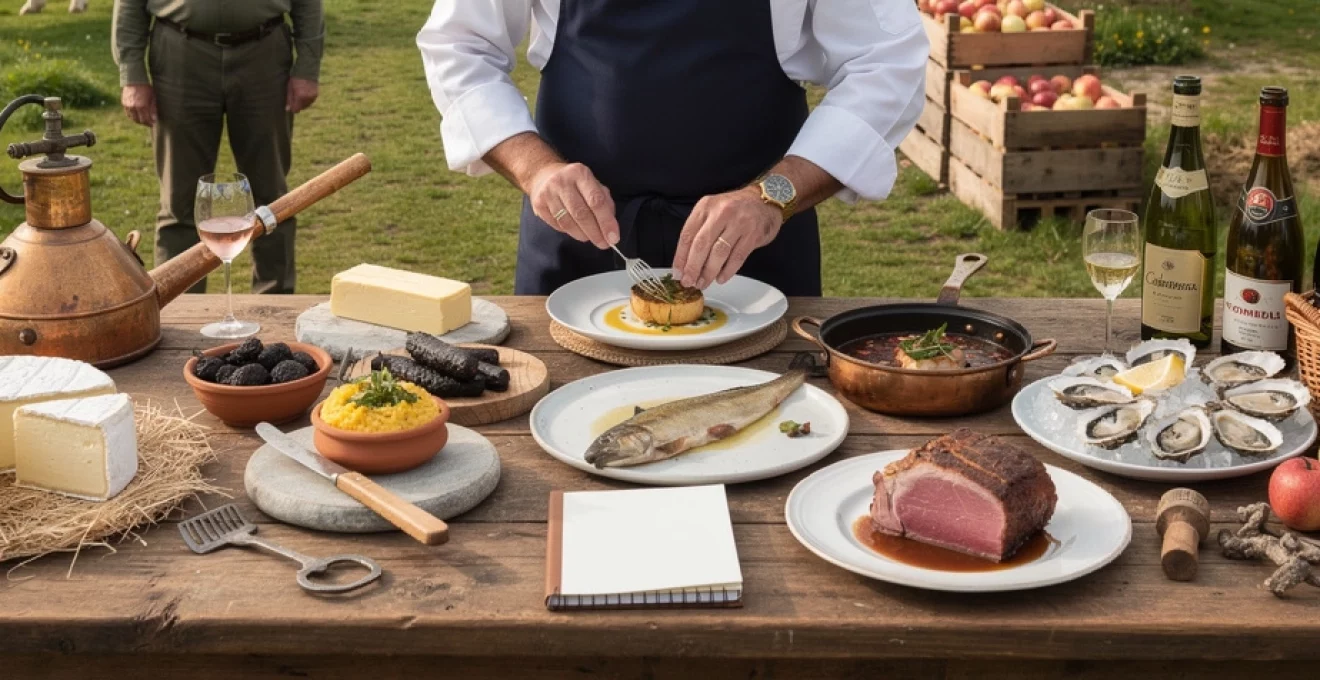
Normandy stands as one of France’s most celebrated gastronomic regions, where centuries of agricultural tradition meet the bounty of the English Channel. This northern territory has cultivated a reputation that extends far beyond French borders, built upon products that bear the prestigious Appellation d’Origine Contrôlée designation. From the rolling pastures of Pays d’Auge to the fishing ports of the Côte Fleurie, every corner of Normandy tells a story through its distinctive flavours. The region’s culinary identity emerged not by accident but through generations of farmers, cheese makers, distillers, and fishermen who refined their crafts with meticulous attention to quality. Today, Normandy’s gastronomic landscape offers you an unparalleled opportunity to experience authentic French terroir, where the relationship between land, sea, and table remains as vital as it was centuries ago.
Normandy’s terroir: understanding the agricultural heritage behind AOC products
The concept of terroir defines Normandy’s agricultural excellence more than perhaps any other French region. This unique combination of soil composition, climate, and traditional practices creates products that cannot be replicated elsewhere. Norman terroir benefits from oceanic influences that moderate temperatures and provide consistent rainfall, creating ideal conditions for dairy farming and orchard cultivation. The region’s chalk-rich soils contribute mineral complexity to the milk produced by Norman cattle breeds, particularly the distinctive Normande cows with their characteristic eye patches. Understanding this foundation helps you appreciate why Normandy’s protected designation products command such respect in culinary circles worldwide.
Camembert de normandie: traditional affinage techniques and raw milk production
Authentic Camembert de Normandie represents one of France’s most counterfeited cheeses, yet the genuine article follows strict production protocols established over centuries. Only five Norman cheese makers still produce this legendary cheese using traditional methods with raw milk from Normande cows. The village of Camembert itself remains modest despite its world-famous namesake, though the Maison du Camembert celebrates Marie Harel’s 16th-century creation. The production process requires at least five ladlings of unpasteurized milk into moulds, followed by a minimum 21-day affinage period. During maturation, the cheese develops its characteristic white bloomy rind through carefully controlled Penicillium candidum growth. You’ll notice that authentic Camembert possesses a complex flavour profile that evolves from chalky at the centre to creamy and intensely mushroomy near the rind, a characteristic impossible to achieve with pasteurized industrial versions.
Calvados AOC distillation: from pays d’auge orchards to oak barrel maturation
Calvados production represents the pinnacle of Norman apple distillation, transforming carefully selected fruit into one of France’s most sophisticated spirits. The Pays d’Auge designation requires double distillation in copper pot stills, mirroring Cognac production methods, whilst other AOC regions may use continuous column stills. Over 200 apple varieties contribute to Calvados production, categorized as bitter, bittersweet, sweet, or acidic, with master blenders combining 20-40 varieties for complexity. What many don’t realize is that Calvados begins as a clear spirit; its amber colour develops entirely during oak barrel ageing. The Pere Magloire distillery offers an immersive theatrical experience that guides visitors through this transformation process. Minimum ageing requirements dictate two years for standard Calvados, climbing to six years for XO designations, though premium expressions often rest for decades. The resulting spirit carries notes of baked apple, vanilla, caramel, and warm spices, with older Calvados developing remarkable complexity rivalling fine Cognac.
Isigny-sainte-mère butter: salt marsh pastures and protected designation of origin standards
The butter from Isigny-sur-Mer holds both AOC and PDO status, reflecting the unique characteristics imparted by its coastal terroir. Cows grazing on salt marsh pastures consume grasses enriched with maritime minerals and trace elements, producing milk with distinctive golden pigmentation from elevated carotene content. Isigny
Isigny butter undergoes a slow lactic fermentation before churning, which develops subtle hazelnut and crème fraîche aromas that chefs prize for both pastry and sauce work. To carry the Isigny-Sainte-Mère AOP label, the butter must contain at least 82% fat, with no added colouring, and be produced, processed, and packaged within a tightly defined geographic area. When you taste it simply spread on warm baguette, you immediately notice its silky texture, gentle salinity, and long, clean finish on the palate. In professional kitchens, this butter forms the backbone of countless Norman recipes, from sole meunière to apple tarts, where its richness enhances but never overwhelms the primary ingredients. If you are sourcing ingredients for authentic Norman cooking at home, prioritizing PDO Isigny butter is one of the easiest ways to elevate your dishes to restaurant quality.
Pommeau de normandie: balancing apple must with eau-de-vie for fortified aperitifs
Pommeau de Normandie offers a fascinating illustration of how Norman producers use every nuance of the apple harvest. This fortified aperitif results from blending fresh apple must with young Calvados, usually in a ratio of roughly two parts must to one part spirit. The mixture is then aged in oak barrels for at least 14 months, though many producers extend this to three years or more to build complexity. The alcohol from the Calvados halts fermentation of the must, preserving natural sweetness while developing notes of baked apple, toffee, and dried fruit. When you sip Pommeau, you experience a balance similar to a fine sherry or port, but with a distinctly Norman apple imprint.
Understanding Pommeau production deepens your appreciation of Norman terroir because it unites two emblematic products: cider apples and Calvados. Only specific apple varieties, often rich in tannins and aromatics, are selected for the must, ensuring structure and depth despite the sweetness. Producers must adhere to strict AOC regulations covering everything from orchard management to ageing methods, which safeguards quality and authenticity. For visitors, a Pommeau tasting at a family-run farm provides an accessible gateway into Norman spirits, especially if Calvados feels too strong as an aperitif. At home, you can pair chilled Pommeau with foie gras, blue cheeses, or apple-based desserts to recreate the relaxed elegance of a Norman table.
Coastal gastronomy: seafood delicacies from the côte fleurie to mont-saint-michel bay
While Normandy’s pastures and orchards are legendary, its coastline provides an equally compelling chapter in the region’s gastronomic story. Stretching from the chic resorts of the Côte Fleurie to the windswept landscapes around Mont-Saint-Michel Bay, these shores yield exceptional scallops, oysters, and fish. Cold, nutrient-rich waters from the English Channel create ideal conditions for slow-growing shellfish with concentrated flavour. Fishing communities have honed sustainable harvesting techniques over generations, a vital consideration as seafood demand rises worldwide. As you travel along this coastline, each port reveals a slightly different expression of Norman seafood cuisine, shaped by local currents, tides, and culinary traditions.
Dieppe scallops and saint-jacques: seasonal harvesting in the english channel
The scallops of Dieppe, often marketed as Coquilles Saint-Jacques de Normandie, enjoy a reputation among chefs that borders on reverence. Harvested primarily between October and May, these scallops benefit from cool Channel waters that encourage slow growth and dense, sweet flesh. Strict quotas and regulated fishing seasons help preserve stocks and maintain quality, making scallop season in Normandy a highly anticipated culinary event. In Dieppe and surrounding ports, you will see boats unloading crates of still-living scallops, destined for both local bistros and Parisian fine-dining rooms. Ordering scallops in season, simply seared in butter with a splash of cider or cream, gives you a direct taste of the English Channel at its finest.
If you are planning a gourmet journey in Normandy, timing your visit to coincide with scallop festivals can be particularly rewarding. Towns such as Dieppe and Port-en-Bessin host annual celebrations where fishermen, chefs, and food lovers gather for cooking demonstrations, tastings, and market stalls laden with shellfish. These events highlight how closely the local economy and culture remain tied to the rhythm of the sea. For home cooks, the key to treating Norman scallops with respect is minimalism: high heat, quality butter, and perhaps a hint of Calvados or lemon are all you need. Much like a good cheese or fine wine, the product’s intrinsic quality should take centre stage.
Honfleur’s sole meunière: classic norman preparation with brown butter emulsion
Honfleur, with its postcard-perfect harbour and rows of tall, narrow houses, has long attracted artists and gourmets alike. Among its classic dishes, sole meunière stands out as a benchmark of Norman coastal cuisine. The preparation appears simple—lightly floured sole, pan-fried in generous Isigny butter, then finished with lemon and parsley—yet each step demands precision. In Honfleur’s better restaurants, chefs often enrich the traditional brown butter with a subtle emulsion, whisking in a splash of fish stock or cream to create a silky, nutty sauce. The result is a dish where the buttery richness is balanced by fresh acidity, echoing the interplay between Normandy’s dairy pastures and maritime environment.
You might wonder why this seemingly straightforward recipe remains such a touchstone for chefs and diners. The answer lies in its ability to showcase product quality in its purest form: firm, delicately flavoured sole from the Channel and butter that carries the terroir of Norman pastures. When you taste sole meunière in Honfleur, you are experiencing a kind of culinary litmus test—if the fish is impeccably fresh and the butter well browned but not burnt, everything else falls into place. For those inspired to recreate the dish at home, investing in fresh whole sole and high-quality Normandy butter will do more for authenticity than any complex technique. Think of it as the seafood equivalent of a perfectly pulled espresso: few ingredients, but no margin for error.
Mont-saint-michel bay lamb: salt meadow grazing and pre-salé meat characteristics
Few products illustrate the marriage of land and sea as poetically as agneau de pré-salé, the salt-meadow lamb from Mont-Saint-Michel Bay. Here, flocks graze on tidal grasses and halophytic plants—such as samphire and sea purslane—that absorb sea spray rich in minerals and natural salts. This unique diet subtly seasons the meat from within, producing lamb with a fine texture, delicate marbling, and a flavour that chefs describe as both sweet and faintly saline. The meat is so distinctive that several zones around the bay benefit from protected geographical indications to safeguard authenticity. When slow-roasted or gently braised, the lamb develops aromas that are more nuanced and less strongly “lamby” than conventional pasture-raised meat.
For travellers, enjoying pré-salé lamb in a restaurant overlooking Mont-Saint-Michel or its surrounding marshes is an unforgettable experience. Menus often highlight the seasonal availability, as the lambs are slaughtered at specific ages to capture the ideal balance of tenderness and flavour. If you are curious about what sets this meat apart, imagine the difference between a standard table salt and a carefully harvested sea salt: both serve a similar role, yet one carries a depth of character that transforms a dish. In practical terms, chefs tend to keep preparations simple—think roasted saddle with thyme and garlic or slow-cooked shoulder—to let the natural flavour profile speak. When you see agneau de pré-salé listed, it is well worth choosing this local specialty over more generic cuts.
Courseulles-sur-mer oyster cultivation: pacific and native species in norman waters
Along the Normandy coast, oyster beds stretch out across estuaries and sheltered bays, with Courseulles-sur-Mer standing as one of the notable centres of production. Here, cold, plankton-rich waters nurture both Pacific oysters (Crassostrea gigas) and, in smaller quantities, native flat oysters (Ostrea edulis). Farmers raise oysters in mesh bags placed on metal tables or directly on the seabed, where the constant movement of the tides encourages robust shells and firm flesh. The result is an oyster with a clean, briny taste and a pleasant balance of sweetness and minerality, quite different from the more iodine-forward oysters of southern France. Many producers now invite visitors to tour their operations, explaining each stage from spat to market-ready shellfish.
If you are new to oysters, Courseulles-sur-Mer is an excellent place to start your exploration in a relaxed, authentic setting. You can often enjoy a plate of freshly opened oysters at simple waterfront shacks, accompanied by rye bread, salted butter, and a glass of crisp Norman cider. This pairing might seem unusual at first, but the gentle tannins and acidity of cider cut through the richness of the oysters much like a dry white wine would. For those seeking a deeper understanding of Normandy’s seafood, ask producers about differences between growth cycles, water quality, and oyster sizes—these variables influence flavour in much the same way that soil and grape variety shape wine. Bringing this knowledge home, you will be better equipped to select oysters by origin and style, turning a simple aperitif into a miniature tasting of the Norman coast.
Traditional norman cuisine: heritage recipes from caen to rouen
Beyond individual products, Normandy’s culinary identity also lives through a repertoire of traditional recipes that have survived, and in some cases evolved, over centuries. From rustic farmhouse dishes to ceremonious restaurant classics, these preparations often make generous use of cream, butter, apples, and cider. Towns like Caen and Rouen act as gastronomic anchors, each associated with emblematic specialties that tell stories of local history and taste. Exploring these heritage recipes allows you to experience how ordinary ingredients—offal, rice, or duck—are transformed through time-honoured techniques. As you move from one city to another, you will notice subtle variations, yet a common Norman thread of comfort, richness, and respect for raw materials runs through them all.
Tripes à la mode de caen: slow-cooked offal with calvados and aromatic vegetables
Tripes à la mode de Caen exemplifies the region’s ability to elevate humble cuts into a dish of remarkable depth. Traditionally attributed to the 19th-century innkeeper Prosper Montagné, this specialty uses four parts of beef stomach and often includes the hoof for additional gelatin and texture. The ingredients—tripe, carrots, onions, leeks, garlic, bouquet garni, and a splash of cider or Calvados—are layered in a sealed earthenware pot. The stew then cooks at a low temperature for up to 12 hours, a process that breaks down connective tissue and infuses the meat with aromatic richness. What emerges is a silky, deeply savoury dish that rewards patience and craftsmanship.
For many visitors, offal can seem intimidating, yet Tripes à la mode de Caen offers a persuasive introduction when prepared by skilled hands. The long, gentle cooking mellows strong flavours, resulting in something closer to a delicate beef stew than you might expect. When you encounter this dish in a traditional brasserie, it is often served with boiled potatoes or crusty bread to soak up the sauce, emphasizing its role as hearty comfort food. If you are an adventurous eater, ordering it at least once during your gourmet tour will broaden your understanding of Norman cuisine’s resourcefulness. At home, the key to success lies in sourcing high-quality tripe, thorough pre-cleaning, and resisting the urge to rush the slow-cooking process—much like making a proper stock, time is the hidden ingredient.
Teurgoule: rice pudding with cinnamon in terracotta pot baking methods
On the sweeter side of Norman tradition, teurgoule is a rustic rice pudding that has warmed family tables for generations. The name, which loosely translates to “twist mouth,” refers playfully to the expression made when tasting it too hot from the oven. Long-grain rice, whole milk, sugar, and cinnamon are combined in a deep terracotta dish and baked at a low temperature for several hours. As it cooks, the rice slowly swells and absorbs the milk, while a thick, caramelized skin forms on top—a prized feature among aficionados. The texture inside remains soft and creamy, perfumed with cinnamon and sometimes a hint of vanilla.
The baking method is as important as the ingredients, and it offers useful lessons for home cooks seeking authentic results. Traditional recipes call for a slow oven, akin to residual heat in a bread oven, where the dessert can cook undisturbed. This gentle, prolonged bake allows the Maillard reaction to develop complex flavours without scorching the milk solids. When you taste teurgoule in Normandy—often at village fairs or in farmhouse guesthouses—you experience a dessert that feels both simple and deeply nostalgic. Recreating it at home requires nothing more than patience and a suitable ovenproof dish, making it one of the most accessible ways to bring a taste of Norman comfort to your own kitchen.
Canard à la rouennaise: blood-enriched sauce and press techniques at la couronne
Canard à la Rouennaise, sometimes called canard au sang, is one of France’s most elaborate classic dishes, and Rouen claims it as a culinary emblem. The preparation begins with a young duck, traditionally suffocated rather than bled to retain as much blood as possible, which is essential for the sauce. The duck is roasted briefly, then the carcass is placed in a special silver press that extracts remaining juices and blood. These are combined with reduced stock, Cognac or Calvados, and sometimes foie gras or bone marrow to create a rich, velvety sauce that coats slices of rare breast meat. The technique demands both technical skill and impeccable timing, which is why it remains the preserve of specialist restaurants.
At La Couronne in Rouen—often cited as France’s oldest inn—this dish is presented almost like a culinary ceremony. The duck press is brought tableside, and the final emulsification of the sauce happens in front of you, underscoring the theatre of French grand cuisine. While the idea of cooking with blood may seem unusual today, it functions much like egg yolk, lending body, sheen, and a subtle mineral depth to the sauce. For gastronomes, tasting Canard à la Rouennaise is akin to attending a live performance of a classic play: you are not just eating, but witnessing a piece of culinary heritage. It is not a dish you are likely to recreate at home, but including it in your Normandy itinerary offers insight into how local products—here, river duck—were historically transformed into haute cuisine.
Boudin noir de mortagne-au-perche: blood sausage craftsmanship and competition standards
Another example of Normandy’s nose-to-tail philosophy is boudin noir de Mortagne-au-Perche, a celebrated blood sausage from the Perche region. This specialty combines pig’s blood with onions slowly cooked in fat, breadcrumbs or cream, and a blend of warm spices such as nutmeg and allspice. Producers take great care in balancing these elements to achieve a smooth texture and a flavour that is rich but not metallic. The mixture is gently filled into natural casings and poached, resulting in a sausage that can be sliced and pan-fried until the exterior crisps while the interior remains soft and almost custard-like. When served with caramelized apples or mashed potatoes, it encapsulates the sweet-savory interplay so characteristic of Norman cooking.
The town of Mortagne-au-Perche hosts an annual Confrérie des Chevaliers du Goûte-Boudin competition, where artisans from across France and beyond present their best versions of boudin noir. Entries are judged on criteria such as appearance, texture, seasoning, and overall balance, and winning a medal can significantly boost a producer’s reputation. For visitors, attending this event—or simply seeking out a medal-winning boucher-charcutier—offers a window into the pride and craftsmanship invested in what might otherwise be considered a humble product. If you are hesitant about trying blood sausage, starting with a small tasting portion in a reputable restaurant can be eye-opening; the flavour profile is often closer to a savoury pâté than many expect. As with many Norman specialties, quality of ingredients and respect for technique make all the difference.
Norman cidre production: from bittersweet apple varieties to méthode traditionnelle
Cider, or cidre, forms the backbone of Normandy’s drinking culture, every bit as important as wine is in other French regions. Unlike the uniformly sweet commercial ciders found in many supermarkets, traditional Norman cider expresses a wide range of styles, from dry and tannic to gently effervescent and off-dry. Production begins in autumn when apples—often 30 or more varieties from a single orchard—are harvested at optimum ripeness, then left to rest briefly to concentrate sugars and aromas. These apples fall into four broad categories: sweet, bittersweet, bitter, and acidic, each contributing structure, aroma, or balance to the final blend. Pressing yields a cloudy juice that undergoes a natural, slow fermentation using indigenous yeasts, a process that can last several weeks to several months depending on temperature and style.
Many artisanal producers, especially in Pays d’Auge, employ the méthode traditionnelle (similar to Champagne) to create sparkling ciders with fine, persistent bubbles. After an initial fermentation, the cider is bottled with a small amount of residual sugar, allowing a second fermentation to occur in the bottle. This method creates natural carbonation and can add complexity through sur lie ageing, where the cider rests on yeast deposits before disgorgement. For visitors, touring a cider farm offers an excellent opportunity to see these stages firsthand and to compare different styles—cidre brut, demi-sec, and cidre doux—side by side. When choosing cider to pair with food, consider matching texture and intensity: a dry, tannic brut complements rich dishes like boudin noir or Camembert, while a softer, fruitier cider pairs well with desserts or light crêpes.
From a practical standpoint, incorporating Norman cider into your own cooking and entertaining is both simple and rewarding. You can use it to deglaze pans for chicken or pork, reduce it into glazes for apples and root vegetables, or substitute it for white wine in classic cream sauces to add a subtle fruit note. At the table, offering a flight of different ciders alongside a cheese board featuring Camembert, Pont-l’Évêque, Livarot, and Neufchâtel creates an immersive regional tasting. As interest in low-alcohol and artisanal beverages grows globally, Normandy’s traditional cider producers find themselves at the forefront of a renewed appreciation for terroir-driven drinks. By seeking out bottles labelled AOP Pays d’Auge or cidre fermier, you support this heritage and bring a touch of authentic Norman flavour to your glass.
Michelin-starred innovation: contemporary norman gastronomy in deauville and cabourg
While tradition forms the backbone of Normandy’s food culture, a new generation of chefs is reinterpreting local ingredients through a contemporary lens. Nowhere is this more evident than in coastal resort towns like Deauville and Cabourg, where Michelin-starred restaurants sit alongside classic brasseries. These chefs maintain deep respect for products such as Isigny cream, pré-salé lamb, and Channel fish, yet they present them in lighter, more intricate formats that reflect global influences and modern techniques. Tasting menus often juxtapose minimalist plating with bold, concentrated flavours, creating a dialogue between past and present on the plate. For food travellers, including at least one fine-dining experience in your Normandy itinerary reveals how dynamic and forward-looking the region’s gastronomy has become.
In Deauville, for example, you might encounter dishes like lightly smoked scallops served with apple gel and cider vinegar foam, or a reimagined teurgoule presented as a delicate rice espuma with cinnamon-infused milk ice cream. Chefs lean on techniques such as low-temperature cooking, fermentations, and precise reductions to magnify the intrinsic qualities of local produce. Wine and cider pairings are curated with the same care, with sommeliers often highlighting small-scale producers and experimental cuvées. In Cabourg, ocean-view dining rooms showcase tasting menus that follow the rhythm of the tides and seasons, meaning no two visits are exactly alike. If you are accustomed to associating Normandy only with hearty farmhouse fare, these restaurants will broaden your perception considerably.
One of the most interesting trends in contemporary Norman gastronomy is the focus on sustainability and short supply chains. Many Michelin-starred and aspiring establishments now work directly with nearby fishermen, dairy farms, and vegetable growers, reducing food miles and supporting local economies. You will often see producers named on menus, turning each course into a miniature story of origin and craftsmanship. For travellers, this offers both reassurance and inspiration: you can note down the names of farms, fromageries, and cideries to visit later in your trip. In this way, dining in Deauville or Cabourg becomes not just an indulgence but also a guide to deeper, more authentic culinary experiences throughout Normandy.
Artisan food markets and producers: sourcing authentic norman ingredients across the region
No gourmet journey through Normandy would be complete without time spent in its vibrant markets and at the doors of artisan producers. Weekly markets in towns like Bayeux, Caen, and Honfleur overflow with seasonal vegetables, cheeses, charcuterie, seafood, and baked goods that capture the region’s diversity. Walking through these markets, you see at a glance the pillars of Norman gastronomy: stacks of apple varieties destined for cider and Calvados, rounds of Camembert and Pont-l’Évêque, jars of salted caramel, and bottles of golden Pommeau. Engaging directly with producers allows you to ask questions about farming practices, ageing methods, and recipe suggestions—turning shopping into an educational experience. For many visitors, these market mornings become some of the most memorable moments of their trip.
Beyond open-air markets, Normandy invites you to visit farms, creameries, distilleries, and cider orchards that open their doors to the public. In the Pays d’Auge, for example, you can follow dedicated “cider routes” that link Calvados distilleries, Pommeau producers, and traditional cider farms, often with tastings and tours in English. Cheese lovers can tour facilities where Livarot and Pont-l’Évêque are still made according to AOP standards, observing each stage from milk reception to affinage. Coastal visitors might explore oyster farms near Courseulles-sur-Mer or shellfish markets in Trouville to see how the catch of the day reaches local tables. These encounters help demystify products you may later see abroad, giving you the confidence to choose authentic Normandy foods wherever you live.
When it comes to bringing a taste of Normandy home, a bit of planning goes a long way. Many producers now offer vacuum-packed cheeses, sealed butter, and well-protected bottles of cider or Calvados suitable for travel, though you should always check customs regulations for your destination country. Prioritise items that best express the region’s terroir—AOP Camembert, salted Isigny butter, artisanal cider, small-batch Calvados, and sea-salt caramels are all excellent candidates. You might also consider keeping a small notebook of your favourite producers, markets, and restaurants during your trip, effectively creating your own personalised Norman gourmet guide. Long after you return home, these flavours and memories will remind you that Normandy is more than a destination; it is an enduring relationship between land, sea, and the people who transform them into extraordinary food.