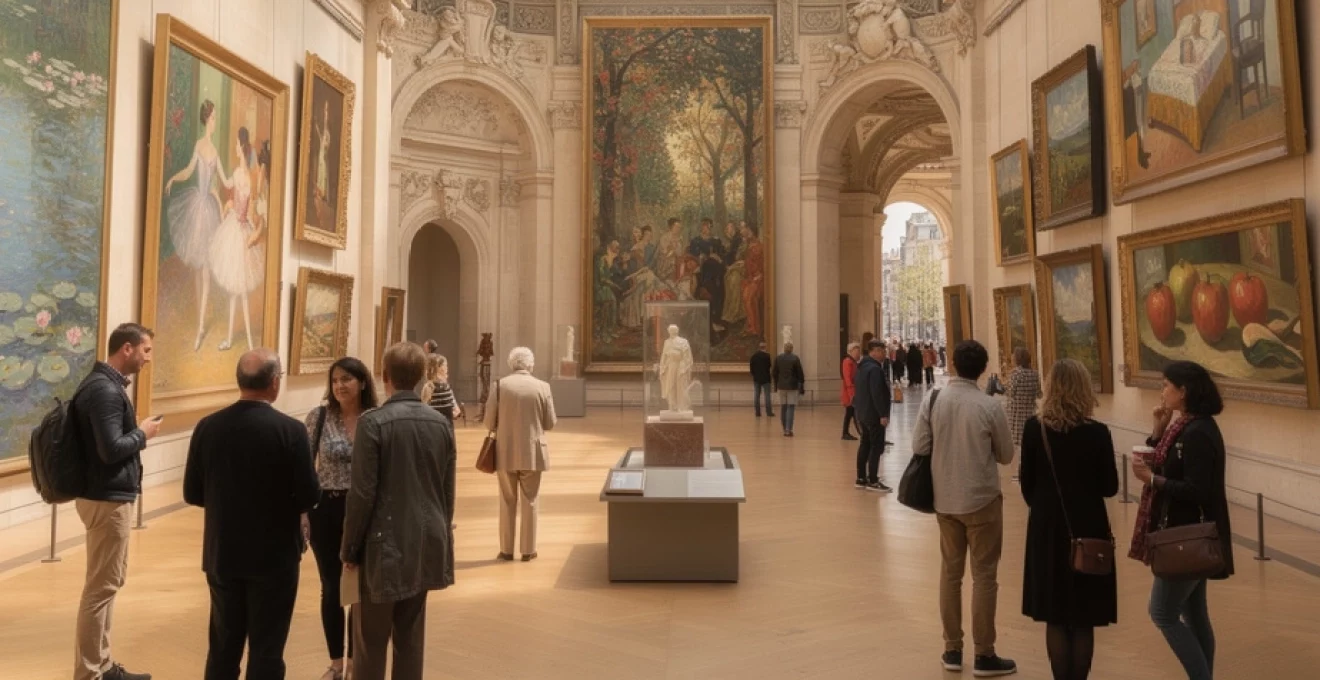
Nestled within the walls of a magnificently transformed Belle Époque railway station, the Musée d’Orsay stands as the world’s premier destination for Impressionist and Post-Impressionist art. This extraordinary museum houses the largest collection of Impressionist works globally, featuring over 4,000 pieces that span from 1848 to 1914. The museum’s collection represents one of the most revolutionary periods in art history, when traditional academic painting gave way to bold new movements that forever changed how we perceive colour, light, and artistic expression.
The Musée d’Orsay’s journey began in 1986 when curators carefully assembled masterpieces from the Louvre, the former Musée du Luxembourg, and the Jeu de Paume into this spectacular architectural setting. Today, visitors encounter works by legendary artists including Monet, Renoir, Van Gogh, Cézanne, and Degas, each piece telling the story of art’s evolution during Europe’s most creative century. The museum’s strategic location on the Left Bank of the Seine makes it an essential cultural destination for anyone seeking to understand the foundations of modern art.
Impressionist masterworks: monet’s water lilies and renoir’s dance at moulin de la galette
The Impressionist galleries at the Musée d’Orsay showcase the movement that revolutionised European art in the late 19th century. These artists abandoned the controlled studio environment, venturing outdoors to capture the fleeting effects of natural light with unprecedented immediacy. The museum’s collection demonstrates how these pioneers developed techniques that would influence generations of artists, from their innovative brushwork to their bold approach to colour theory.
Among the museum’s most celebrated holdings are works that exemplify the Impressionist commitment to depicting modern life with fresh eyes. The collection includes pivotal pieces that demonstrate how these artists transformed everyday subjects into profound artistic statements. Their revolutionary approach to painting en plein air created a visual language that captured the energy and movement of contemporary urban life.
Claude monet’s nymphéas series: revolutionary brushwork techniques
Monet’s Water Lilies series represents the pinnacle of Impressionist achievement, demonstrating the artist’s lifelong obsession with capturing light’s ephemeral qualities. The Musée d’Orsay houses several versions of these iconic works, each showcasing Monet’s evolution from representational painting towards pure abstraction. His technique involved applying paint in visible brushstrokes that merge optically when viewed from a distance, creating shimmering surfaces that seem to breathe with life.
The artist’s revolutionary approach to colour theory becomes evident in these masterpieces, where traditional modelling gives way to colour relationships that create form and depth. Monet’s broken colour technique involves placing pure colours adjacent to each other rather than mixing them on the palette, allowing the viewer’s eye to perform the optical blending. This method creates a luminosity impossible to achieve through conventional mixing methods.
Pierre-auguste renoir’s bal du moulin de la galette: capturing movement through light
Renoir’s “Dance at Le Moulin de la Galette” stands as one of the most beloved works in the Musée d’Orsay’s collection, capturing the joie de vivre of Parisian leisure culture in the 1870s. This masterpiece demonstrates Renoir’s exceptional ability to render human figures within complex lighting conditions, using dappled sunlight filtering through leaves to create a sense of movement and spontaneity. The painting’s composition draws viewers into the scene, making them feel like participants in this Sunday afternoon gathering.
The technical brilliance of this work lies in Renoir’s handling of light and shadow, where traditional chiaroscuro gives way to colour-based modelling. His brushwork varies throughout the composition, from tightly rendered facial features to loose, gestural strokes that suggest fabric textures and atmospheric effects. This variation in technique creates visual interest while maintaining overall compositional unity.
Edgar degas’ ballet rehearsal series: pastels and compositional innovation
Degas’ ballet paintings and
Degas’ ballet paintings and pastels reveal his fascination with the discipline, repetition, and backstage reality of the Paris Opéra. Rather than focusing on grand performances, he preferred intimate moments of rehearsal: dancers stretching, adjusting costumes, or awaiting their cue. At the Musée d’Orsay, these works demonstrate how Degas used unusual viewpoints—cropped figures, steep diagonals, and off-centre compositions—to create a dynamic sense of movement that feels almost cinematic.
His pastel technique is especially striking. Degas layered vibrant pigments on rough paper, blending with his fingers and fixing the surface repeatedly to build up dense, velvety colour. The result is a tactile texture that suggests both the softness of tulle and the harsh glare of gaslight. By combining drawing, painting, and printmaking methods, Degas turned traditional ballet scenes into radical studies of modern life and visual perception.
Camille pissarro’s boulevard montmartre paintings: urban landscape evolution
Camille Pissarro’s series of paintings depicting the Boulevard Montmartre offers a compelling record of Parisian urban life at the end of the 19th century. From the galleries of the Musée d’Orsay, you can see how he captured the same boulevard under different weather conditions and at various times of day, from bright afternoon light to misty, overcast skies. This systematic approach transforms the bustling street into a laboratory for studying light, atmosphere, and movement.
In these works, Pissarro applies broken brushstrokes and a high-key palette to render the shimmering surfaces of wet cobblestones, shopfronts, and carriages in motion. The elevated viewpoint, likely taken from a hotel window, gives you the sense of observing the city from above, much like looking down from a contemporary drone photograph. By treating the modern city as a worthy subject—just as Monet did with his Gare Saint-Lazare scenes—Pissarro helped shift landscape painting from rural vistas to the evolving urban environment.
Post-impressionist revolutionary works: van gogh’s starry night over the rhône and cézanne’s mont sainte-victoire
As you move deeper into the Musée d’Orsay, the Post-Impressionist galleries reveal how artists began to push beyond fleeting impressions towards more structured, emotional, and symbolic forms of expression. If Impressionism focused on capturing the moment, Post-Impressionism sought to interpret and transform it. Painters like Van Gogh, Cézanne, Gauguin, and Toulouse-Lautrec developed distinctive visual languages that laid the foundations for modern art movements such as Fauvism, Cubism, and Expressionism.
In this part of the museum, colour becomes more intense, forms grow more simplified or distorted, and composition is used to convey psychological depth rather than mere appearance. You will notice that brushstrokes are no longer just tools for depicting light; they become carriers of emotion and ideas. This evolutionary shift is particularly evident in works that, while not always depicting starry nights or famous landscapes, share the same experimental spirit as Starry Night Over the Rhône and Mont Sainte-Victoire.
Vincent van gogh’s bedroom in arles: psychological colour theory application
Van Gogh’s Bedroom in Arles, represented at the Musée d’Orsay through related works and contemporaneous canvases, is a powerful example of how colour can reflect a state of mind rather than physical reality. Instead of using realistic tones, Van Gogh chose bold complementary colours—yellows, blues, and reds—to construct an atmosphere of uneasy calm. The exaggerated perspective and tilted furniture give the impression that the room is slightly off-balance, mirroring the artist’s fragile mental state.
For Van Gogh, colour was a language. He believed that certain combinations could evoke specific emotions, much like musical chords create particular moods. The simplified shapes and thick, directional brushstrokes act almost like the handwriting of an intense letter, revealing his inner world. When you stand in front of his self-portraits, landscapes, or interior scenes at the Musée d’Orsay, you can sense how he used colour theory not academically, but intuitively, as a way to communicate feelings that words could not fully express.
Paul cézanne’s still life with apples: geometric form deconstruction
Paul Cézanne’s still lifes, including his celebrated compositions with apples, mark a crucial turning point in the history of art. At first glance, these works at the Musée d’Orsay may seem deceptively simple: a table, fruit, perhaps a jug or a cloth. Yet the more closely you look, the more you notice how Cézanne subtly distorts perspective, tilts tabletops, and shifts viewpoints within the same canvas. It is as if he is inviting us to walk around the objects while we look at them.
Cézanne often said he wanted to “treat nature by the cylinder, the sphere, the cone,” and you can clearly see this in the rounded forms of his apples and the facets of his vessels. The brushstrokes are laid down in small, carefully considered patches of colour, like a mosaic that gradually builds up volume and structure. This method of deconstructing and reassembling form laid the groundwork for Cubism, influencing artists such as Picasso and Braque. When you view these paintings in person, you experience how a simple bowl of fruit became a radical experiment in perception and geometry.
Paul gauguin’s tahitian period: synthetist movement foundations
Gauguin’s Tahitian paintings, several of which are displayed at the Musée d’Orsay, introduced a radically new way of thinking about colour, form, and narrative. Instead of striving for naturalistic representation, Gauguin flattened space, outlined figures with bold contours, and used large, unmodulated areas of colour. This approach, known as Synthetism, sought to combine the outward appearance of things with the artist’s inner feelings and symbolic ideas.
In his Tahitian scenes, everyday moments—women seated on the ground, figures near the sea, or people in quiet contemplation—are imbued with mythological and spiritual undertones. The tropical setting allowed Gauguin to experiment with saturated hues—deep violets, intense oranges, and luminous greens—that depart from European realism. You can think of these compositions almost like visual poems: they do not describe reality literally, but synthesize emotion, memory, and culture into a single, powerful image.
Henri de toulouse-lautrec’s moulin rouge lithographs: commercial art integration
Henri de Toulouse-Lautrec blurred the boundaries between fine art and commercial design, particularly through his famous posters for the Moulin Rouge and other Parisian cabarets. At the Musée d’Orsay, his lithographs stand out for their bold silhouettes, cropped figures, and daring use of typography. Designed to be seen from a distance on busy streets, these images had to grab attention instantly—much like modern-day advertising and social media visuals.
Lautrec drew inspiration from Japanese prints, flattening space and using strong outlines to create striking, graphic compositions. His posters did more than promote performances; they helped define the public image of Belle Époque nightlife. When you view these works up close, their vibrant colours and dynamic linework reveal the artist’s acute observational skills and empathy for the performers he depicted. It is a reminder that the history of modern graphic design begins not in digital studios, but in the print workshops of 19th-century Paris.
Symbolist movement treasures: gustave moreau and odilon redon’s mythological narratives
Beyond Impressionism and Post-Impressionism, the Musée d’Orsay houses an exceptional collection of Symbolist art, where artists turned inward to explore dreams, myths, and the subconscious. Rather than portraying the visible world, Symbolist painters sought to visualise ideas and emotions, often using allegory and fantastical imagery. If Impressionism is like a snapshot of reality, Symbolism is more akin to a richly layered novel full of metaphors and hidden meanings.
Gustave Moreau and Odilon Redon are central figures in this movement, and their works at the museum create an atmosphere of mystery and introspection. Standing before their canvases, you may feel as if you have stepped into a world of legends, visions, and spiritual quests. These paintings encourage slower looking: the more time you spend with them, the more details and symbolic connections you uncover.
Moreau’s mythological scenes are densely packed with ornate detail—jeweled costumes, elaborate architecture, and intricate patterns that invite comparison to illuminated manuscripts. His treatment of subjects such as Salome, Orpheus, or biblical figures transforms familiar stories into personal, almost hallucinatory visions. In contrast, Redon often prefers a more ethereal approach, using soft contours and delicate colour harmonies to evoke a dreamlike state. His works feel like visual equivalents of music, suggesting rather than describing, and leaving space for your imagination to complete the narrative.
Architectural marvel of victor laloux: beaux-arts railway station transformation
One of the great pleasures of visiting the Musée d’Orsay is discovering that the building itself is as impressive as the artworks it contains. Originally designed by architect Victor Laloux as a Beaux-Arts railway station for the 1900 Exposition Universelle, the Gare d’Orsay was a symbol of modern engineering and elegant design. Its vast iron-and-glass vault, ornamental stone façade, and monumental clock faces made it a showcase of turn-of-the-century Parisian architecture.
By the mid-20th century, however, the station had fallen into disuse and faced the risk of demolition. Instead, a visionary decision was made in the 1970s to convert it into a museum dedicated to the art of 1848–1914. The transformation preserved the building’s industrial skeleton while adapting the interior to museum standards—an early and influential example of reusing heritage architecture for cultural purposes. Walking through the central nave today, you still sense the rhythm of the old train platforms, now lined with sculptures and decorative arts instead of carriages.
The high, vaulted ceiling floods the galleries with natural light, carefully moderated to protect the artworks. Architectural details such as the original clocks and stone arches create dramatic sightlines, framing paintings and sculptures in unexpected ways. For many visitors, simply standing behind the great clock window and looking out over the Seine towards the Louvre is an unforgettable experience. It is a reminder that the Musée d’Orsay is not just a container for masterpieces; it is itself a masterpiece of adaptive reuse.
Photography collection: nadar’s portrait studies and documentary evolution
The Musée d’Orsay is also a key destination for understanding the birth and development of photography as an art form. During the period covered by the museum—roughly 1848 to 1914—photography evolved from a technical curiosity to a powerful medium for both artistic expression and social documentation. This transition is beautifully illustrated in the museum’s photography collection, which includes works by pioneers such as Nadar.
Nadar’s portrait studies of 19th-century writers, artists, and performers are particularly striking. Using controlled lighting and simple backdrops, he focused on capturing the personality and psychological presence of his sitters. Unlike stiff, formal studio portraits common at the time, Nadar’s images feel spontaneous and modern, as if he were trying to reveal the inner life of figures like Baudelaire, Sarah Bernhardt, or Delacroix. His approach paved the way for later developments in psychological portraiture and editorial photography.
Alongside these studio works, the museum presents early documentary photographs that recorded streets, construction projects, and changing urban landscapes. These images function almost like time capsules, allowing us to trace the modernisation of Paris—from Haussmann’s boulevards to the construction of bridges and monuments. As you move through these galleries, you can see how photography gradually shifted from a purely descriptive tool to a medium that interprets reality, foreshadowing the photojournalism and fine-art photography we know today.
Sculpture gallery highlights: rodin’s gates of hell and decorative arts integration
No cultural escape to the Musée d’Orsay would be complete without exploring its rich sculpture collections, which are thoughtfully integrated into the building’s central nave and surrounding galleries. Here, you can walk among works that range from refined neoclassical marbles to expressive, modern bronzes. The spatial presentation allows you to see sculptures from multiple angles, much like walking around architectural landmarks in a city square.
Auguste Rodin’s influence is particularly strong. While the complete Gates of Hell are housed at the nearby Musée Rodin, the Musée d’Orsay exhibits related pieces and figures that emerged from this monumental project, such as versions of The Thinker and The Kiss. These works show how Rodin broke with academic conventions by leaving surfaces rougher, emphasising gesture, and capturing fleeting psychological states in three dimensions. His sculptures almost seem to vibrate with inner tension, turning marble and bronze into living, expressive matter.
One of the museum’s distinctive features is the way sculpture is presented alongside decorative arts—furniture, glass, ceramics, and metalwork from the same period. This integration echoes the 19th-century ideal of the Gesamtkunstwerk, or “total work of art,” in which architecture, design, and fine art work together to create a unified environment. As you move from a Rodin bronze to an Art Nouveau cabinet or a finely wrought piece of jewellery, you gain a more complete picture of how artistic innovation shaped everyday life as well as museum masterpieces.